In the epic Ramayana, the relationship between Lord Rama and Lakshmana is considered an example of brotherhood, self-sacrifice, and devotion. Lakshmana left the comfort of the royal palace to accompany his elder brother during the fourteen-year exile. However, one of the well-known stories of the Ramayana describes a situation where Lord Rama had to face the necessity of pronouncing a death sentence on his dear brother. What circumstances forced Rama to make such a harsh decision? This story is connected to a promise made to Yama, the anger of the sage Durvasa, and Lakshmana's sacrifice to save the inhabitants of Ayodhya.
After Mother Sita dissolved into the earth, Lord Rama realized that the purpose of his incarnation on Earth was achieved, and it was time for him to return to Vaikuntha, the abode of Lord Vishnu. According to a common legend, Rama threw his ring into the underworld to distract Hanuman. He instructed Hanuman to find this ring, after which Hanuman went to Patala Lok. During this search, Yama arrived at Lord Rama to have an important private conversation with him.
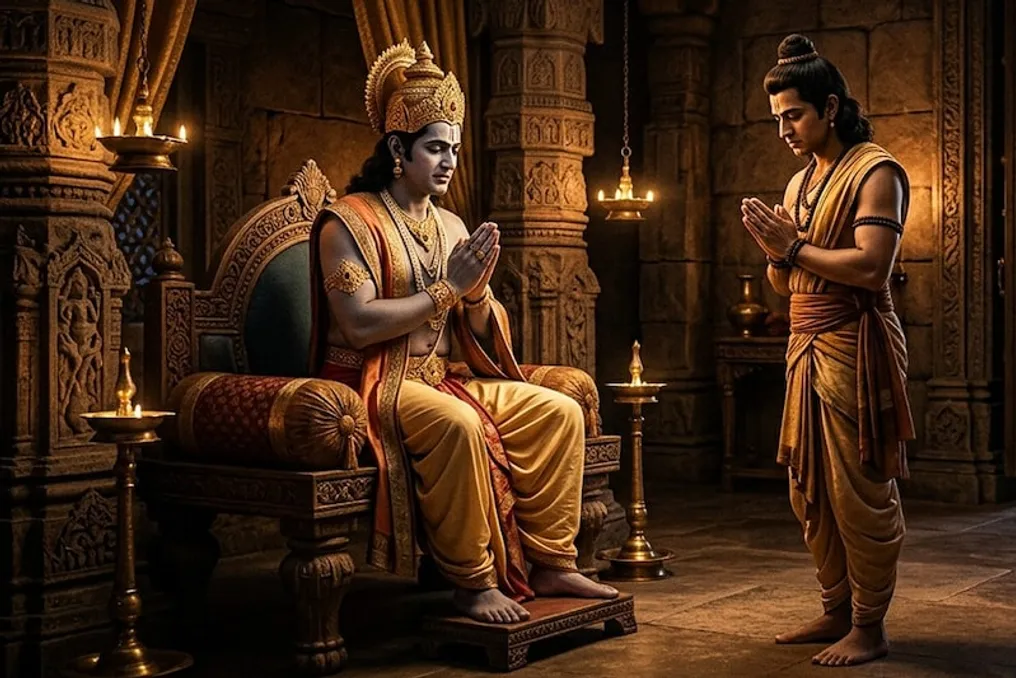
Yama set a condition before Lord Rama: no one should interfere during their conversation. If anyone violated this rule, they would face the death penalty. Rama agreed to this condition and instructed Lakshmana to guard the entrance. Lord Rama gave his brother clear instructions not to let anyone in until the conversation was over. Lakshmana faithfully performed his duty, unaware that a situation would soon arise where he would have to choose between his brother's order and the defense of Ayodhya.
While the conversation between Lord Rama and Yama was taking place, Maharshi Durvasa arrived. He immediately expressed a desire to meet Rama. Lakshmana informed him that Lord Rama was having an important private discussion, so a meeting was not possible at that moment. Hearing this, Rishi Durvasa became angry and warned that if he was not brought to Rama immediately, he would curse Lakshmana, his family, and all of Ayodhya. The threat from Durvasa, known for his wrath, put Lakshmana in a difficult moral position. If he continued to obstruct, disaster could befall the entire kingdom. On the other hand, informing Rama would mean breaking a promise made to Yama, putting himself at risk of execution.
Lakshmana placed the welfare of the people of Ayodhya above his own fears. He decided that to save the entire kingdom from the sage's curse, he had to reach Lord Rama. He entered during the private conversation and informed Rama about Durvasa's arrival. Rama concluded the conversation with Yama and went to meet the sage. Durvasa asked for food, and Lord Rama hosted a feast for him. Satisfied with the food, the sage left, and the danger hanging over Ayodhya passed. Nevertheless, now Lord Rama faced the task of keeping his promise, as Lakshmana had entered his chambers.
Lord Rama did not want to punish his beloved brother. Lakshmana accompanied him through every difficult situation, from childhood to exile. The thought of parting from such a brother caused Rama immense pain. According to the legend, to resolve this dilemma, Rama consulted his teacher Vasishtha. The Guru explained that refusing a loved one could also be considered a form of death for him. Thus, Rama could renounce Lakshmana to uphold the honor of his promise. Following his teacher's advice, Lord Rama decided not to impose a direct death sentence on Lakshmana, but instead to renounce him.
Lakshmana understood his brother's predicament. He persuaded Rama to keep his promise and maintain the boundaries of Dharma. For him, his brother's honor and keeping a promise were more important than his own life. Lakshmana did not want Lord Rama to backtrack on his word because of him. To save the people of Ayodhya, he had already risked his safety, and now he made a sacrifice to preserve the honor of his brother's promise.
After bidding farewell to Lord Rama, Lakshmana approached the bank of the Saru River. According to common mythological beliefs, he entered the river and sacrificed his life through yoga. The narrative states that at the moment Lakshmana's soul departed, the god Indra appeared and took him to heaven in physical form. Thus ends Lakshmana's life. This sacrifice by Lakshmana demonstrates not only his love for his brother but also his determination to save the people of Ayodhya from calamities.