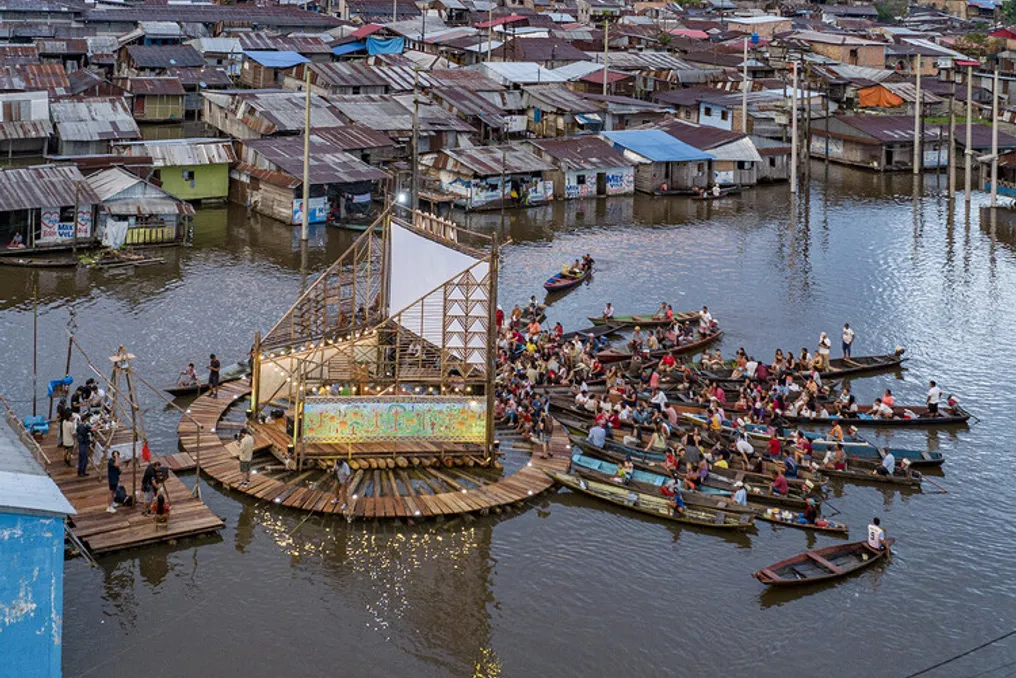
The XIV Ibero-American Biennial of Architecture and Urbanism (BIAU), an international event organized by the Government of Spain through its Ministry of Housing and Urban Agenda (MIVAU) since 1998, will be held in Brasília from November 3 to 6, 2026. This edition follows the thirteenth, titled 'CLIMAS: Actions for Good Living,' which took place in Lima, Peru, in 2024, and will have the central theme 'Caring for Life' (Cuidar da Vida).
The reflection of this biennial will be structured around four main thematic axes: water, vegetation, housing, and communities. The event aims to explore the interconnection between architecture and the environmental, social, and cultural conditions essential for maintaining life.
During the four days, the Biennial will offer a variety of activities, including lectures, exhibitions, debates, awards, guided tours, and cultural and musical events in different locations across the city. The choice of Brasília carries a particular significance, given the growing tension between urban development, territorial alteration, and quality of life in the region. Founded in 1960 as an ambitious project to create a new capital in the interior of the country, Brasília symbolizes a vision of modernity and social transformation.
BIAU proposes a critical and detailed analysis of Brasília, recognizing both its strengths and its contradictions. The curatorial proposal emphasizes works that manage to respond to current societal challenges and generate a positive impact on urban and rural contexts. The agenda will include discussions on new territories and the changes redefining ways of living.
On September 22, 2026, the organization released the 46 finalists, with 34 in the Works category and 12 in Publications, selected from the 174 proposals submitted in July.
The jury highlighted projects that maintain an active link with natural ecosystems, treating water and vegetation not merely as controllable resources but as territorial infrastructures capable of promoting landscape regeneration and raising the standard of living. The social dimension was also a central focus, as the chosen projects carefully consider the scenario and needs of the local population, integrating participatory practices, culture, training, or economic opportunities within the architectural scope.
Regarding housing, the suggestions go beyond the concept of individual residence, encompassing the street, the neighborhood, and the urban landscape, aiming to foster coexistence, climate-adapted design, and the use of simple and appropriate building materials for each situation.
In the Publications section, the jury emphasized the vast and diverse editorial production that places architectural investigation at the heart of contemporary debates. The finalist works address the act of dwelling as a way of caring for life, investigating themes such as education, territory, natural resources, community, housing, and urban disparity, while also highlighting the political and social aspect of architecture and urbanism. Special value was placed on research stemming from concrete realities to formulate broader questions, combining fieldwork, critical analysis, and design knowledge. The selection also recognized publication and education as intervention tools that help preserve memory, stimulate dialogue, and encourage critical thinking.
Activities will take place in notable locations in Brasília, such as the National Theater Cláudio Santoro, SESI Lab, the University of Brasília (UnB), Cine Brasília, and Index SCS. The event will begin on Tuesday, November 3, with registration at Index SCS, followed by the opening ceremony at the National Theater, the presentation of Trajectory Awards to Gonçalo Byrne, Erminia Maricato, and Frederick Cooper Llosa, the inauguration of the exhibition in the theater lobby, and a concert by the Brasília Symphony Orchestra.
On Wednesday, November 4, after a morning guided tour departing from Index SCS, four discussion panels on water, vegetation, housing, and communities will be held, divided into two parallel groups at SESI Lab and UnB, coordinated by Loreta Castro, Marcelo Rosenbaum, and Inês Lobo. In the evening, there will be an open meeting with Byrne at the Embassy of Portugal.
Thursday, November 5, will start with a guided tour from Index SCS, followed by a documentary screening at Cine Brasília. This documentary will serve as an introduction to a debate focused on new territories and the environmental, social, and cultural transformations reshaping the relationship between architecture, landscape, and society. Paraguayan architect Solano Benítez will coordinate this session with Angelo Bucci, Fernando Pérez Oyarzún, and Fredi Casco, and the day will end with a public party at SESI Lab, featuring Brazilian singer Ellen Oléria.
On Friday, November 6, the National Theater will host the closing of the Biennial, presenting the curatorial team, lectures by Lobo and Benítez, a second set of discussions with Castro, Al Borde, and Rosenbaum, an afternoon roundtable with renowned international architects (to be confirmed), and the presentation of Works and Publications Awards.
The XIV BIAU is organized by the Ministry of Housing and Urban Agenda of Spain (MIVAU), in partnership with the Superior Council of Architects' Colleges of Spain (CSCAE) and the Arquia Foundation. Since 1998, various Ibero-American institutions have participated in the organization, consolidating the event as an essential reference for the current panorama of architecture and urbanism in the region.
The curatorial team includes Nuno Sampaio, Executive Director of Casa da Arquitectura (Portugal); Carlos Quintáns Eiras, architect, editor, and curator of the Unfinished project, winner of the Golden Lion at the Venice Biennale in 2016; Fernando Serapião, editor and critic; Matheus Seco Ferreira and Daniel Mangabeira da Vinha, founding partners of BLOCO Arquitetos; and Luciana Saboia, professor at the University of Brasília.