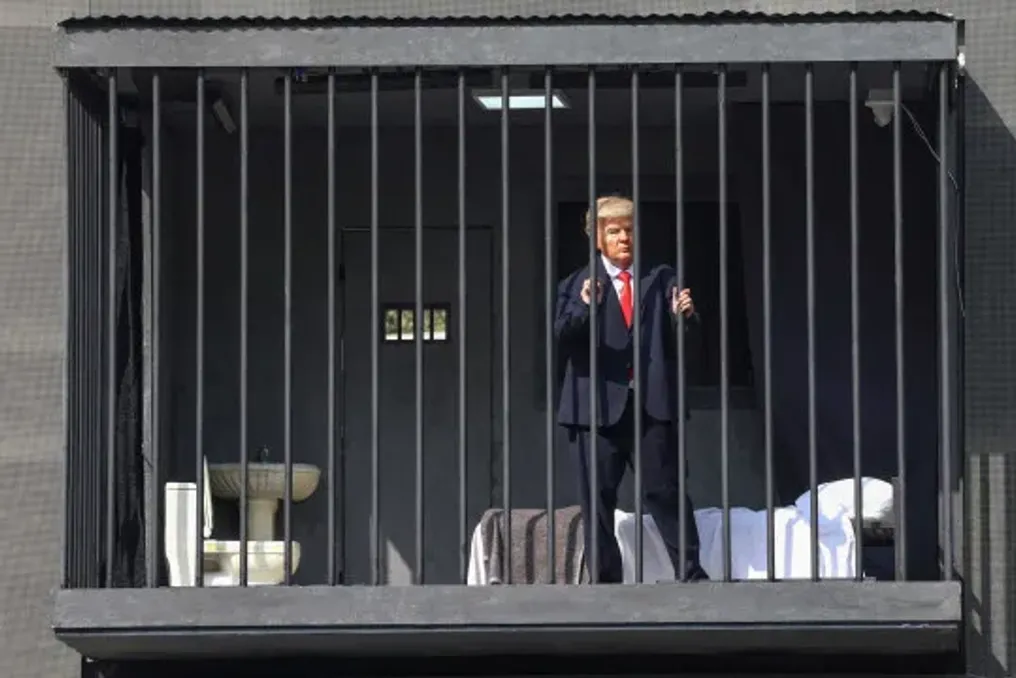
A fake Donald Trump today threatened passersby from inside a cage on one of Tehran's busiest squares, eliciting laughter and insults from onlookers. This performance was created to mock the US president.
The installation is located in Tajrish Square, in the northern part of the Iranian capital. It consists of a cage set up on an 'outdoor' structure, where the fake Trump is behind bars next to a bed and a toilet, making various movements to attract the attention of people passing by.
The fake Trump imitated the US president's famous dance, made threatening gestures, such as running his thumb along his neck, and repeatedly tried to squeeze through the bars to escape his fictional prison.
A screen behind the cage broadcast images of children killed in American attacks, as well as blood stains at a wedding celebration in the Sirik district, in the south of the country. This district was hit by bombing in September, resulting in the deaths of no less than five people and injuring 68.
The slogan of this production reads: 'Not seeing this scene is a crime.' The installation opened on Tuesday and will operate around the clock, according to Iranian press, which did not disclose details about the creators.
Passersby reactions were mixed: some laughed, others insulted the fake US president, and many drivers stopped in the middle of the square to film the performance on their mobile phones, causing traffic jams.
From a bus, some students asked the fake Trump to attack Iran as soon as possible to cancel exams scheduled for the next day, which caused laughter among those gathered.
Other passersby shouted: 'Uncle Trump, turn around!' so the actor would look at them, allowing them to take photos or videos of him; another citizen asked him to reopen the visa lottery so that Iranians could emigrate to the United States.
The installation appeared against the backdrop of new diplomatic efforts to resume negotiations between Iran and the US aimed at ending the war. It coincided with the arrival in Tehran of the Commander-in-Chief of the Pakistani Armed Forces, General Ashim Munir, one of the main mediators between the two sides of the conflict.
Tehran's response to the Pakistani mediator was that Iran has no new messages for the US, insisting that the country must fulfill its conditions to 'earn its trust' and end the war that began on February 28 this year with a joint offensive operation by the US and Israel against Iran.
Washington justified this attack by citing the inflexibility of the Islamic Republic in negotiations regarding the cessation of uranium enrichment within its nuclear program, which Iran claims is intended exclusively for civilian purposes.
In response to the offensive, Iran closed the Strait of Hormuz, shocking the global economy, and began attacks on targets in Israel, American bases, and civilian infrastructure in regional countries such as Saudi Arabia, Bahrain, the United Arab Emirates, Qatar, Kuwait, Jordan, Oman, and Iraq.