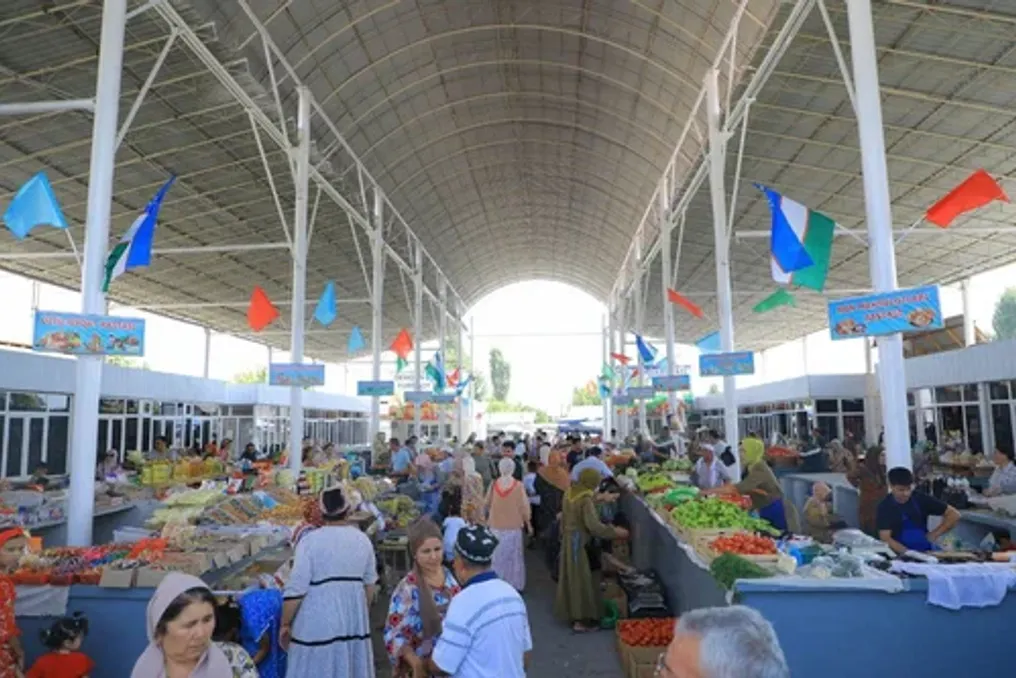
Tashkent authorities will begin inspection of 35 markets before privatization
Read more
Podrobno.uz [uz]
podrobno.uz

Tashkent authorities will begin inspection of 35 markets before privatization

A special working group will be formed in Tashkent to conduct a comprehensive review of the financial indicators, property, and documentation of 35 markets and trade complexes planned for sale at public auctions. This inventory is an integral part of the process of preparing the assets for potential sale.

The decision to carry out such inspections was signed by the capital's hokim, Shavkat Umurzakov, on October 20. The working group's tasks include studying the markets' property, identifying their legal owners, detecting any illegally constructed buildings, and analyzing existing tax debts and other mandatory payments.

It was previously announced that 35 markets, their branches, and trade complexes would be put up for auction. Among the listed assets are Urikzor, Parkent Market, Yangiabad Market, 'Aviasozlar' market (Kadyseva), Farhad Market, and Sergely Market. This initiative is being implemented in accordance with President Shavkat Mirziyoyev's decree of July 27, concerning measures for the socio-economic development of Tashkent for the period 2026–2027.

Documentation and Territory Inspection

According to the new directive, the city administration of the Cadastral Agency, together with district hokims, will audit the buildings and structures on the market territories. A complete list of property and its owners will be compiled, and the data obtained will be transferred to 'Toshkent Invest'. Specialists will also inspect the territories of the trade complexes to identify illegal constructions, accurately determine the boundaries of land plots, and study existing restrictions and protection zones. If necessary, proposals for adjusting the capital's general plan may be prepared.

Financial and Tax Control

The Tashkent Tax Administration will take charge of analyzing all market debts, including taxes, mandatory payments, and other types of payments. Simultaneously, the Center for Municipal Assets Management under the hokimiyat will assess the financial condition of the complexes and identify existing problems.

Based on the results of the inspections, the deputy hokims must develop draft decisions regarding the further use of these markets' assets, including their placement in public auctions, and submit these proposals to the Cabinet of Ministers. The July decree also mandates the development of business plans for the objects being put up for auction, and 'Toshkent Invest' will be responsible for preparing the markets for sale in the format of a ready-made business. It is planned that modern eco-markets, trade and service centers, and multi-level parking lots will appear at the implementation sites of these projects.

Similar stories

New Capital Market Law in Uzbekistan Will Expand Business Opportunities and Introduce New Financial Instruments
Read more
podrobno.uz

New Capital Market Law in Uzbekistan Will Expand Business Opportunities and Introduce New Financial Instruments

A new law concerning the capital market is currently being prepared in Uzbekistan. This legislative act aims to expand enterprises' opportunities to attract investments and introduce a number of new financial instruments, including Islamic sukuk securities.

The return on sukuk will be determined according to the principles of Islamic finance, rather than through traditional interest payments. The draft law, which was presented on October 14th to the National Agency for Advanced Projects (NAAP), includes 16 chapters and 123 articles. It has already passed its first reading in the Legislative Chamber of the Oliy Majlis and is preparing for consideration in the second reading.

What Instruments Will Appear in the Market

One of the most important changes will be the regulation of sukuk. Unlike standard bonds, where an investor receives interest for the loan provided, the income from sukuk can be generated from project profits, rental payments, or other asset operations, which complies with the norms of Islamic finance. For example, a company can use funds to build an object, and investors receive income from its operation based on the issued securities.

The draft law also provides for the issuance of bonds focused on sustainable development, intended to support environmental and social initiatives. Furthermore, it plans to regulate the use of instruments such as futures, options, forwards, swaps, and price difference contracts. These instruments help manage financial risks and apply diverse investment strategies, although they carry additional risks.

The issue of covered and securitized bonds is also being considered: the former are guaranteed by a specific pool of assets, while the latter allow attracting financing based on assets or related cash flows. Rules for issuing international financial institution bonds are also proposed.

The expansion of the range of available instruments should give investors broader opportunities to place funds, and companies additional ways to attract capital beyond traditional bank loans.

Why Change the Legislation

NAAP explains the necessity of this reform by stating that the financial market is developing, and new types of instruments are emerging that require their own regulation. The new bill is based on an analysis of existing securities market rules adopted in 2015. The current law contains 64 articles, whereas the updated document has 123.

Representatives of international financial institutions, including the European Bank for Reconstruction and Development, the International Finance Corporation, and the Asian Development Bank, participated in its development. According to NAAP, the volume of share issuance grew from 189.7 trillion soms in 2023 to 265.1 trillion soms in 2025, and by July 1, 2026, this figure is expected to reach 269.4 trillion soms.

Similarly, the volume of corporate bond issuance increased during the same period from 1.06 trillion to 3.93 trillion soms. There is also growth in trading volumes on the stock exchange: they rose from 2.9 trillion soms in 2023 to 17.6 trillion soms in 2025.

NAAP predicts that thanks to the introduction of new instruments, an additional 10 trillion soms in investments will be attracted by 2030. It should be noted that this is a target indicator, not an already achieved volume.

What Will Change in Stock Market Operations

The draft law also introduces changes to market infrastructure. The introduction of a central counterparty institution, the expansion of the functions of the Central Securities Depository, and the improvement of the regulation of management companies and rating agencies are planned.

The document provides for the creation of self-regulatory organizations and the establishment of the institution of bondholders' representatives. This latter mechanism is designed to ensure the protection of the general interests of debt security holders. Nevertheless, all the listed changes are currently only proposals, as the bill must still undergo further discussion in parliament, which may lead to adjustments in the final list of instruments and their application rules.

The actual result of the reform will directly depend on the effectiveness of the new mechanisms and the conditions created for market participants—both investors and companies.

Uzbekistan State Will Cover Costs for Green Certification of Major Construction Projects in New Tashkent
Read more
podrobno.uz

Uzbekistan State Will Cover Costs for Green Certification of Major Construction Projects in New Tashkent

Investors planning to invest over $50 million in the construction of non-residential buildings in New Tashkent will receive a comprehensive package of state support measures. These benefits include covering the costs of obtaining 'green building' certificates and assigning a dedicated manager to each such investor.

Information about these measures was announced during President Shavkat Mirziyoyev's visit to the developing city. The certificates serve as confirmation that the constructed facilities comply with established environmental standards.

Furthermore, when implementing projects in New Tashkent, investors will no longer be required to independently manage the landscaping of 30% of the acquired land plot. According to the approved master plan, the state assumes responsibility for landscaping 30% of the entire city area.

Another form of assistance is full project support at all stages—from the start of work until the object is commissioned. For every project exceeding the $50 million threshold, a responsible manager will be assigned to support the investor in resolving any arising issues.

All terms of this support will be officially documented in the investment agreement. For projects valued over $50 million, a 'one project—one contract' approach will be used, clearly outlining the investor's obligations and potential risks, as well as the list of provided preferences.

It should also be noted that New Tashkent plans to reduce infrastructure payments for commercial enterprises, which aims to stimulate the construction of hotels, shopping centers, tourist facilities, and social sphere institutions.

Popular