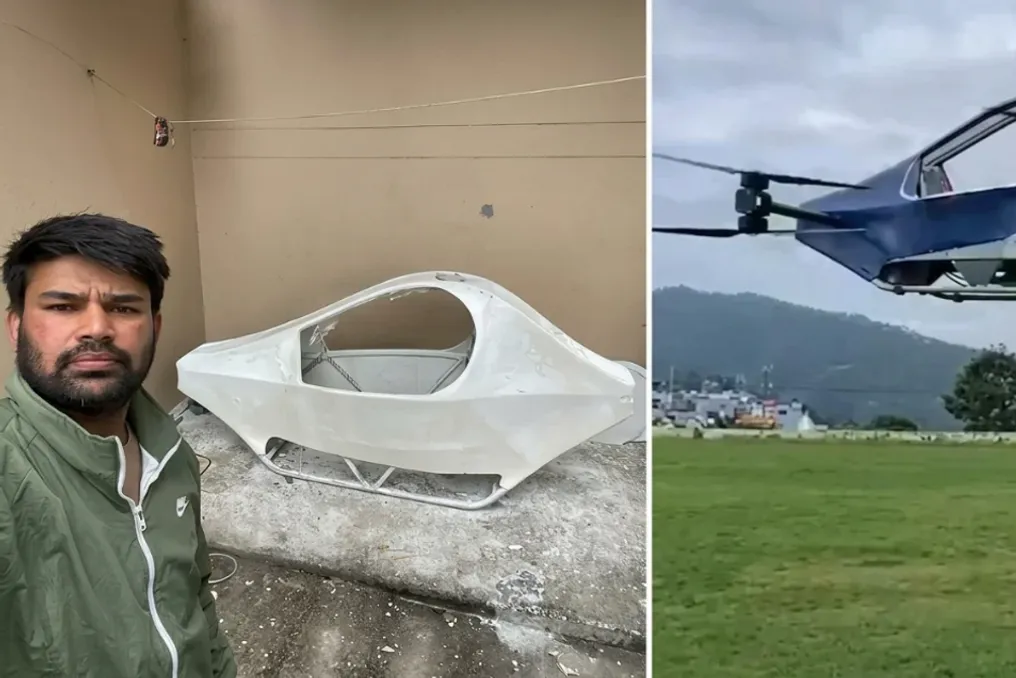
Mechanic's Son from Almora Developed Flying Device by Studying the Internet
Read more
The Better India
thebetterindia.com

Mechanic's Son from Almora Developed Flying Device by Studying the Internet

While Tesla's plans continue to generate widespread buzz online, discussing the future of air travel instead of traffic jams, an innovator in Almora, Uttarakhand, spent thirteen years realizing a similar concept, motivated by a more pressing local problem.

Ravi Tamta grew up in the mountains of the village of Kaflikhan, near Jageshwar Dham. There, he noticed that reaching the hospital could take hours due to winding roads. This prompted him to consider an alternative way to traverse the hills that would not depend on road infrastructure or airports.

This question led him to create a prototype electric flying device, HAPIDA SKYNeX, capable of vertical takeoff and landing. After many years of experimentation, the device made its first test flight in August, taking off from a military helipad in Almora and staying airborne for almost a minute.

The Mountain Problem Led to the Idea

For residents of mountainous regions, distance is often measured not in kilometers. Complex terrain and winding roads can turn a relatively short trip into a long journey, especially when medical assistance is required. Tamta began researching the possibility of using an aircraft to speed up the traversal of such distances. His goal was to create a vehicle that could take off vertically, move over difficult terrain, and land without the need for a runway.

The main objective is to increase the accessibility of air transport in mountainous regions, especially during medical emergencies or in hard-to-reach areas. HAPIDA SKYNeX, developed under his company Hapida Sky Private Limited, combines modified large-scale multirotor drone technology with an electric Vertical Take-Off and Landing (eVTOL) system. Simply put, it uses the same basic principle that allows a multirotor drone to take off and hover, but applies it to a prototype designed to carry a person.

Unlike traditional airplanes, which require a runway to gain sufficient speed, the eVTOL vehicle is designed for vertical takeoff and landing. This makes this technology particularly relevant for mountainous areas, where finding suitable space for runways can be difficult.

How the Flying Device Works

HAPIDA SKYNeX uses several electric motors and propellers mounted on external struts to generate lift. These components work together to lift the device from the ground, maintain hovering, and help control its movement in the air. This multirotor configuration is fundamentally similar to the technology used in drones, although scaling it up to carry a person presents additional engineering and safety challenges.

The prototype is also equipped with a lightweight frame, a cockpit designed for one pilot, and a transparent dome. Its electric drive system runs on batteries, eliminating exhaust emissions during operation. Nevertheless, its practical flight range, battery autonomy, and overall efficiency will depend on factors such as battery capacity, the weight of the device, and the power required to maintain flight.

The intended application is short trips across difficult terrain. According to project data, a journey of about 40 kilometers, which takes approximately 90 minutes by mountain road, could potentially be completed in the air in 10–15 minutes. This is a target travel time, not a demonstrated operational capability at this stage.

Thirteen Years of Learning Through Experimentation

Tamta did not have an engineering degree or access to a high-tech laboratory. Instead, he turned to the internet for learning, relying on the support of his parents and constant experimentation to develop his idea. Over a period of more than 13 years, the concept gradually took shape within his company, Hapida Skynex. The first flight was an important step in testing the feasibility of his vision beyond drawings.

The prototype is still in its early stages and requires further testing. While the test flight gives an idea of what the device can do in the future, it is too early to judge its performance in regular use. Before such a device can be used for regular passenger transport, it must demonstrate reliable flight control, sufficient battery performance, structural integrity, and safe reaction to component failures. Operation in mountainous terrain will require consideration of additional factors, including changing weather, wind conditions, available landing spots, and emergency procedures.

From Everyday Inventions to Flying Machines

The flying device is not Tamta's first attempt to solve practical problems through invention. His previous creations include shoes that charge mobile phones while moving, a smart cane for the visually impaired, a bamboo splitting machine, and fire extinguishing equipment. Each project started with a practical task that prompted him to find ways to simplify a specific job.

HAPIDA SKYNeX still has a long way to go before it can carry passengers or help people reach hospitals faster. Currently, its first flight marks a step forward for an idea shaped by life in the mountains. While discussions about flying cars continue online, Tamta's work offers a different perspective on this technology: not just as a futuristic mode of transport, but as a potential solution to everyday mobility problems.
Similar stories

New Tesla Roadster Demonstrated During Show, Including Somersaults and Flight
Read more
www.khaleejtimes.com

New Tesla Roadster Demonstrated During Show, Including Somersaults and Flight

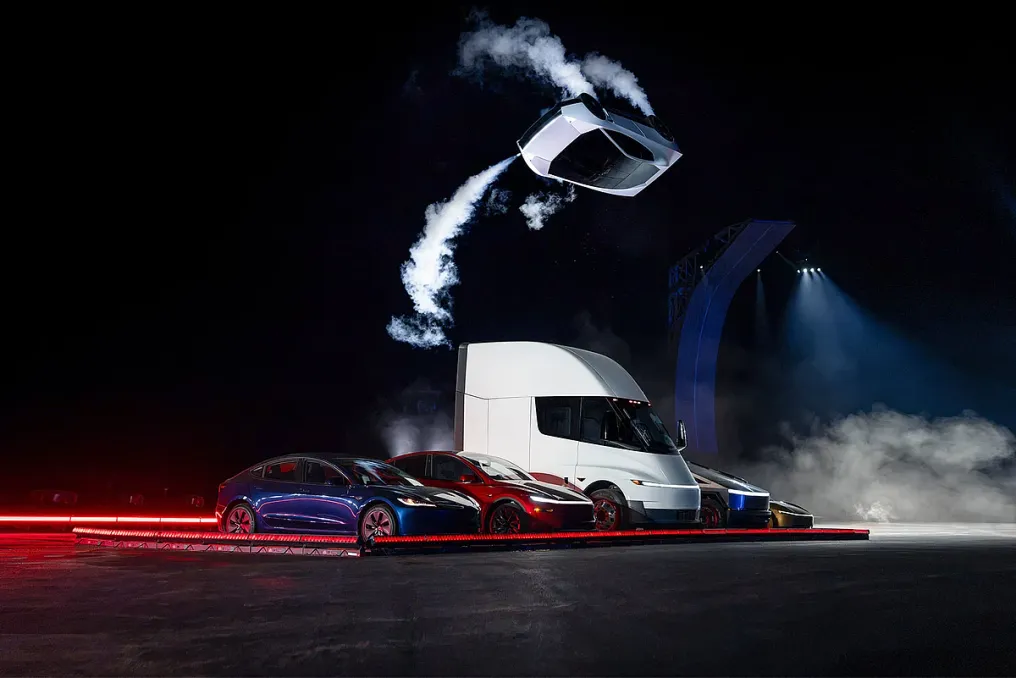
Tesla has unveiled the updated Roadster, equipped with rocket-like engines that allow the car to perform flights and somersaults during an event which one fan called 'the craziest product demonstration' in history. Tesla announced that mass production will begin in 2028, more than a decade after the first showing of this new generation electric sports car.

The white two-seater vehicle, developed in collaboration with the rocket company SpaceX, led by CEO Elon Musk, was demonstrated on a ramp using a suction system, then it performed an aerial turn and landed thanks to integrated engines. Later, during the event, it used these engines to jump over a truck and other vehicles, spinning in the air during the maneuver.

Some observers interpreted this collaboration as an attempt by Musk to generate interest in the merger of two major companies he leads, an idea he has discussed, pointing to overlaps between them. This showcase provides Tesla with an iconic vehicle after many missed Roadster release dates, but it occurs while the company is shifting its focus to autonomous driving and robotics technologies, and shortly before the publication of third-quarter results, which analysts believe are more significant for investors.

Gene Munster, managing partner at investment firm Deepwater Asset Management, stated on social media platform X: 'This was an engineering challenge without commercial value, except for humiliating traditional automakers.' Munster added that 'the Roadster event is the latest example of why Elon cannot wait for the merger of (Tesla) and (SpaceX).'

Musk downplayed the car's significance to Tesla's finances, calling it a 'small potato situation' in 2023 that 'will not change the big financial picture.' Nevertheless, the car retains symbolic value. Morningstar analyst Seth Goldstein noted in his note that 'Tesla currently lacks a flagship or high-performance luxury vehicle designed to showcase the best of automotive engineering and technology. The Roadster will become Tesla's new flagship.'

Attendees and witnesses were amazed by the launch spectacle. Tesla fans and investors, such as Sawyer Merritt, posted on X: 'This was the craziest product demonstration I have ever seen. I just saw it in person, and I still wonder how it wasn't AI.'

At the event on Thursday, Musk and other executives did not name target prices, although nearly ten years ago Tesla quoted a base price of $200,000 for the car. Following this event, the Tesla booking page for the Roadster featured 'Performance' versions requiring a $50,000 deposit, and a 'Thrust' version with 'accelerating engines' requiring a $250,000 deposit. The 'Rocket' option, which Tesla calls 'by invitation only,' is described as a single-seater model with a 'full flight system.'

The event, held at the SpaceX test site in McGregor, Texas, had all the hallmarks of a classic Musk product presentation: dramatic music, smoke, mechanical hissing sounds, and a launch countdown. Musk, dressed in a silver Western belt with the Tesla logo, told the assembled crowd of enthusiasts and investors: 'This is the culmination of incredible work by Tesla and SpaceX engineers working closely together to create something you haven't seen in any movie.'

Tesla's Chief Vehicle Development Engineer, Lars Moravy, reported that the Roadster can accelerate from zero to 60 mph (97 km/h) in under one second and reach a top speed exceeding 230 mph (370 km/h). Enthusiastic Musk added: 'Definitely much faster than that. I think you need to get to half the speed of sound.'

The Roadster can also travel over 300 miles (480 km) on a single charge, which is less than half of what Musk promised in 2017 when Tesla first introduced the second-generation Roadster prototype and stated that deliveries would begin in 2020. The original Roadster, released in 2008 and sold until 2012, was Tesla's first electric vehicle and used a Lotus Elise chassis, which helped change the world's perception of electric cars. Since then, the company has been known for its Model Y and Model X SUVs, as well as Model S and Model 3 sedans.

The unveiling of the second-generation Roadster comes against the backdrop of Tesla's sharp shift in focus towards autonomous driving and artificial intelligence-driven robotics, rather than manufacturing cars for human drivers. This year, Tesla stopped selling the Model S and X to make way for the production of its humanoid Optimus robots. The company also launched the Cybercab—a driverless two-seater robotaxi without a steering wheel, pedals, or mirrors. Tesla plans to publish its third-quarter results on October 21.

Sales of Tesla's older models have been declining over the past two years, although high gasoline prices contributed to increased deliveries in the third quarter. Josh Gilbert, lead analyst for the Asia-Pacific region at the trading platform eToro, noted: 'Margin and cash flow figures will carry much more weight for investors than anything they saw at the presentation.'

_

Popular