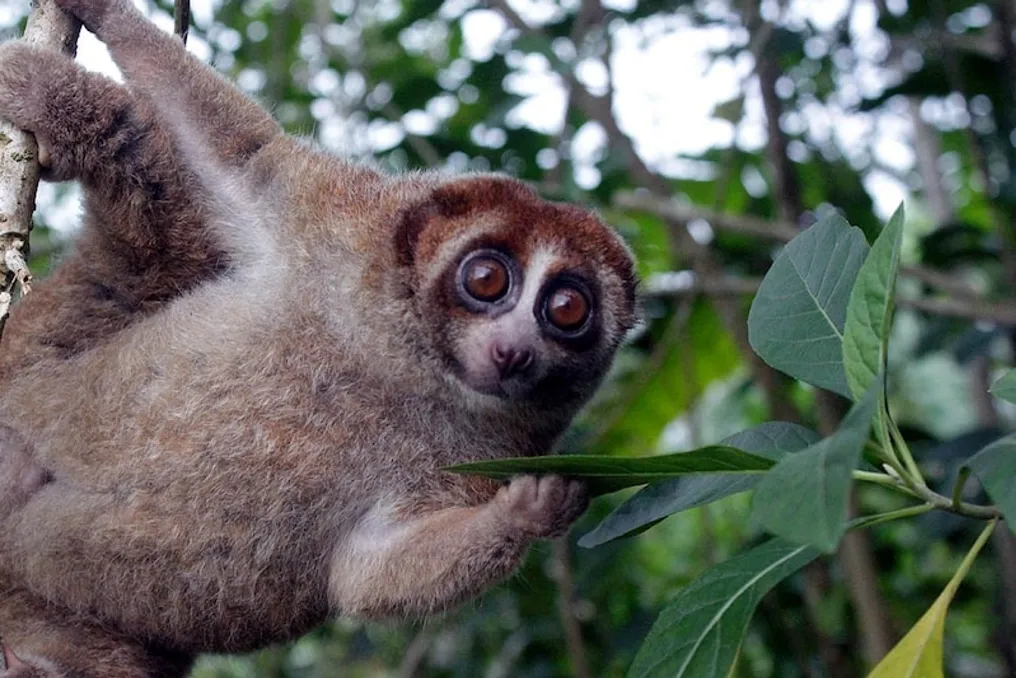
It has been discovered on the Indonesian island of Bank that the Bank slow loris, which was believed to be lost for about 90 years, is alive. This small animal primarily comes out at night and lives in trees. Bites from this animal can cause severe allergic reactions in people.
According to scientists, more than 90 Bank slow lorises were found on this island between 2015 and 2025. Of these, 86 were released back into the wild after rescue and treatment. The last scientific record of this animal dates back to the period between 1930 and 1932.
In 2020, this species was included in the list of endangered animals, and there was a possibility of its complete extinction. However, new scientific research has shown that this animal still lives in various areas of Bank Island, although the exact number of individuals is currently unknown.
The scientific name of the Bank slow loris is Nycticebus bankanus. It is small in size, has reddish-brown fur, large eyes, and characteristic facial markings. The animal lives in trees and forages at night. It moves very slowly through the trees and does not jump between them as quickly as monkeys. Scientists believe that its kinship is closer to lemurs found in Madagascar and galagos from Africa than to monkeys and humans; it belongs to a separate group of primates.
The most distinctive feature of the Bank slow loris is that venom can enter a person's body through a bite. This feature is rare among mammals. It has special glands near its elbow from which fluid is secreted. The animal brings its paws to its mouth, mixing this fluid with saliva. After this, a bite can lead to the venom entering the body, causing severe allergies in people, and in some cases, death. Studies of other slow loris species have shown that they can use venom when fighting other lorises or for defense against predators.
The Alobi Wildlife Rescue Center in Indonesia rescued or recorded information about more than 90 Bank slow lorises between 2015 and 2025. These animals were found in different parts of the island. Some individuals were found near houses, gardens, fields, and roads. Some animals sustained serious injuries after colliding with electrical wires, and some died during treatment. The rest of the animals were cared for, and after recovering, 86 of them were returned to the forest. The discovery of these animals in various locations indicates that the species is still present in many areas of the island, but additional research is needed to determine the total population size.
The main threat to the Bank slow loris is the reduction of forest areas. Tanam cultivation is carried out on this island, and forests are also cleared for palm oil plantations. This leads to a constant decrease in the animal's habitat and food base. Scientists emphasize that the priority task is the preservation of the remaining forests. Simultaneously, surveys must be conducted in various areas of the island to determine exactly where this animal is located and what its population size is. Although the rediscovery of the Bank slow loris is good news, the threat remains relevant. If forest damage continues, the survival of this species in the future may become extremely difficult, making it vital to protect its natural habitat—the forests.