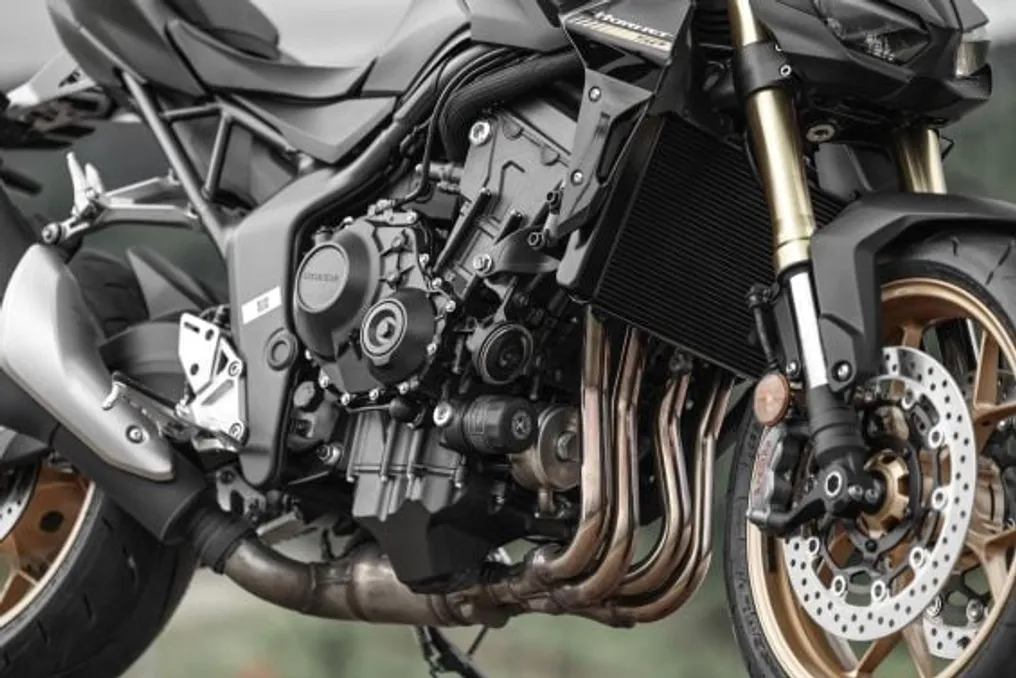
Four-cylinder motorcycles are gradually being replaced by two or three-cylinder models. Notable examples of this transition include the new Honda CB750 Hornet, Suzuki GSX-8S, and Yamaha R7, which are twin-cylinder and succeeded older four-cylinder machines.
Although emission standards are becoming progressively stricter, engine developers point out that the decision on engine configuration begins before legislation. For contemporary engineering, the choice of the number of cylinders must be determined by the specific proposal and the model's need.
Technical view on model design
Bismark do Vale, an engineer specializing in Honda research development, explains that the difference in model design does not depend solely on emissions; it is linked to the ultimate purpose of the vehicle concept. He argues that a four-cylinder engine is typically designed for on-road use, operating at high RPMs and generating lower torque at low speeds. Conversely, a two-cylinder engine presents opposite characteristics, being more suitable for off-road applications.
As an illustration, Bismark points out that putting a four-cylinder inline engine in an off-road bike, such as the Africa Twin, would result in very weak power delivery at low revs, compromising the motorcycle's control and efficiency for its intended use.
The factor of cost and engineering optimization
Beyond practical application, cost emerges as another decisive factor. The engineer questions the necessity of using a four-cylinder engine in a 500cc model if a properly designed and sized two-cylinder engine can deliver the same level of performance. Bismark emphasizes that, although the four-cylinder engine is more efficient on tracks, this rule is not universal. Mid-displacement models, for example, show good performance even on speed circuits using two-cylinder engines.
Engineering has been reassessing its approaches in various aspects, as replicating the four-cylinder architecture in a bike that already achieves the desired performance with two cylinders would be considered a waste of application. This reasoning becomes even more relevant in mid-displacement segments, where sales volume is higher and profit margin is lower, weighing more heavily than in superbikes.
Regarding regulations, the Euro 5+ standard, in effect since 2024 for new approvals, did not reduce pollutant limits but rather tightened requirements for onboard diagnostics, component durability, and catalyst monitoring. Engineering consultants had already indicated that under Euro 5, manufacturers stopped approving certain models because the costs were not viable.
It is important to note that the four-cylinder engine has not become synonymous with a failed engine. Models like the Kawasaki ZX-4R and competitors like the QJMotor SRK450RR are four-cylinders compatible with Euro 5+. When the brand decides to invest, the engine is approved.
In the Brazilian market, there are examples of this. The new Honda CB1000 Hornet, for instance, was launched with four cylinders and 147 hp. Adapting this machine to Promot 5 required the use of a large-dimension exhaust system. Although the Japanese manufacturer could have considered a smaller model, it would be difficult to achieve the same performance and tuning as the current model.
Consumer perception
Finally, there is the consumer perspective, which maintains the association between four cylinders and high performance. Bismark observes that the public who talks about four cylinders generally associates this type of engine with performance due to established culture or prior experience with these motorcycles. This can generate a feeling of 'downgrade' in those consumers when migrating to smaller engines.
The engineer recognizes that this perception has a sensory basis: the fewer cylinders, the more perceptible the imbalance in engine operation, which increases vibration and the sensation of power. Many manufacturers seek precisely this effect. However, in his analysis, the mid-to-low displacement audience is not composed mainly of track day riders, and even among those who attend tracks, a large part of the currently available twin-cylinder models meets the necessary requirements.