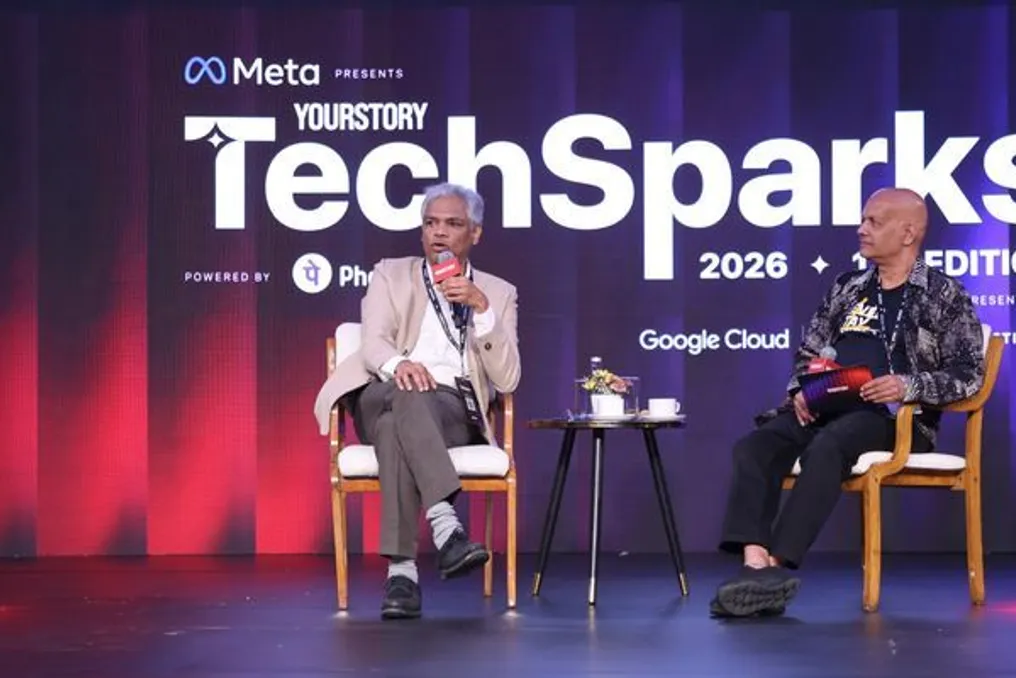
Actor and theatre personality Prakash Belavadi began his session at the TechSparks 2026 event with a simple question: 'Are there artists here?' He then answered his own question with deep reflection, stating: 'This is a tricky question. You are all born artists. But the formal education system and corporate life have suppressed the artist within you. Reconnect with that artist; it will help you survive this AI era.'
Belavadi delivered a presentation on the topic 'The Last Human Advantage: What AI Will Not Replace,' during which he examined how technology is transforming culture, work, social life, and creativity. In response to the question of whether AI challenges artists and if they need to upskill to remain relevant, Belavadi drew a distinction between art created for personal satisfaction and art produced for commercial or practical purposes.
To illustrate his point, Belavadi asked the audience how many people had tried writing poetry. Although few called themselves artists, several people raised their hands in response to the question about poetry. He asked, 'Why do you want to write poetry? Don't you think you will earn money from it. Don't you consider it a career. Why did you try to write?'
According to Belavadi, the answer lies in the impulse to create something for oneself, without the pursuit of commercial gain or external approval. In such cases, he argued, AI poses no threat because the act of creation itself is the main goal. He added: 'You write it because you wanted to. You don't take AI's help to write poems.'
However, the situation changes when creativity becomes a professional assignment with a set deadline and a specific outcome. For example, a lyricist tasked with writing a song in four hours might use AI to generate text based on characters, setting, language, and scene context. In such scenarios, AI acts as a tool to achieve a given goal. As more people turn to it for similar tasks, competition among artists intensifies.
Belavadi noted: 'If you want to engage in art that is useful, I think AI is more than a challenge. I feel we will have to find another profession,' he stated. He acknowledged that actors can also be replaced in certain roles as technology advances.
'For me, as an actor, at the current level of AI, I can provide my image and receive royalties only for my image. You can create a non-fungible token of my image, and then simply lend it, and AI will do the rest. For instance, I don't need to go to shoots. I can be replaced,' he said. Belavadi believes that AI is incapable of easily reproducing the dimension of human experience—the ability to react to the world through lived experience. While AI can imitate an actor's appearance and deliver a convincing performance, he believes that replacing a person in a traditional screen role will be much easier than reproducing the complexity of a personality shaped by life experience. 'But if you play the lead role in a film, I think it is very easy to replace.'
Belavadi pointed out that today's youth face a double blow: climate change and numerous new technologies. 'There is a third thing related to both: you will need two and a half times more energy than now when AI is fully deployed, and this will exacerbate climate change. And new technologies will not give you jobs.'
Belavadi was not against technological development. When asked what human skills surpass AI, he turned the question around: 'AI can replace much of what people do. The question is: what do you do? Do you need to do it? What do you do and why do you do it?'
He then listed several areas that, in his opinion, AI could take over. These include: courts (with about 54 million pending cases, AI could start reviewing them in seconds, while appeals might remain with human judges); primary healthcare (diagnosis and minor procedures in rural clinics with remote guidance for complex surgery, provided 'without prejudice' based on caste, gender, skin color, or geography); elections (if people trust their phones for payments, why not trust OTP for voting); accounting (he told his daughter, a certified accountant, that she had already lost her job); transportation (he suggested that a million autonomous vehicles for Bengaluru would return its streets to the city).
Belavadi urged AI developers to use their skills to improve the lives of others, asserting that creating ethical AI requires a sense of responsibility towards one's community. 'If you are creating ethical AI, I think you need to rise up and build a better India. There is no other country that would be as good for you as India if you have self-respect,' he said. Emphasizing that this responsibility starts with people in one's immediate surroundings, he added: 'When I say India, I don't mean you are speaking for 1.5 billion people. I am talking about myself: can you be useful and improve the lives of the people around you.'
He warned that developers who do not bring this sense of purpose into their work risk being displaced by the very technology they create. 'Otherwise, I will be talking to AI. Maybe I won't need you, I'm telling you.'