
Scientists discover green white dwarf WD J1330+6435 that has swallowed planets
Read more
Aaj Tak
www.aajtak.in

Scientists discover green white dwarf WD J1330+6435 that has swallowed planets

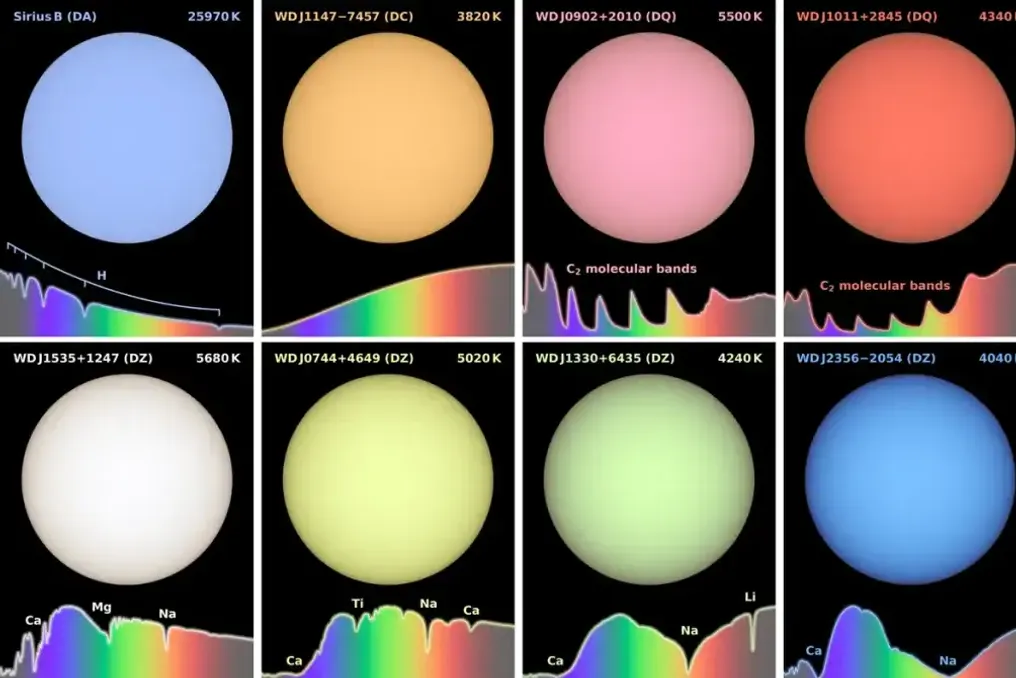
Scientists have recorded a green star in space for the first time. This star, named WD J1330+6435, is located in the constellation Draco, in the Milky Way galaxy, at a distance of about 280 light-years from Earth. It is a white dwarf that has absorbed fragments of planets that were previously orbiting it.

According to scientists' data, the green hue of the star is due to the interaction process between sodium, which came from these fragments, and helium present in the star itself. Usually, a star's color is determined by its temperature: cool stars appear orange, Sun-like stars are white, and hotter ones are pale blue. However, WD J1330+6435 deviates from this rule.

The study showed that elements such as calcium, lithium, and sodium, originating from destroyed planets, were found in the outer layer of WD J1330+6435. The green color of this star largely depends on sodium. Although sodium usually absorbs orange light (as seen in the orange color of streetlights), something different is happening in this case.

Scientists explain that this star has a very high density. Sodium atoms constantly collide with helium atoms, which changes how sodium functions. After this, it begins to absorb parts of the yellow, orange, and red light. This affects the light emitted by the star; when the balance of different colors in the light is disrupted, the star acquires a green tint, called charrage, which has a slight yellowish hue. Such a color is not observed in ordinary stars like the Sun.

White dwarfs form during the final stage of a star's life. Their size can be comparable to the size of the Earth, but they contain a huge amount of matter. Typically, a white dwarf can have a mass approximately equal to half the mass of the Sun. Due to extremely high density, even a small amount of sodium can have a significant impact on the light they emit. In the case of WD J1330+6435, most of the orange light is absorbed by sodium, leading to the visible green color of the star.

As part of this study, scientists examined the colors of 151 white dwarfs within 65 light-years of Earth. Most of them turned out to be white, but one appeared light pink. This dwarf, named WD J1011+2845, is located about 48 light-years away in the constellation Cygnus. Unlike the case with WD J1330+6435, the color change of this dwarf is related not to sodium but to carbon. Scientists believe that the release of carbon from inside the star influenced its coloration. The study also showed that some white dwarfs with high carbon content can appear pink or purple, while others containing elements from destroyed planets can be yellow.

To study the starlight, researchers used data obtained from a telescope in New Mexico, as well as computer models. During the work, information was gathered on the colors and composition of 151 white dwarfs. This analysis proved that a star's color is determined not only by its temperature but also by the elements contained within it and the structure of its outer shell. WD J1330+6435 is the first registered example of a green star in space.

Similar stories

Astronomers discover green star differing from most known types
Read more
getaway.co.za

Astronomers discover green star differing from most known types

Astronomers studying the remnants of dead stars have identified a white dwarf that may appear green to the human eye. While most stars are orange, white, or blue, some white dwarfs possess unusual atmospheric chemistry capable of creating unexpected hues, according to a study led by astrophysicist Mark Holland from the University of Warwick in England.

Holland and his team analyzed data from 151 known white dwarfs located within approximately 65 light-years of Earth. By examining the light spectra of these stars, which reveal their chemical composition, researchers were able to calculate how these distant objects might look to a human observer.

One of the white dwarfs attracted attention due to its unusual green appearance. Its atmosphere contains elements such as calcium, sodium, and lithium, providing clues about the material accumulated on its surface. These elements could have originated from rocky bodies of a once-existing planetary system.

When an asteroid or another object approaches a white dwarf too closely, the star's intense gravity can tear it apart. The resulting debris falls onto the star, leaving chemical traces that astronomers can study. This makes white dwarfs valuable sources of information about the past, as analyzing the elements in their atmospheres allows scientists to investigate the composition of planetary material that may have existed around other stars.

Other unusual objects and research methodology

The green star was not the only unusual object in the sample. Holland also discovered a white dwarf whose calculated color was close to salmon-pink, possibly due to a high concentration of carbon molecules. Although these colors cannot be observed directly with the naked eye from Earth, they provide a more tangible way to visualize objects that would otherwise remain mere points of light in the vast expanse of space.

The study, published in RAS Techniques and Instruments, also offers a useful method for classifying white dwarfs based on temperature, atmospheric properties, and color. It is important to note that the conclusions are based on existing astronomical data, not the discovery of a previously unknown star. Nevertheless, they offer a new perspective on how scientists interpret the light from these stellar remnants.

Astronomers expect that new spectroscopic surveys will increase the number of white dwarfs whose light will be analyzed in detail. Holland believes that the available sample could increase tenfold, potentially leading to the discovery of more stars with unusual colors. Currently, the possibility of a green star serves as a reminder that the universe is full of surprises; even the remnants of long-dead stars can hold keys to worlds that once orbited around them, allowing astronomers to reconstruct the history of planets across light-years.

White dwarf star WD J1330+6435 surprises astronomers with its green color
Read more
olhardigital.com.br

White dwarf star WD J1330+6435 surprises astronomers with its green color

The white dwarf star WD J1330+6435, located approximately 326 light-years from Earth, is potentially the first identified green star. Its unusual hue is attributed to the presence of sodium in its atmosphere, which has been enriched by absorbing material from a planetary body.

This discovery demonstrates that stellar remnants can exhibit colors significantly different from the traditionally associated white-blue shade; the chemical composition of the atmosphere plays a key role in explaining this diversity.

White dwarfs are dense remnants of stars that have exhausted their fuel. When they cease to support their own weight, their cores collapse under gravity, forming extremely dense objects.

Temperature usually serves as the primary indicator of a star's color: the coolest have an orange tint, Sun-like stars appear white, and the hottest can take on blue tones. However, for white dwarfs, the chemical composition also influences the emitted light.

Research conducted by Mark Holland from the University of Warwick in the UK shows that elements such as carbon, calcium, and sodium are capable of absorbing different parts of the light spectrum under the extreme conditions of these objects.

Holland stated: 'We found that these incredibly dense stars can produce colors no one expected, and some of them truly surprised us.'

The atmospheric composition helps explain other shades predicted by researchers. WD J1330+6435 accumulates rocky material from a nearby planetary body. This process, called accretion, has increased the content of calcium, lithium, and sodium in its atmosphere.

Sodium is responsible for the unusual coloration. According to the team's model, this element absorbs part of the orange light spectrum, allowing the green glow to stand out.

Holland explained: 'The sodium residue in the atmosphere of this white dwarf star absorbs the orange part of the spectrum, leaving a ghostly green luminescence.' He added: 'Imagine you are on a planet looking up and seeing a green star. It's like something out of science fiction.'

Researchers also discovered another unusually colored star—WD J1011+2845, located 48 light-years from Earth. Its pinkish-peach glow is linked to a deep convection zone that transports carbon from the interior to the outer layers, altering the light emitted by the element's molecules.

Despite these hues, white remains the predominant color. Of 151 white dwarf stars located approximately 65 light-years from Earth, only five have demonstrated extraordinary colors. Based on analysis, scientists suggest that about one in every 30 white dwarfs has an unusual color.

Boris Gansik from the Department of Physics at the University of Warwick noted: 'One in thirty may seem like a small proportion, but considering the entire population of white dwarfs in the universe, it still represents many stars with unusual colors.'

The findings indicate that the chemical composition of these stellar remnants is capable of altering their appearance in ways that go beyond predictions based solely on temperature.

Popular