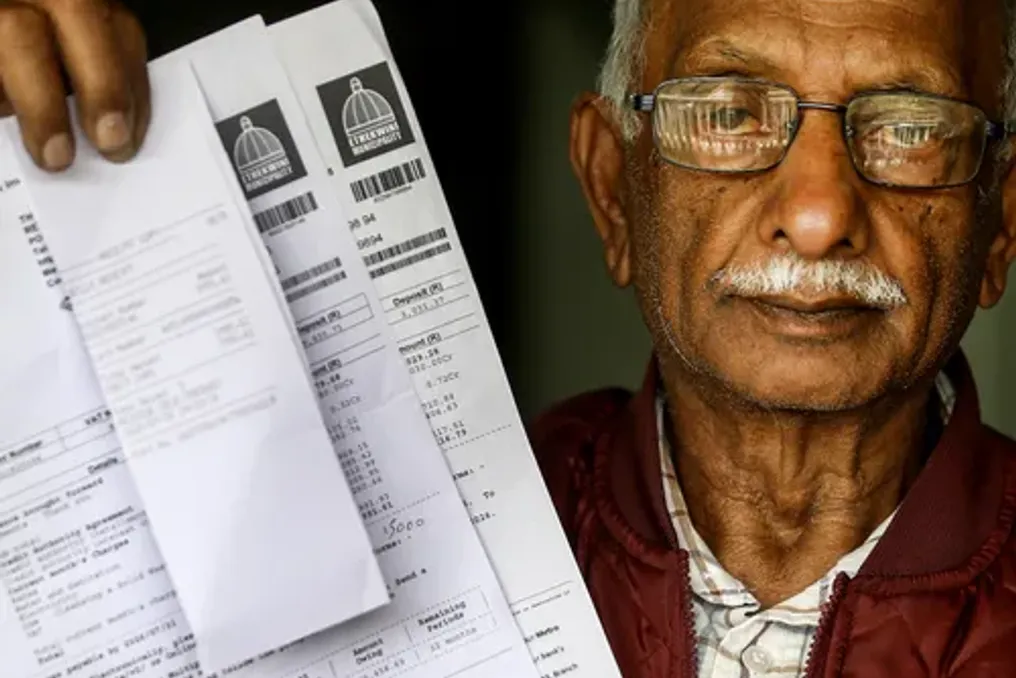
An 84-year-old pensioner from Everest Heights, Tony Babulal, is experiencing significant distress while recounting his long-standing struggle with municipal debt. This debt initially amounted to about R9000 in the late nineties but subsequently grew to approximately R245,000.
Babulal stated that he made monthly payments of R1000 towards this debt for years but never received a satisfactory explanation as to why the amount kept increasing. He calculated that over all these years, he spent more than R300,000 on debt repayment and associated legal costs.
Now, with the expected monthly payment exceeding R6700, Babulal fears he will be unable to settle the debt during his lifetime. He expressed concern for the future of his widowed daughter, who resides in the house.
The conflict began around 1998 when Babulal was informed of a debt of approximately R9000 owed to the then local city council. Following this, his case was passed between several lawyers and debt collection agencies. He agreed to make a lump sum payment of R5000 in cash and then started paying monthly installments of R1000.
He told POST that he continued making these monthly contributions for many years, in addition to paying regular utility bills, while the total amount kept rising. Due to the lack of clarity, Babulal eventually instructed a lawyer to dispute the debt and stopped making the individual R1000 payments.
He repeatedly approached the court hoping to receive answers regarding the amount being demanded from him. He mentioned constantly asking the lawyers handling the case for an itemized breakdown of the calculations, but was ultimately advised to negotiate with the municipality.
The situation worsened when, according to Babulal, municipal officials came to his home and disconnected the electricity. He stated that he could not bear the prospect of living without electricity and felt compelled to enter into another payment agreement.
The financial pressure forced him to sell his car. He noted that he worked overtime to earn enough money to build a home for his family and always kept himself going by working around the clock, driving tankers in Zimbabwe to save up for this dream home.
When asked if he believed he could repay the debt in his lifetime, Babulal replied that he did not know. The Etkesini Municipality could not provide specific answers regarding Babulal's case. Instead, municipal representative Senzelwe Mzila stated that there was no general issue with billing at the municipality.
Mzila explained that municipal bills are based on individual customer consumption, property valuation, and applicable tariffs and charges. He added that the city does not discuss the details of individual customer bills with third parties due to client confidentiality requirements. He advised customers with questions to contact the City Revenue Directorate or the nearest Sizakala center to check their bills, bringing along the bill and any relevant documentation.
Mzila also clarified that in cases where customers considered their bills incorrect, issues are assessed individually to determine the reason for the charges and the need for corrective action. He emphasized that the city urges customers who have not received assistance through primary channels to formally register their request and escalate it through the appropriate revenue complaint and query resolution processes.
Asad Gaffar from the Etkesini Taxpayers Protest Movement (ERPM) stated that thousands of residents are in a similar situation. He noted the absence of a policy within the municipality to resolve such problems, and that council members do not address this issue, leading to the current situation. Furthermore, customer center staff are not trained to assist with such matters, which contributes to the growth of municipal debt. Gaffar added that many residents cannot read or understand their bills, which also leads to increased arrears, and payment plans are not designed to help such people.