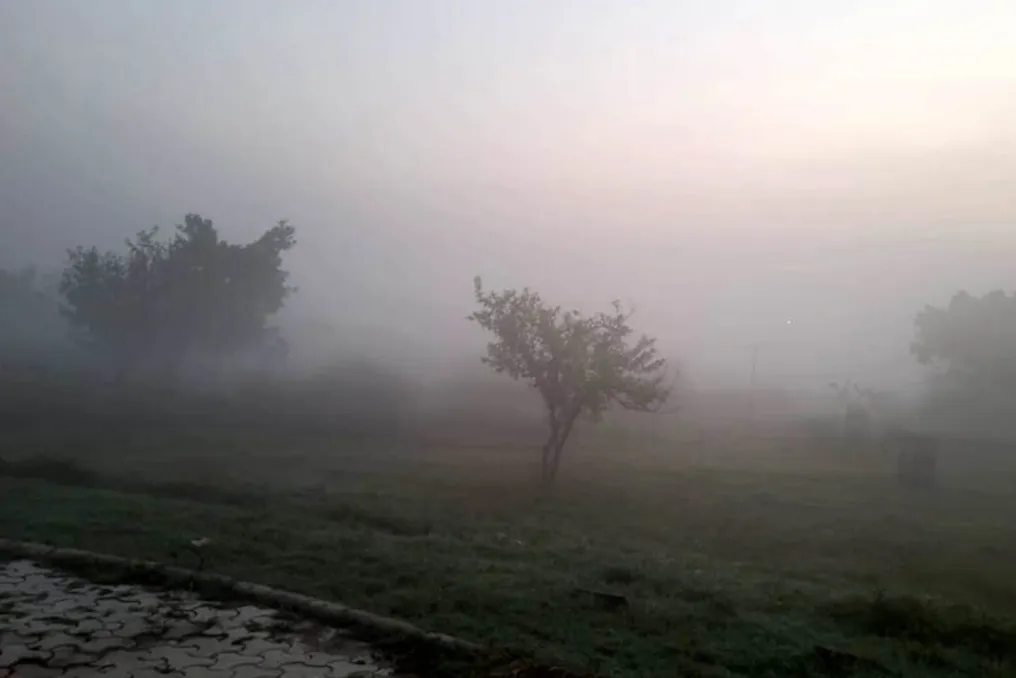
In mid-October, the familiar haze reappeared over the sky of Delhi-NCR. As early as October 20-21, it became visible in many areas that everything around was shrouded in mist. Despite Diwali being far off and fireworks not yet being launched, the air had already become heavy. The Dussehra festival had passed, and effigies of Ravana had been burned.
People are wondering if the act of burning Ravana itself can cause such smog. Although the Graded Response Action Plan (GRAP) will start operating in November, pollution began showing signs about 10-12 days before that. This raises the question of the scientific reasons for such an early appearance of smog.
With the onset of October, nights in Delhi become colder. On normal days, warm air near the ground rises, dispersing pollutants. However, during cold nights, the opposite effect occurs, known as temperature inversion. A layer of warm air forms above, which prevents the cold air from below from rising.
Pollutants remain close to the Earth's surface. This effect is most noticeable in the morning because the pollutants accumulated overnight have not yet dispersed. Furthermore, wind speed significantly decreases. When the wind moves slower than 10 kilometers per hour, pollutants cannot be carried away.
The Delhi air quality early warning system also indicates that low ventilation index and slow winds are factors contributing to increased pollution. This year, after the monsoon season, rainfall was less, and winds remained calm, allowing local pollution to accumulate easily. As a result, the Air Quality Index (AQI) started exceeding the 200 mark in the morning and falling into the 'poor' category.
Smog is not only a result of smoke coming from outside. Local sources in Delhi contribute to pollution annually. Vehicle exhaust contributes about 23%. Dust from construction work, road dust, waste burning, and industrial emissions together account for another 15 percent. According to surveys, people cite construction dust and waste burning as the most serious problems. In October, these sources are already active, and their impact is increasing with the change in weather.
In Punjab, Haryana, and neighboring states, rice harvesting has begun. Hundreds of instances of stubble burning were recorded between mid-September and mid-October this year. Statistics in some districts of Punjab are higher than last year. While the contribution of stubble to PM 2.5 in Delhi was about 4 percent, it could reach 8-13 percent in the coming days. Northwesterly winds can bring this smoke to Delhi. Although it is not the main cause in the initial stages, its share increases rapidly under favorable weather conditions.
During Dussehra, huge effigies of Ravana, Kumbhakarna, and Meghnad, made of bamboo, cloth, plastic, and pyrotechnics, are burned. During combustion, they release PM 2.5, PM 10, sulfur dioxide, and other harmful particles. At a local level, especially where many effigies are burned simultaneously, pollution levels can temporarily rise. Experts call this 'hyperlocal emissions'. However, for the smog of the entire city, this is not the main reason. The haze the day after Dussehra is mainly caused by temperature inversion, weak winds, and already accumulated pollution. Burning Ravana only adds a small additional load.
The Graded Response Action Plan starts operating in November because historically, the peak pollution occurs in November-December, when stubble burning reaches its maximum and winter fully sets in. Nevertheless, according to meteorological data, adverse conditions arise already at the end of October. Therefore, this year, pollution activated 10-12 days earlier. The Delhi government announced a 10-point winter project, starting in November, which includes measures such as banning old vehicles, PUC checks, construction control, and remote work options.
The main scientific reason for the Delhi-NCR problem is that local and regional emissions occur constantly, but in October, the weather begins to trap them. Due to the Himalayas, the Indo-Gangetic plain functions as a basin where pollutant particles cannot easily escape. The mixing height, i.e., the altitude at which pollutants spread, decreases. The drop in temperature at night makes the particles even denser. This is why morning smog becomes visible even before Diwali. Ravana burning is not the sole culprit. The real reason is a combination of changing weather patterns and constant local and regional emissions.
If the winds do not start blowing in the coming weeks and stubble burning increases, the situation could worsen. Therefore, on a personal level, it is important to wear masks and avoid unnecessary outings, while at a collective level, efforts to reduce emissions are necessary. Clean air requires not only government programs; awareness and cooperation play an equally important role.