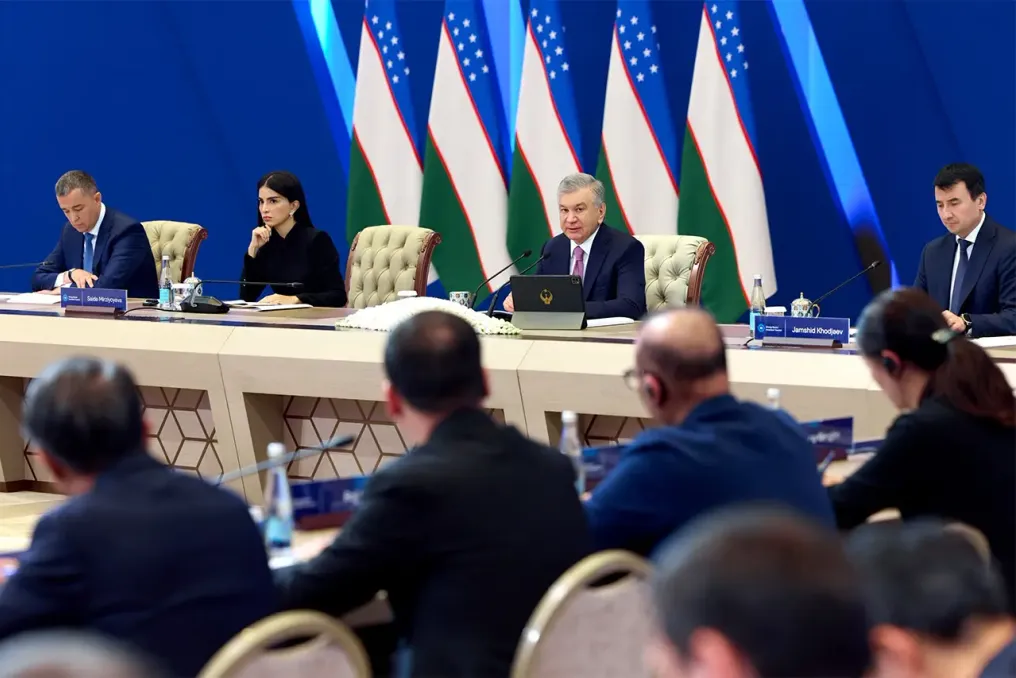
During the second meeting of the US-Uzbekistan Business and Investment Council, held in Samarkand on October 19, 2026, a package of 54 agreements and promising initiatives was presented, with an estimated total value of approximately 12 billion US dollars. However, the true significance of this meeting lies not so much in the declared amount as in the target industries and the potential for American capital to change Uzbekistan's position in regional production networks.
The meeting was attended by President Shavkat Mirziyoyev, US Secretary of State Marco Rubio, Presidential Special Envoy Sergio Gor, and representatives of American companies. The visit coincided with the C5+1 ministerial meeting, which gave the bilateral economic agenda a broader regional scope. Uzbekistan is interested in obtaining technologies and new financing channels, while Washington seeks to expand its commercial presence in a region already connected with investors from China, Russia, Europe, and the Persian Gulf.
Central Asia is gaining increasing importance for global industry for reasons beyond traditional energy resources. The region possesses mineral deposits, important Eurasian transport routes, and growing domestic markets. For the United States, these advantages are becoming increasingly vital as companies and policymakers seek to diversify the supply of materials needed for electronics, energy systems, and advanced machinery manufacturing.
In Samarkand, Marco Rubio emphasized the risks of excessive concentration in critical mineral supply chains. The American logic is pragmatic: a wider group of partners can reduce dependence on a limited circle of suppliers. Uzbekistan, meanwhile, intends to transition from simple extraction and raw material export to processing and high value-added production.
This difference is significant. Additional mining may increase export revenues but does not necessarily create a developed industrial base. Establishing processing capacities, technology transfer, engineering education, and support for local suppliers can ensure a more sustainable economic return. Therefore, the quality of the final projects will be more important than their announced value.
The $12 billion figure covers the agreements and promising initiatives prepared for the council meeting. According to Mirziyoyev, 45 ministries and agencies of Uzbekistan participated in the preparatory work, and American companies were matched with potential partners in government, regional administrations, and business. This indicates significant coordination, but it does not mean that $12 billion in foreign direct investment has already entered the economy.
Between a signed document and a functioning enterprise lie feasibility studies, financing decisions, permits, infrastructure construction, and commissioning. Some initiatives may change in scale or timeline, while others may never be implemented. The correct indicators of success will be the actual attracted capital, created jobs, and produced goods, not the initial total amount of declared commitments.
Tashkent also offers a 'plug-and-play' model, where investors are provided with ready sites with existing infrastructure and documentation. This can shorten project implementation times. Nevertheless, its effectiveness will depend on predictable regulation, reliable power supply, credible dispute resolution, and the ability to repatriate profits. Administrative readiness cannot replace a stable investment climate.
The central priority is developing a chain that runs from mineral extraction to the output of advanced products. For Uzbekistan, this opens up the opportunity to strengthen not only the mining industry but also domestic processing. Cooperation with American research and industrial institutions can support modern exploration methods, increase efficiency, and expand the pool of qualified engineers.
However, processing requires a stable and competitively priced electricity supply, access to water, transport infrastructure, and a skilled workforce. If these conditions are absent, investors may prefer to export concentrates for subsequent processing elsewhere. This is where Uzbekistan's ability to transform natural resources into industrial opportunities is tested.
Another priority is the modernization of the energy system, including renewable generation sources and energy storage systems. For a rapidly growing economy, this is not a secondary issue. New factories, data centers, and urban infrastructure increase the demand for electricity. Unreliable supply can undermine other attractive tax incentives and investment conditions.
Uzbekistan is also seeking cooperation in artificial intelligence, digital applications, and data centers. This combination is logical: digital infrastructure needs reliable energy, and modern energy systems benefit from data analysis, forecasting, and complex management tools. However, the mere import of technology does not create a domestic innovative economy.
For this, university programs, local engineering teams, small business access, and demand from domestic producers are necessary. Without these foundations, digitalization may remain a set of isolated projects rather than a driver of productivity.
Dialogues point to a gradual shift from individual commercial deals to a more institutionalized partnership. The Council combines political support, specific companies, and project coordination. Tashkent has also proposed a long-term cooperation program in trade, investment, and technology spanning until 2035.
However, the longevity of this structure will be determined not by the number of official visits. It will depend on business profitability, transparent competition, and consistency in internal reforms. Even with state support, American companies will make commercial decisions. Therefore, Uzbekistan must compete for investments by continuously improving its institutions.
Regional implications may be broader than bilateral relations. The C5+1 format provides a platform for Washington and all five Central Asian governments to discuss connectivity, energy, and critical minerals. Nevertheless, the economies of the region differ significantly in structure, market size, and investment needs.
Kazakhstan has a larger resource and energy base, as well as important transport links via the Caspian Sea. Uzbekistan combines a significant population with a growing domestic market and production capabilities. Kyrgyzstan and Tajikistan may attract interest in hydropower, infrastructure, and certain mineral projects. Turkmenistan possesses significant energy potential, although investor access remains more limited.
These differences generate both competition for capital and opportunities for cooperation. Minerals from one country can be processed in another, and finished products can reach external markets through neighboring transport corridors. Such a model requires compatible standards, customs procedures, and energy infrastructure. Without coordination, large investments may remain isolated national projects.
More active participation from America should not be automatically interpreted as replacing ties with China, Russia, or the European Union. For the economies of Central Asia, diversifying partners is generally more practical than replacing one major partnership with another. A greater number of sources of funding, technology, and market access can expand opportunities for economic maneuver—provided that regional governments maintain the ability to determine their own priorities.
The agreements reached in Samarkand cannot yet be called a completed investment breakthrough. They form a pipeline of opportunities and signal the political readiness to implement them. The next stage must include financing decisions, facility launches, and the creation of sustainable commercial relationships.
If projects related to critical minerals lead to local processing, energy investments enhance reliability, and digital initiatives develop internal expertise, this partnership could become a factor in Uzbekistan's structural modernization. If, however, most initiatives only lead to equipment imports and additional raw material exports, the long-term benefits will be significantly smaller.
For Washington, Samarkand represents another channel of access to the Central Asian economy. For Tashkent, it is a chance to attract capital and technology without relying on a single external partner. For the entire region, it demonstrates a deeper transformation: Central Asia is increasingly becoming not just a transit and extraction space, but a place where new production, investment, and trade links can emerge.