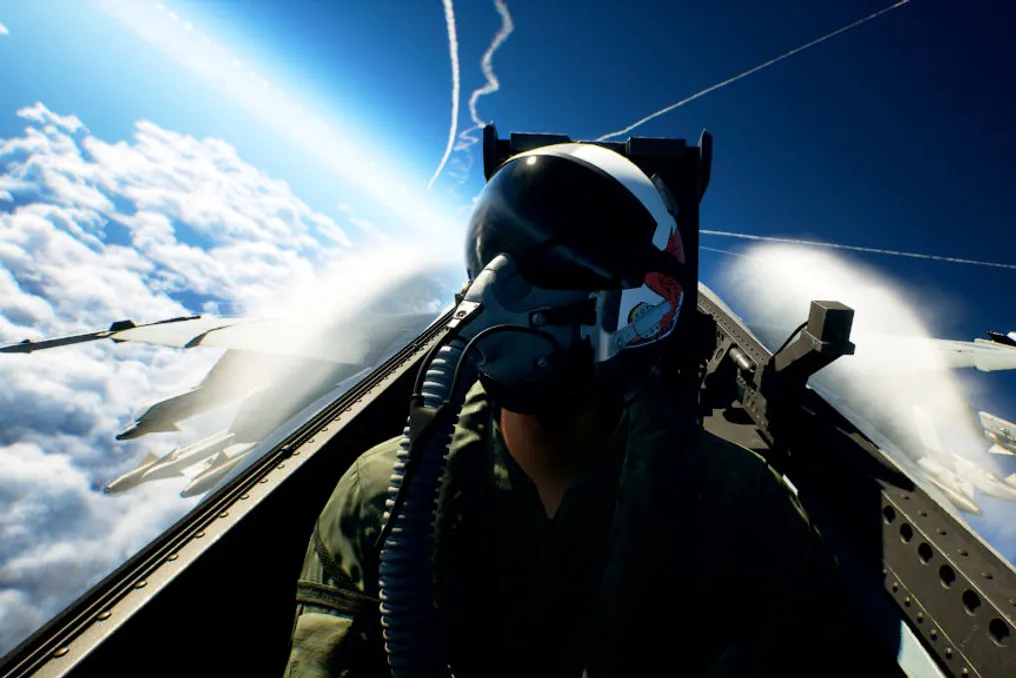
Flight games have always attracted public interest, just like aviation itself. These games have a long history, evolving from electromechanical arcade machines in the early 70s to current models, covering everything from aerial combat to flight simulators.
Before the release of Microsoft Flight Simulator, there were other notable titles. The first prominent one, released in 1975, was Taito's Interceptor, followed by Atari's Red Baron in 1980. However, these games were essentially focused on aiming and shooting at enemy aircraft, far removed from any flight simulation.
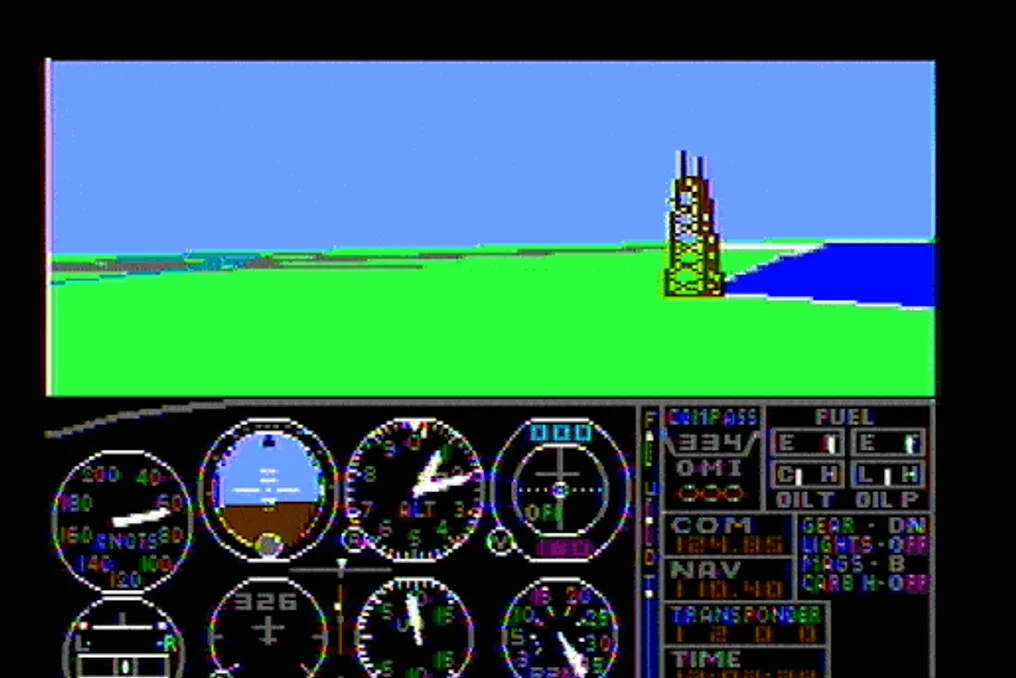
Microsoft Flight Simulator was only introduced in 1982, featuring basic graphics and elementary gameplay, but causing a great impact at the time. Its success prompted Microsoft to release Flight Simulator 2.0 in 1984, and subLOGIC launched Jet, focused on combat, in 1985.
By the late 1980s, a trend was observed in arcade cabinets incorporating motion simulation. These machines used hydraulic mechanisms to tilt in various directions, providing the sensation of being inside a craft. This technology was widely employed by Sega in its 'taikan' (body sensation) games, such as Hang-On, Space Harrier, After Burner, and G-LOC: Air Battle, the latter equipped with the R360 cabinet, capable of up to 360-degree rotations.
The close of the 1980s was marked by the rise of 3D games. Among these, flight games pioneered the use of this technology, exemplified by Midnight Landing (1987) and Top Landing (1988), both developed by Taito. Shortly thereafter, air combat simulators also adopted these graphics, such as Taito's Air Inferno and Atari's Steel Talons, released in 1990 and 1991, respectively.
In the subsequent years, 3D flight games migrated to PCs, including titles like Stunt Island (1992), Star Wars: X-Wing, and Strike Commander (both 1993). Thus, 3D established itself as the standard for the genre, both in terms of gameplay and achievable realism.
These games were not limited to computers, as titles began to be adapted for consoles during the 1990s, such as Pilotwings and Ace Combat – whose series remains active. In parallel, the Microsoft Flight Simulator series began having console versions starting in 2021.
With the decline in arcade popularity and the increase in the use of consoles and PCs, those seeking greater immersion and realism began looking for alternatives in home cockpits. These are structures designed to maximally replicate the experience of piloting an aircraft, including controls.
A notable example is that of air traffic controller James Price. He acquired the nose of a Boeing 737 from an aircraft graveyard for US$1,500. This amount is significantly less than the total project cost, which reached approximately US$150,000. However, most home cockpits do not reach such a price point, offering simpler kits costing up to US$3,000 in total.
The Virtual Air Traffic Simulation Network is a free online platform that unites flight simulation enthusiasts globally, allowing them to fly together or act as air traffic controllers. The entire operation takes place virtually, simulating a real aviation environment with authentic rules and voice or text communication between pilots and controllers.
This organization uses proprietary software compatible with various simulators, such as Microsoft Flight Simulator, X-Plane, Prepar3D, and FSX. Access to the tool is free on the website, provided the user completes an orientation course and passes a test with at least 80% accuracy.
VATSIM also maintains a Brazilian section, providing support, training, guidance in Portuguese, and promoting weekly events for enthusiasts in the country.
Although they are a niche within the gaming universe, flight simulators constitute a vast market generating billions of dollars annually. It is estimated that the market will reach US$6.22 billion in 2025, with a projection of US$6.65 billion for 2026, according to Markets and Markets data. Furthermore, the sector is predicted to reach US$9.77 billion by 2031, representing a Compound Annual Growth Rate (CAGR) of 8%, indicating the robustness and profitability of this market.
Beyond the recreational aspect, these simulators are used in the training of airline professionals, constituting a distinct but equally lucrative segment. According to Global Market Insights, the civil aviation training market was valued at US$5 billion in 2025, with an expectation of US$5.36 billion for the current year, a growth of 7.2%, and a projection of US$10.14 billion by 2035.
Despite lacking formal recognition, flight games have shown influence on pilot preparation, as pointed out by a study from the Flight Simulation Association involving over a thousand pilots. It was found that these pilots saved an average of 5.5 hours of flight time, corresponding to savings of over US$1,000. Additionally, 89% stated that simulators were useful or very useful in their training.
In the United States, a student can count up to 2.5 hours on a certified equipment with an instructor present. For instrument rating, ten hours are required on a BATD (Basic Aviation Training Device) and twenty on an AATD (Advanced Aviation Training Device), both approved by the Federal Aviation Administration (FAA). The agency also recognizes the X-Plane simulator, but only its professional version, requiring the computer and remaining hardware to undergo certification tests.
In Brazil, ANAC authorizes the registration of instrument flight instruction hours using flight simulation training devices, provided they are qualified or validated by the agency. The number of hours depends on the type of license, and they can be entered directly into the ANAC's digital system.
This entire trajectory illustrates a unique shift: from mere games to a consolidated market and a methodology for pilot training. However, despite the advancements, it remains a high-cost hobby and, regarding flight training, still presents limitations in the current moment.