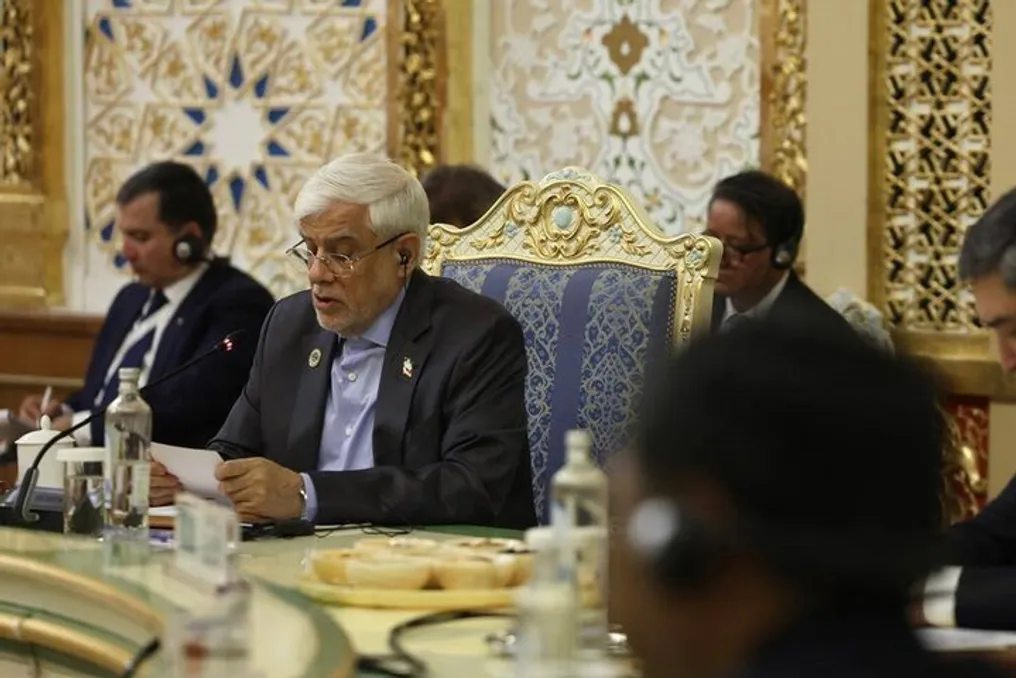
Mohammad Reza Aref, Iran's First Vice President, addressed the members of the Shanghai Cooperation Organisation (SCO) with a call to transform their economic potential into concrete joint projects. He also strongly recommended accelerating the establishment of the SCO Development Bank and expanding cooperation in the fields of trade, energy, transport, and digital technologies.
Speaking at the SCO Council of Heads of State meeting in Dushanbe, Tajikistan's capital, on Tuesday, Aref emphasized that the organization needs to move beyond political commitments and transition to practical initiatives that will bring tangible benefits to member states and their populations.
Furthermore, he condemned the military aggression by the US and Israel against Iran, labeling it a violation of the United Nations Charter, international law, and the sovereignty of an independent state. Aref warned that attacks on civilian infrastructure and economic assets, as well as disruptions in trade, energy, and transport networks, could have far-reaching consequences beyond the directly affected country.
Transforming Economic Potential into Practical Cooperation
Aref noted that over 25 years, the SCO has evolved into a major regional organization with significant capabilities in trade, investment, energy, transport, science, technology, culture, and humanitarian issues. Nevertheless, he stressed that the organization's effectiveness depends on its ability to translate these capabilities into joint investments, expanded commercial exchange, and sustainable economic development.
In the face of global and regional challenges, Aref believes that member states require closer interaction, strengthened ties, diversification of economic relations, and increased resilience to external shocks. The Iranian Vice President affirmed Iran's readiness to contribute its experience and capabilities to the organization's economic, financial, and infrastructural endeavors, emphasizing that cooperation must be inclusive and based on mutual respect, common interests, and equality.
He also called for greater participation from the private sector, asserting that political agreements alone would be insufficient to achieve the SCO's economic goals without effective institutions, reliable financing, and working mechanisms.
Iran Calls for Accelerated Establishment of the SCO Development Bank
Expanding financial and banking cooperation was a central theme of Aref's speech. He advocated for greater use of national currencies in trade among SCO members, strengthening links between their banking systems, developing national financial messaging systems, and creating independent payment and settlement mechanisms.
Aref demanded an acceleration of work on the proposed SCO Development Bank, urging member states to move from the negotiation stage to operational planning. According to him, this bank could help finance joint projects, resolve payment issues, and mitigate risks arising from sanctions and financial restrictions. He particularly stressed that the institution must possess maximum independence from the financial systems used by countries to gain unilateral advantages.
The Iranian Vice President also supported the expansion of export insurance and investment risk coverage to increase private companies' confidence in participating in joint projects. He highlighted the role of the SCO Business Council and the Interbank Consortium in promoting investment, strengthening cooperation between member states' banks, and developing alternative payment systems. Iran, he stated, is ready to provide its expertise through these structures.
Aref also called for the accelerated inclusion of Keshavarz Bank, the Iranian agricultural bank, into the Interbank Consortium. He positively assessed the consortium's development strategy for the period 2027–2031 and the adoption of a roadmap for sustainable and social financing, calling these steps important for more effective financial interaction.
Cooperation in Digital Economy and Technology
Aref defined the digital economy as another key area where SCO members can deepen cooperation and strengthen their collective economic position. He proposed activating the exchange of experience in areas such as artificial intelligence, e-commerce, financial technology, e-government, digital services, and data infrastructure. He added that joint projects, interaction between innovative companies and startups, and the exchange of specialized personnel can contribute to integrating the scientific and technological capabilities of member states.
The First Vice President of Iran also called for strengthening the SCO Digital Economy Forum, developing regional value chains, and expanding industrial cooperation and technology transfer.
Regional Transport Corridors and Energy Security
Aref emphasized the critical importance of improving regional and international transport corridors to facilitate trade, reduce logistics costs, and strengthen ties among SCO members. Iran declared its readiness to play an active role in developing regional transport corridors and supporting initiatives to enhance their efficiency. He also suggested increasing the use of maritime and port facilities, implementing more efficient customs procedures, and ensuring electronic exchange of transport and trade documents, noting that digitizing these processes can reduce the time and cost of commercial operations.
In the energy sector, Aref called for moving beyond simple dialogue to deeper practical cooperation, including the creation of the SCO Energy Consortium. He specified that such an body should cover not only oil and gas trade but also energy production, transmission, and distribution, infrastructure security, financing, technology, and renewable energy sources. He added that the effective implementation of the SCO energy cooperation strategy until 2030 must be accompanied by joint projects, and energy security must remain a priority in the transition to new energy sources.
Aref also expressed Iran's willingness to share its scientific and technological capabilities with member states, especially regarding productivity enhancement, development of knowledge-based companies, and reducing carbon emissions in the oil and gas industry.
Food Security and Humanitarian Cooperation
The First Vice President of Iran proposed establishing an SCO working group on agriculture and food security to improve information exchange, forecast potential food crises, and reduce vulnerability to supply and demand fluctuations. He also highlighted water-saving agricultural methods, water recycling, combating desertification, and using renewable energy in agriculture as areas offering significant opportunities for joint initiatives.
Concluding his speech, Aref called for the creation of a more effective and comprehensive SCO capable of delivering practical results in economic, technological, cultural, and humanitarian spheres. The meeting in Dushanbe was chaired by Tajikistan and focused on strengthening trade, economic, cultural, and humanitarian cooperation, as well as enhancing the overall efficiency of the organization. Aref expressed confidence that closer coordination among member states will help transform the SCO's geographical and economic advantages into a solid foundation for regional prosperity.