
World Bank Presents First Digital Strategy for Developing Countries
Read more
UzDaily
uzdaily.uz

World Bank Presents First Digital Strategy for Developing Countries

The World Bank Group has unveiled its first digital strategy aimed at expanding access to technology, improving public and private services, and creating jobs in developing countries.

According to the World Bank Group's statement, this strategy integrates the capabilities of both the public and private sectors and includes measures to develop internet infrastructure, reduce the cost of digital devices, and prepare countries for the use of artificial intelligence (AI).

The strategy operates on four main priorities: expanding access to reliable connectivity, lowering the cost of devices and data, developing digital services and skills, and creating conditions for the practical application of AI.

World Bank Group President Ajay Banga noted that digital technologies can help countries generate jobs and utilize limited resources more effectively. He emphasized the need for a comprehensive approach covering reliable connectivity, affordable devices, digital skills, and useful services.

According to Banga, this strategy combines these areas and is designed to help countries prepare for using modern digital tools, including small AI models adapted to solve practical problems.

The need to accelerate digital development is driven by two issues: resource constraints and the growing demand for jobs. It is projected that over 1.2 billion young people in developing countries will reach working age over the next 10–15 years, but the economies of these countries are forecast to create only about 420 million jobs.

The World Bank views digital technologies as a way to increase productivity and expand employment in five priority sectors: infrastructure and energy, agribusiness, healthcare, tourism, and high value-added manufacturing. Technology can help businesses find customers, secure financing, and reduce costs, while also enabling government agencies to deliver services more efficiently.

Nevertheless, internet access remains uneven. In 2025, over two billion people worldwide lacked internet access. In low-income countries, only 23% of the population used the internet, compared to 94% in high-income countries. Even where mobile networks are available, some people cannot afford smartphones or mobile internet.

Other obstacles include a lack of digital skills and a limited range of services meeting user needs. The first priority of the strategy is to bridge gaps in network infrastructure, ranging from international cable systems and internal connections to lines serving homes, businesses, schools, and medical facilities.

The World Bank intends to promote shared infrastructure, strengthen competition, and attract private investment in underserved markets. In areas lacking electricity or connectivity, it proposes coordinating the development of both systems.

The second priority focuses on the cost of digital devices and internet services. To lower these costs, the World Bank plans to encourage collaboration with manufacturers, mobile operators, financial institutions, and device refurbishment companies. Potential solutions include expanding installment payment options for affordable smartphones.

The third priority relates to developing digital public and private services. Countries will receive support in establishing trusted systems for digital identification, payment systems, and secure information exchange mechanisms. Special attention will be paid to digital literacy and vocational training focused on employment, so that individuals and small businesses can use technology more effectively and securely.

The fourth priority centers on preparing for AI adoption. This includes developing connectivity, expanding access to computing resources, preparing local datasets, and upskilling workers. A special emphasis is placed on small AI models that can be adapted to specific tasks and local conditions. Such tools, for example, can help farmers detect plant diseases, support healthcare workers, and improve inventory management in companies.

All four priorities contain measures for protecting privacy, strengthening cybersecurity, and combating fraud. The strategy combines the World Bank Group's financial instruments, policy advice, guarantees, and private capital mobilization mechanisms. Its implementation will consider the priorities of individual countries and require cooperation with governments, technology companies, international partners, and philanthropic organizations.

The World Bank has also announced an Infrastructure and AI Readiness Initiative. This program aims to help developing market countries gain access to affordable computing power and utilize small AI models to solve practical problems. The initiative plans to use shared GPU infrastructure on a pay-as-you-go basis. These specialized computing resources allow for the development and deployment of AI applications and can serve as an alternative to building separate national data centers. Initially, the program will focus on countries in Africa and Latin America. Among the partners providing expert support are Cassava Technologies and NVIDIA.

The World Bank expects this strategy to help developing countries transform broader digital access into increased productivity, improved services, and new income opportunities.
Similar stories

Network Readiness Index: Kazakhstan Leads Central Asian Countries in Digital Development
Read more
nuz.uz

Network Readiness Index: Kazakhstan Leads Central Asian Countries in Digital Development

Digital technologies are integrating into all spheres of the economy and daily life, including the internet, e-government services, digital payments, and modern means of communication. The level of a state's digital progress depends not only on the availability of technologies but also on the capabilities of the population and businesses, as well as the quality of regulation and the effectiveness of technology use.

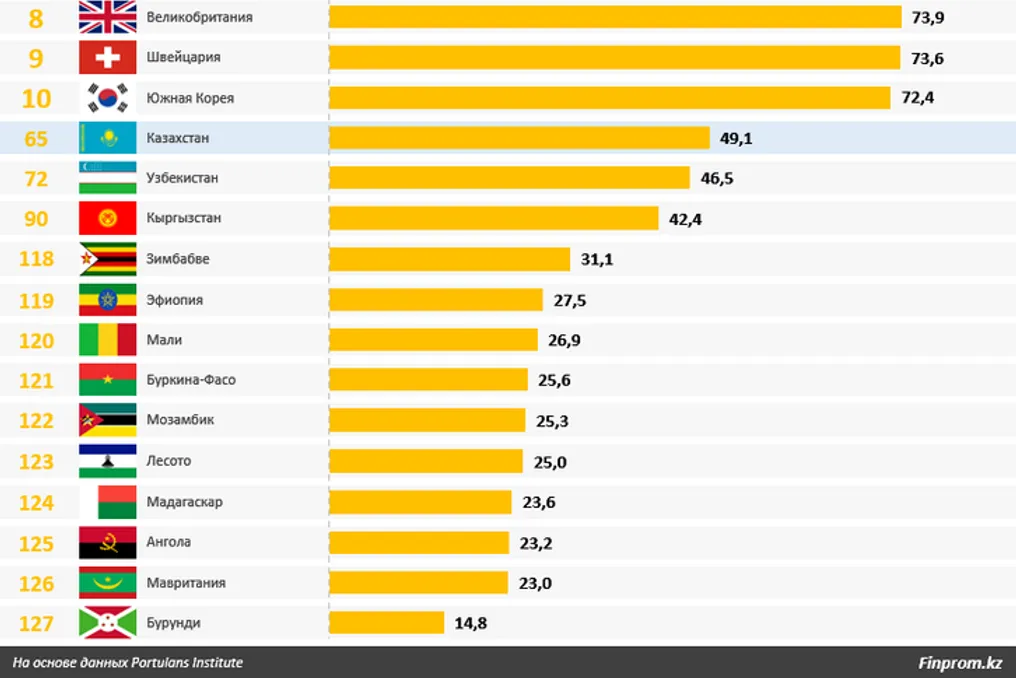
The Network Readiness Index (NRI), compiled annually by the Portulans Institute, is used to assess these aspects. The 2025 rating includes 127 countries and is based on 53 indicators grouped into four blocks: technology, people, governance, and the impact of digitalization on society and the economy.

The USA is recognized as the world leader with 79.1 points out of 100. Following them are Finland (75.8 points) and Singapore (75.5 points). Denmark, Sweden, the Netherlands, Germany, the United Kingdom, Switzerland, and South Korea are also among the top ten leaders. Burundi ranks at the bottom of the list with a score of 14.8 points; Mauritania, Angola, Madagascar, and Lesotho are also noted among the lowest performers.

Among the Central Asian countries, Kazakhstan took the highest position, securing 65th place with a score of 49.1 points. Uzbekistan ranked 72nd (46.5 points), and Kyrgyzstan was 90th (42.4 points). Because of this, Kazakhstan surpassed Uzbekistan by seven positions, and Kyrgyzstan by 25.

It is important to note that Tajikistan and Turkmenistan did not participate in this rating. Although Kazakhstan has an advantage in the overall score, this does not imply superiority across all index components, as neighboring countries showed better results in some individual areas.

In the 'Technology' category, which assesses access to digital infrastructure, content creation, and advanced technology development, Uzbekistan ranked highest among the three CA countries—75th place with 40.7 points. Kazakhstan is 81st (38.9 points), and Kyrgyzstan is 98th (31.4 points). Kazakhstan's result in providing schools with internet access is particularly noteworthy, where the country ranked first globally among the states included in the rating. In terms of mobile tariff accessibility, Kazakhstan is 20th, and for international internet channel throughput, it is 34th.

Uzbekistan demonstrated 7th place in the prevalence of fiber optic connections and 18th place in international internet channel throughput.

In the 'People' category, Kazakhstan ranked 66th with a score of 41.1 points, surpassing Uzbekistan (77th place, 37.8 points) and Kyrgyzstan (94th place, 32.2 points). Kazakhstan's strongest points are seen in the digitalization of public services: the country ranked 10th globally for online service development and 25th for the capacity of government structures to handle data. In terms of domestic mobile broadband traffic volume, Kazakhstan was ranked 29th. However, in the area of ICT skills in education, Kazakhstan ranked 107th, trailing Uzbekistan (76th place) and Kyrgyzstan (83rd place). Meanwhile, Uzbekistan ranked 21st in mobile traffic volume, and Kyrgyzstan ranked 12th in adult literacy rate.

In the 'Governance' section, which examines trust in the digital environment, regulation, and technology accessibility for all segments of the population, Kazakhstan also achieved the best result among the three CA countries—61st globally with 61.4 points. Uzbekistan was 71st (57.3 points), and Kyrgyzstan was 90th (51.0 points). Kazakhstan ranked 32nd in digital inclusion and 27th in electronic citizen participation. Uzbekistan excelled in e-commerce legislation and ranked 7th in the small socio-economic disparity in the use of digital payments. Kyrgyzstan ranked 20th in the indicator of differences in digital payment usage between urban and rural areas.

In the 'Impact' category, which combines economic and social indicators, including quality of life and achievement of sustainable development goals, Kazakhstan and Kyrgyzstan showed the most similar results. Kyrgyzstan ranked 54th with 55.2 points, slightly ahead of Kazakhstan (56th place, 54.8 points). Uzbekistan is 82nd with a score of 50.0 points. Regarding quality of life, Kyrgyzstan ranked 26th, Uzbekistan 28th, and Kazakhstan 35th. In the economic aspect, Kazakhstan was 78th, Kyrgyzstan 106th, and Uzbekistan 107th. Concerning contribution to sustainable development goals, Kyrgyzstan ranked 60th, Kazakhstan 82nd, and Uzbekistan 100th.

Notably, Kazakhstan became the only country among the three Central Asian nations to enter the first half of the global ranking simultaneously in two areas—'Governance' and 'Impact'. Although Uzbekistan and Kyrgyzstan achieved better results in some individual parameters, they lag behind Kazakhstan in the overall standings. This highlights that Kazakhstan's regional advantage stems not from leading every single indicator, but from a combination of sufficiently high results across several areas of digital development.

Popular