The Voyager 1 probe, launched by NASA in 1977, has reached a remarkable distance of about 24.8 billion kilometers from Earth. This milestone places the spacecraft in the most remote location in the Universe that has been directly explored by a human-made instrument.
In this distant region, there are several smaller frozen bodies, including asteroids, comets, and dwarf planets. However, the vast distance between these objects means the scene is predominantly characterized by darkness.
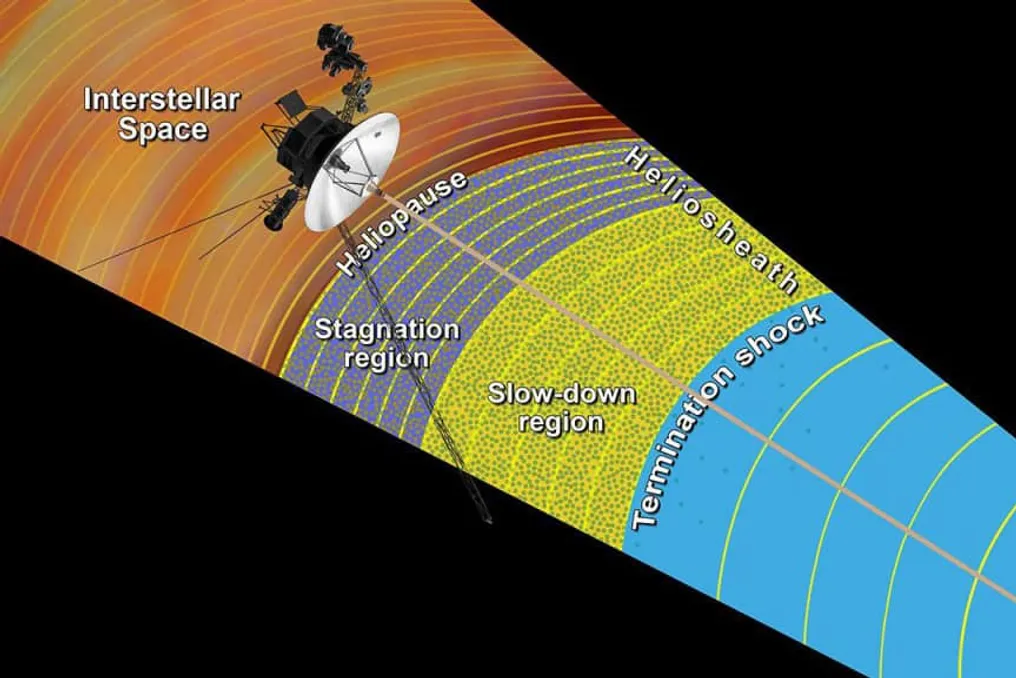
In August 2012, Voyager 1 crossed the heliopause, which is the invisible boundary where the solar wind ends, thus exiting the solar protection sphere. Upon entering interstellar space, the probe began navigating an area composed of dense and icy plasma, formed by ionized hydrogen and helium. In this new environment, the concentration of ions and electrons can be 40 to 50 times higher than that found within the Solar System.
Another crucial element in the current state of the craft is the change in the forces governing space at that point. There, the magnetic field no longer originates from the Sun, but rather from the Milky Way itself. The probe's instruments continuously monitor how the lines of this galactic magnetism orient themselves and interact with the heliosphere left behind.
There is also the so-called 'Hydrogen Wall,' a zone where neutral interstellar hydrogen atoms accumulate. This formation creates a thin barrier of densified gas in the location where the solar wind slows down upon encountering the galaxy's matter.
Besides density and magnetism, the area possesses its own type of 'sound.' Voyager 1's plasma wave sensors have detected constant vibrations in the surrounding gas. These oscillations have allowed scientists to map the medium's frequency and track the density of interstellar space.
Marcelo Zurita, who holds positions such as president of the Paraíba Astronomy Association (APA), member of the Brazilian Astronomical Society (SAB), technical director of the Brazilian Meteor Observation Network (BRAMON), and columnist for Olhar Digital, explains that without the protection of the heliosphere, the region traversed by the probe is subjected to the full bombardment of galactic cosmic rays—high-energy particles emitted by ancient supernova explosions scattered throughout the galaxy. The specialist emphasizes that 'Voyager 1 acts as the first human detector to record this cosmic radiation purely, without the shield of the heliosphere.'
To obtain these measurements made at the farthest point in space, engineering faces an immense communication challenge. The radio signal transmitted by Voyager 1, even traveling at the speed of light, requires more than 24 hours to complete the journey back to the receiving antennas on Earth.
The craft achieves this feat using relatively simple technologies by current standards. Considered a true time capsule from the 1970s, the probe operates with eight-track tape recorders and has storage capacity millions of times smaller than a modern cell phone.
Although it has faced recent failures in transmitting status data, the scientific systems of Voyager 1 remain operational. The mission's engineering team works tirelessly to overcome the wear caused by time, keeping the spacecraft collecting unprecedented data about this isolated and unknown environment of the Universe.
Along with the scientific instruments, the probe carries—just like its partner, Voyager 2, launched in the same mission—a gold disk containing photos, sound recordings of Earth, greetings in 55 languages (including the phrase 'Peace and happiness to all,' in Portuguese), and various musical tracks, ranging from Beethoven and Mozart to Chuck Berry rock and Blind Willie Johnson blues. These disks serve as a gift intended for possible extraterrestrial civilizations that might intercept one of the spacecraft in the distant future.
Before reaching interstellar space, both spacecraft brought significant advances to astronomy, recording never-before-seen images and discovering dozens of moons orbiting Jupiter, Saturn, Uranus, and Neptune during the 1970s and 1980s.
Zurita explains an important astronomical geographical aspect: despite having left the solar wind bubble, the Voyager 1 and 2 probes have not yet left the Solar System. He points out that the definitive gravitational boundary is beyond the Oort Cloud, where the Sun's gravitational force is surpassed by that of the galactic center.
According to the astronomer, to cross this final barrier and permanently leave the solar gravitational domain, the two probes will require a much longer period. Maintaining a speed greater than 50 thousand kilometers per hour, it is estimated that they will take approximately 40 thousand years to cover the necessary distance and overcome this frontier.
There remains the expectation that this 'bottle' launched into outer space will persist for ages, and that, in the distant future, the messages and memories contained within it will finally reach the hands of some cosmic neighbor.