China, the world leader in the automotive sector and the main vehicle exporter, is reforming its urban planning using a concept implemented by Curitiba since the 1970s: Transit-Oriented Development (TOD). This model aims to reduce dependence on private automobiles for daily commutes.
This paradigm gained prominence in the country over the last two decades and has been elevated to a national strategy in the plans of the Communist Party and the State Council for transport. Such plans require the integration of stations with the urban fabric and the reservation of adjacent areas for new developments. In Beijing, for example, it is mandatory that at least 60% of the area within a 500-meter radius of stations features mixed-use zoning.
The essence of the TOD proposal lies in concentrating housing, offices, commercial establishments, schools, and other services near train and subway stations. By reducing the need for long car journeys, the goal is to mitigate congestion and pollutant emissions, as well as control unplanned urban sprawl.
This method contrasts with traditional planning, which historically prioritized large avenues, parking lots, and neighborhoods distant from city centers, making the car essential for almost all activities. In contrast, TOD promotes the integration between different modes of transport, including intermodal stations, pedestrian paths, and bike lanes.
Other cities such as Copenhagen, Denmark, and Tokyo, Japan, have used this approach for decades, but the Paraná capital is among the global pioneers.
The idea emerged during a period of rapid population growth; the city's population nearly doubled in the 1960s, rising from 361,000 to 624,000 inhabitants. To prevent uncontrolled expansion, the master plan approved in 1966 stipulated that Curitiba should grow in straight lines radiating from the center, defining the so-called structural axes.
Architect Jaime Lerner was the one who materialized this plan, having assisted in the creation of the municipal planning institute and being appointed mayor in 1971. In 1974, he inaugurated exclusive bus lanes, a precursor to the BRT (Bus Rapid Transit) system.
At that time, Lerner reported that the prevailing understanding was that cities with a million inhabitants would require a subway. However, Curitiba chose to structure its growth around the bus system. Along these axes, the city government permitted the construction of taller buildings, bringing housing, commerce, and offices close to the lanes. Previously, in 1972, Rua XV de Novembro had already been closed to cars, establishing the country's first pedestrian walkway.
Currently, the city has over 80 km of bus lanes, which accommodate 65% of public transport users, and approximately 200 global municipalities have adopted solutions inspired by the Curitiba experience.
China is applying this concept on an unprecedented scale, although there is a distinction compared to Curitiba: in the Chinese case, the central axis of the model is the tracks, supported by a vast network comprising thousands of kilometers of metro and high-speed rail lines.
By the end of 2025, 58 Chinese cities had urban rail systems, totaling 382 lines and over 13,000 kilometers, according to data from the China Metro Association. These systems recorded 33 billion trips that year.
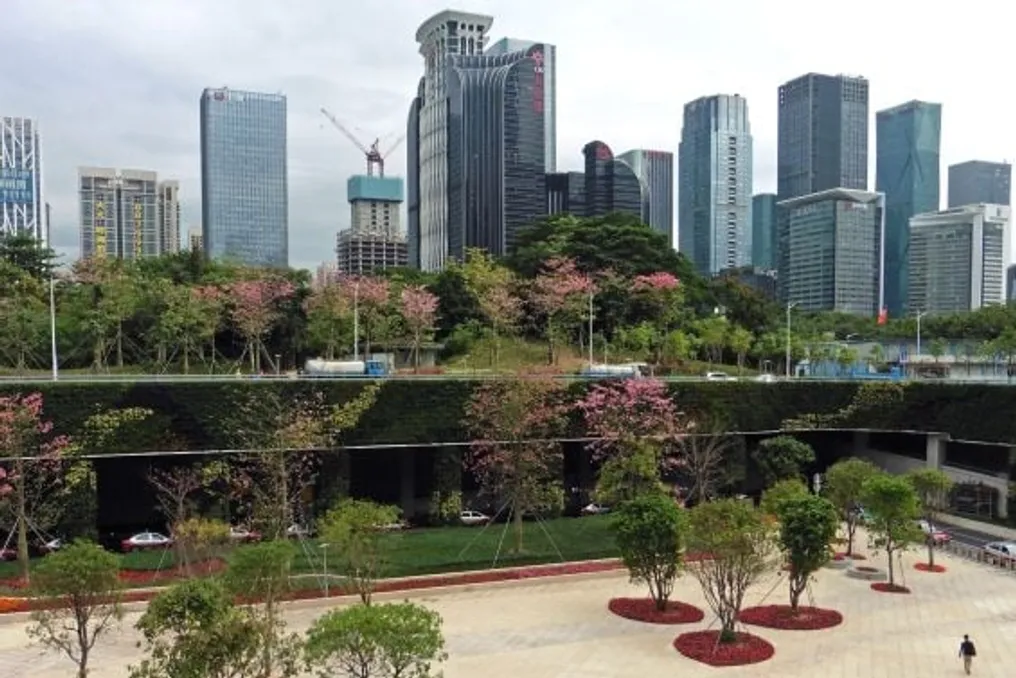
In Shenzhen, new neighborhoods are being developed under the aegis of TOD. Xiong'an, a city planned virtually from scratch about 100 km from Beijing, integrated the concept from its conception.
It is important to note that this new model does not imply that China will abandon vehicles, given that the automotive industry remains crucial to its economy. The change lies in the function of vehicles in the cities, which begin to share space with public transport.