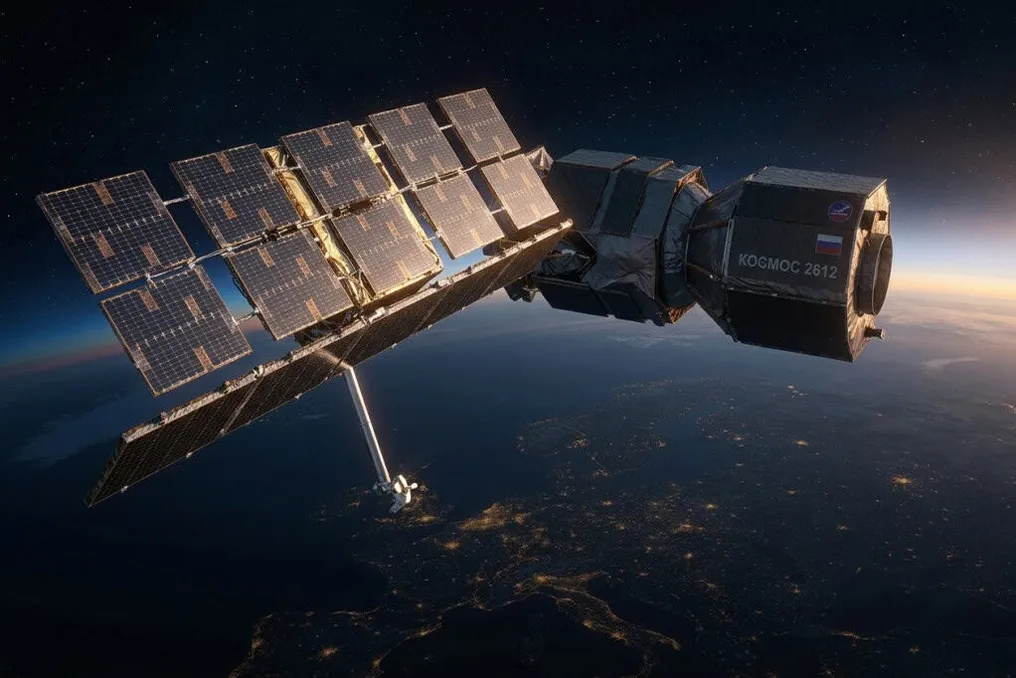
A Russian satellite performed maneuvers to approach US commercial equipment that provides imagery for Ukraine. These movements raised suspicions among experts who are considering the possibility of espionage or even an attack in orbit.
The satellite, identified as Kosmos 2612, has already begun to move away from ICEYE-X36. Although there is no confirmation of hostile intent, such a close approach draws attention to the risks faced by commercial equipment amid military disputes between global powers.
According to The New York Times, the maneuvers began on September 30. Kosmos 2612 started following ICEYE-X36, a radar satellite developed by the Finnish company ICEYE and registered in the United States.
Both devices were at an altitude of about 539 kilometers from Earth. Initially, the Russian satellite was approximately 483 kilometers behind the American one. It then reduced the distance to a few hundred meters and performed successive adjustments to maintain this position.
Adam Marsh, Vice President of Technical Solutions at LeoLabs, a company that tracks objects in orbit, confirmed that the Russian satellite made numerous maneuvers during the approach.
The objective of this operation remains unknown. Kosmos 2612 may have collected images or other data about the American equipment. Experts also suggested that it might be carrying a projectile or another type of weapon, but there is no evidence that Russia planned an attack.
The significance of this close approach increases in light of the relationship between ICEYE and the Ukrainian government. In August 2022, the company announced the transfer of one of its satellites to Ukraine without specifying the type of equipment. It also offered the country access to its satellite constellation to support military efforts against Russia.
In January 2026, a new contract expanded Ukraine's access to the company's space data. Radar imagery helps monitor the Earth's surface and can provide useful information for monitoring and military intelligence.
When ICEYE was questioned about this incident, the company stated that it was monitoring the situation. The company emphasized: 'The architecture of our constellation is designed to ensure continuity and resilience.'
ICEYE-X36 did not make maneuvers to evade the approach. According to Marsh, an attempt to evade could have increased the risk of collision.
On Sunday night, Kosmos 2612 moved to a slightly higher orbit and reduced its speed. On Tuesday afternoon, both devices were already more than 402 kilometers apart, and the distance was increasing by approximately 16 kilometers per hour, according to LeoLabs data.
For Clayton Swoop, Senior Fellow at the Center for Strategic and International Studies, it is currently impossible to determine Russia's intentions. He stated: 'We simply do not know.'
Swoop believes the satellite may have completed its mission but does not rule out the possibility that Moscow abandoned more aggressive actions. The researcher also suggested a possible link between the withdrawal and President Donald Trump's decision to suspend new sanctions against Russia, although this link has not been confirmed.
Monitoring future Russian movements is important for three reasons: while Kosmos 2612 continues to move away; however, this movement does not clarify the purpose of the approach nor does it rule out the possibility of new episodes involving Russian satellites.