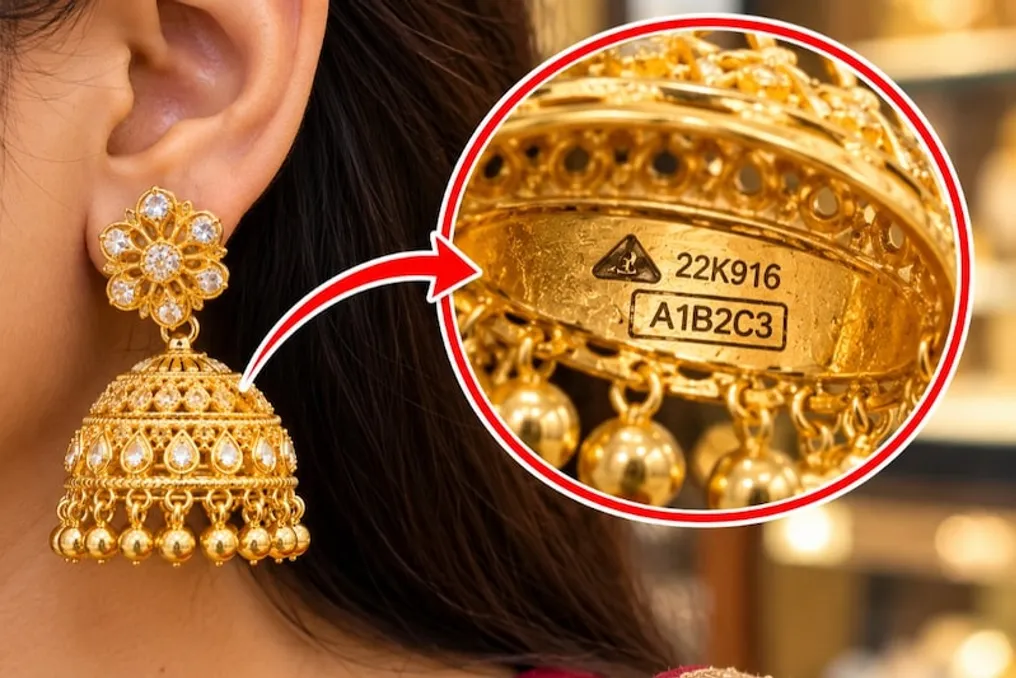
When purchasing gold earrings, buyers often notice that each earring in a pair has its own unique HUID number. Many assume that since the earrings belong to a pair, their numbers should match. However, this is not the case.
According to the rules of the Bureau of Indian Standards (BIS), every jewelry unit in a pair must have a separate hallmark and a unique HUID number. The purpose of this is the individual registration of purity and identification of each item.
What is HUID?
HUID, which stands for Hallmark Unique Identification, is a six-digit alphanumeric code assigned to every hallmarked item. This means that the HUID of one earring will differ from the HUID of the other. According to BIS, this number helps track and identify the jewelry piece. Customers can check it using the Verify HUID function in the BIS Care application.
Why do both earrings in a pair have different numbers?
BIS states that hallmarking is mandatory for each item in a pair. The reason lies in the possibility of replacing one item with another. If both had the same identifier, replacing one part could lead to a breach of purity. Therefore, the identification of both earrings is maintained separately.
Thus, if you bought a pair of 22-carat gold earrings, it is completely normal to see the BIS logo, the purity indication, and different HUID numbers on both earrings. There is no need to worry about this.
What else to consider along with HUID
Jewelry made of hallmarked gold contains three mandatory marks: the BIS logo, the gold purity indicated in carats and fineness, and the six-digit HUID number. For example, 22-carat gold may have a fineness of 916, while 18-carat will have 750, and 14-carat will have 585. Consequently, it is necessary to check not only the HUID but also the information regarding carats and fineness.
How to check HUID?
If you need to verify the information about an earring or another hallmarked jewelry item, you can use the BIS Care application, which contains the Verify HUID function. Through this, you can view details related to the HUID, as well as information about the jeweler.
Another important point is that the requirement to include the HUID number on the receipt is not yet mandatory. According to BIS, including the HUID number on the receipt is voluntary. Nevertheless, the receipt must contain information about the jewelry item, the net weight of the precious metal, carats, and fineness.
Therefore, next time you buy a pair of earrings, if you notice different HUID numbers on both pieces, it is not an error. On the contrary, it is part of the BIS system that allows tracking the purity and identification of each jewelry item individually.