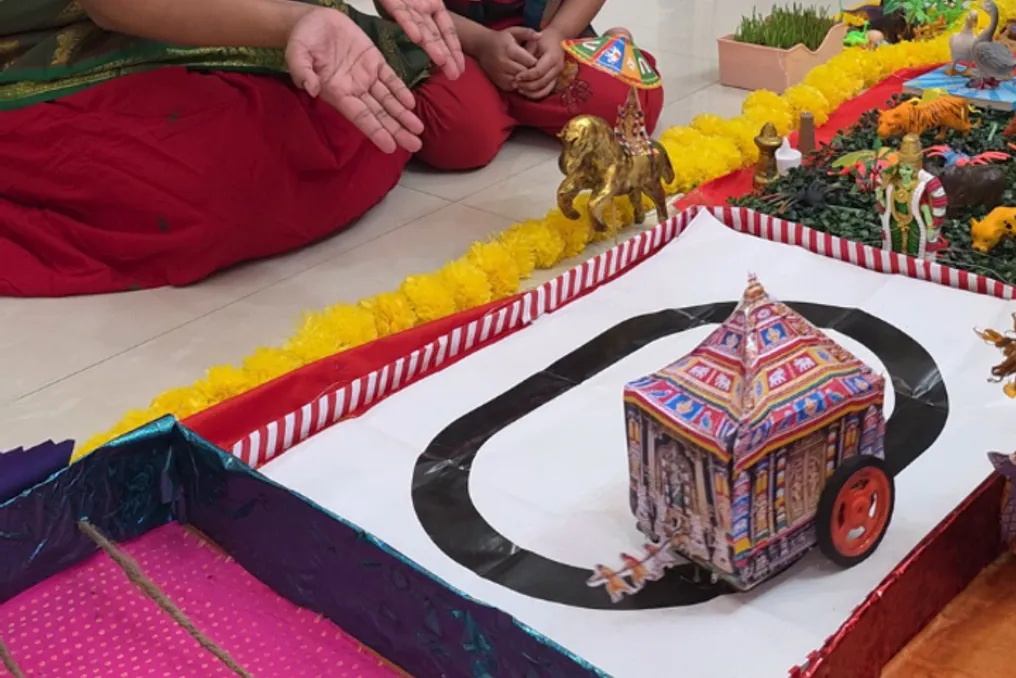
During Navratri, the family decor known as Golu in one household became more than just an exhibition of dolls. Guests can press buttons, observe the movement of the chariot along a set trajectory, and see animated miniature scenes created by the engineer using simple robotics.
Golu is a festive composition of dolls arranged on multi-tiered steps during Navratri, often depicting stories and scenes from Indian culture. This year, the family decided to merge tradition with technology, exploring how simple robotics could make this exhibition interactive.
The idea came from an engineer from IIT Madras, who was previously a member of the Robocon team and the robotics club, helped organize a student technology festival, and enjoyed experimenting with mechanisms at the Innovation Center. Today, she works as an engineer in the wind energy sector and is a working mother.
About fifteen years after graduating from college, she wanted her son to be introduced to robotics while also appreciating Indian culture. She wondered why not combine these two aspects. The family Golu became a platform, and she began designing functional models that brought movement to the traditional scenes, starting work one or two months before Navratri, alongside her job and family responsibilities.
The Menakshi Amman chariot moves autonomously thanks to a line-following robot. Sensors read the marked path on the surface and guide the wheels to keep the chariot on it and move along the route. Krishna's Sudarshana Chakra spins upon pressing a button, while the Samudra Manthan scene—the ocean immersion by gods and demons—is realized on a gear and pinion mechanism that converts rotational motion into linear movement.
A remarkable aspect is the simplicity of the engineering solutions. She aims to demonstrate that robotics does not have to be complex, and that simple concepts, when used creatively, can make traditional exhibitions more engaging and interactive for children. Inspiration comes from two women: her mother, who explores the links between science and traditional ideas, and her mother-in-law, who introduced her to Golu and the stories behind its displays. Children visiting the exhibit were delighted by the working models.
Through this series of projects, she hopes to inspire more women and children to study STEM and to create something. If a festival tradition can become a robotics lesson, what other domestic stories might come alive?
