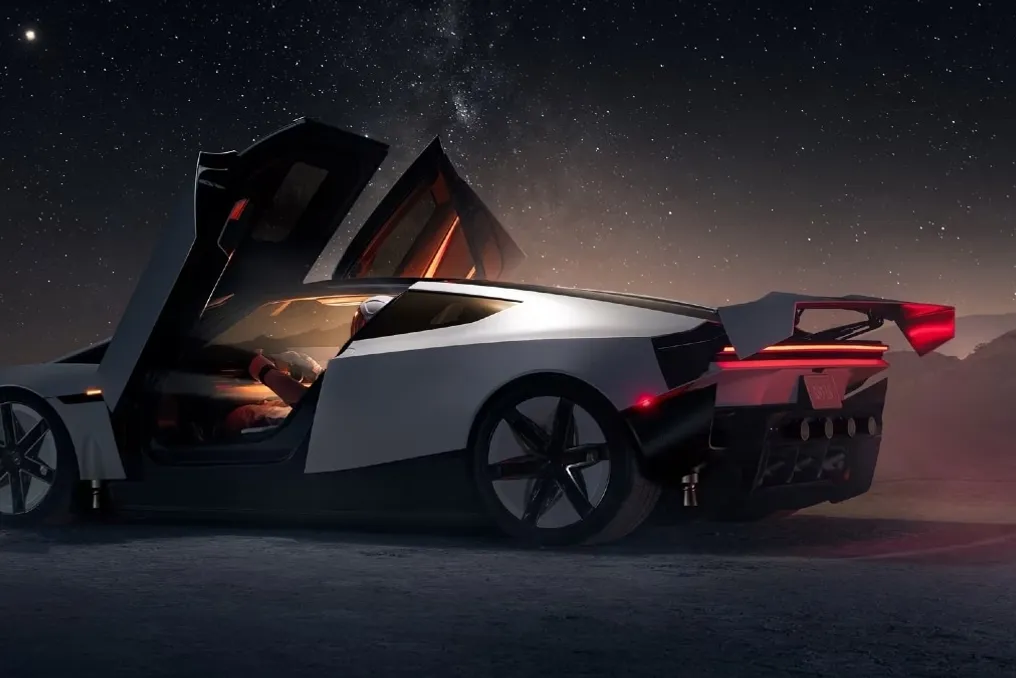
In films, from Hollywood to Bollywood, viewers often see cars flying in the air and performing acrobatic stunts. Many filmmakers achieve such scenes either with professional acrobats or by using visual effects (VFX). However, Tesla, owned by Elon Musk, has demonstrated something resembling a scene from a science fiction movie.
Last Thursday evening, during a live demonstration in Texas, the new Tesla Roadster performed an impressive maneuver: it drove backward down a curved ramp, lifted into the air, and then landed safely on all four wheels, like an airplane. This presentation of the new Tesla Roadster model caused great astonishment among the public regarding the possibility of cars leaving the roads and moving through the air in the future.
Nevertheless, it is important to understand that the ability of a car to fly in the air and create a safe flying vehicle for use on regular roads are two completely different tasks. Although the new Roadster demonstrates the potential of this technology, its practicality and permission for operation on public roads still need to be proven.
Tesla presented three modifications of the Roadster: Roadster, Roadster Thrust, and Roadster Rocket. Among them, the Rocket model is the most advanced and technically complex. Its creation utilized the rocket technology of SpaceX, founded by Elon Musk. This variant is equipped with a special thruster system that helps not only accelerate the car but also lift it into the air and control its direction.
The goal of this technology is not just to increase the car's speed, but also to ensure its ability to be airborne and maneuver in various directions. Tesla has developed three types of systems: the first provides forward motion, the second assists in ascent and course change, and the third creates downward thrust to keep the car close to the road surface.
Usually, when talking about rockets or jet engines, the picture presented is one of fuel combustion and hot gas expulsion. However, Tesla's technology uses compressed cold air, known as Cold Gas Thruster. Lars Moravi, Tesla's chief vehicle engineer, stated during the car presentation that the four nozzles at the rear release air at speeds exceeding the speed of sound. The force generated by this process pushes the car forward.
To understand the principle of operation, one can draw an analogy with a balloon. When air is released from a filled balloon, the air quickly exits, and the balloon begins to move in the opposite direction. Tesla's technology works on a similar principle, but here the air is stored under very high pressure and released through special nozzles. Furthermore, this process does not require burning gas.
The Roadster Rocket is equipped with additional engines in different parts of the car, including those located underneath. These are used to lift the car, as well as to turn left or right in the air and maintain balance. Thus, this system is designed not only for forward movement but also for controlling the car's position in the air.
Additionally, wing-like systems located under the car suck in air from below. This creates downward pressure, allowing the car to grip the road surface firmly. This can be compared to a vacuum cleaner that sucks in air and fixes itself to the surface. Tesla claims that this system generates a force twice the weight of the car, which helps stabilize it at high speed.
Elon Musk, presenting the Roadster for 2026, announced that no special fuel or propellant would be required to operate this car. According to him, the car itself will be able to replenish its air tank autonomously. Musk had spoken about using SpaceX's Cold-Gas Thruster technology in the Roadster since 2019.
In this system, high-pressure air is stored in a special vessel reinforced with a layer of composite material for strength. When necessary, this air is released through the engines. Nevertheless, Tesla has not specified how simple the process of refilling the tank will be in real conditions or how long it will take to prepare the car for normal driving after using this system.
According to available data from Tesla, the Roadster Rocket features two air tanks with a total capacity of about 600 liters. It is stated that these tanks can hold about 250 kilograms of pressurized air. If this volume of air were filled at normal pressure, it would occupy the space of a small two-room apartment. Media reports indicate that the air pressure inside the tanks is about 5500 PSI, which is approximately twice the pressure used in standard CNG cylinders.