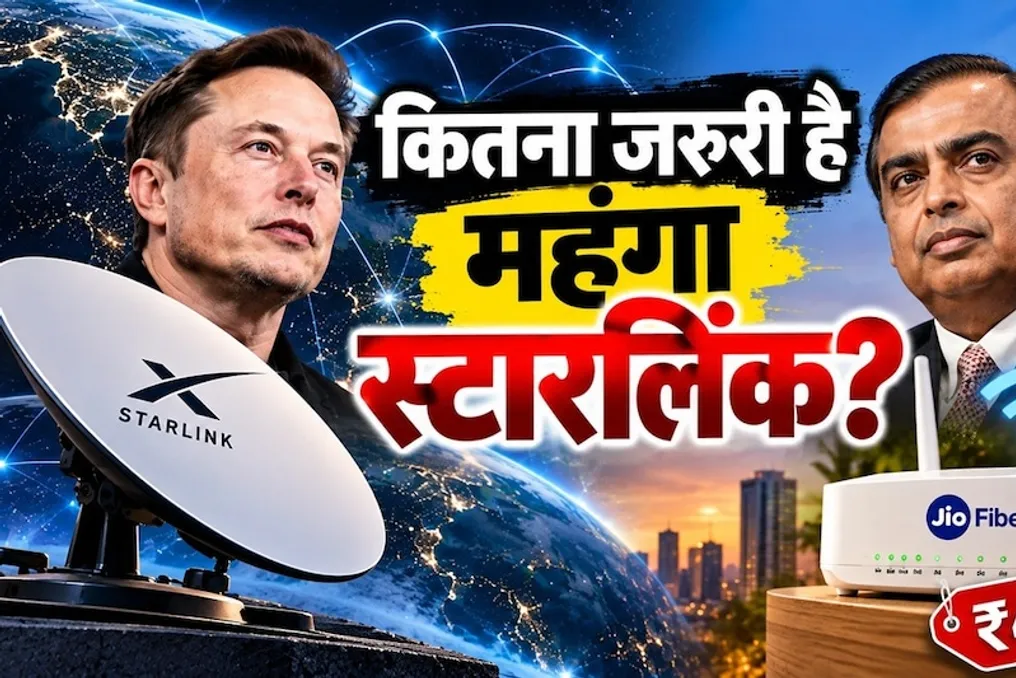
In India, operators Jio and Airtel provide high-speed internet through 5G networks and fiber optic cables in many regions of the country. The initial cost for fiber optic broadband access is 399 rupees, whereas the Starlink service in Chicago, USA, starts from 5499 rupees.
This raises the question of the necessity of satellite internet in India. Previously, Starlink CEO Elon Musk expressed a strong stance regarding India, questioning the local system due to delays in service launch. In response, the Indian government stated that the country's policy is uniform for everyone.
The Indian government announced that three companies, including Starlink and Jio, have received licenses for satellite communication (SATCOM) in India. After these companies undergo security checks, an auction for spectrum allocation will take place.
Following the publication of Elon Musk's post concerning Ambani, Reliance Jio responded with its own post, declaring readiness for competition.
Satellite internet or communication service functions without using mobile towers. It utilizes numerous low Earth orbit satellites to create a coverage area, providing internet access anywhere. The advantage of satellite internet is that it continues to operate even during natural disasters such as earthquakes and tsunamis.
A service similar to Starlink would be useful in remote areas, mountain ranges, small islands, and border zones where laying fiber optic cables is impossible. In places where cable laying is difficult, satellite communication becomes extremely in demand.
Many parts of India still lack fiber optic cable coverage. Changes in weather conditions, mountainous terrain, or landslides often lead to damage to fiber optic lines, causing frequent communication outages. In such inaccessible locations, a service like Starlink would be very useful.
Elon Musk granted Starlink a license to operate in India, and after obtaining all necessary permissions, the company can begin providing services in the country. However, official information on prices in India has not yet been released. In Chicago, USA, the initial monthly plan costs 55 US dollars, which is equivalent to approximately 5224 rupees.
In cities like Delhi-NCR, there already exists fiber optic infrastructure that provides a high level of internet speed for both businesses and residents. Fiber optic connection guarantees a stable connection, low latency, and good download speed. Furthermore, Jio offers an initial fiber optic broadband connection for only 399 rupees, providing a speed of 30 Mbps.