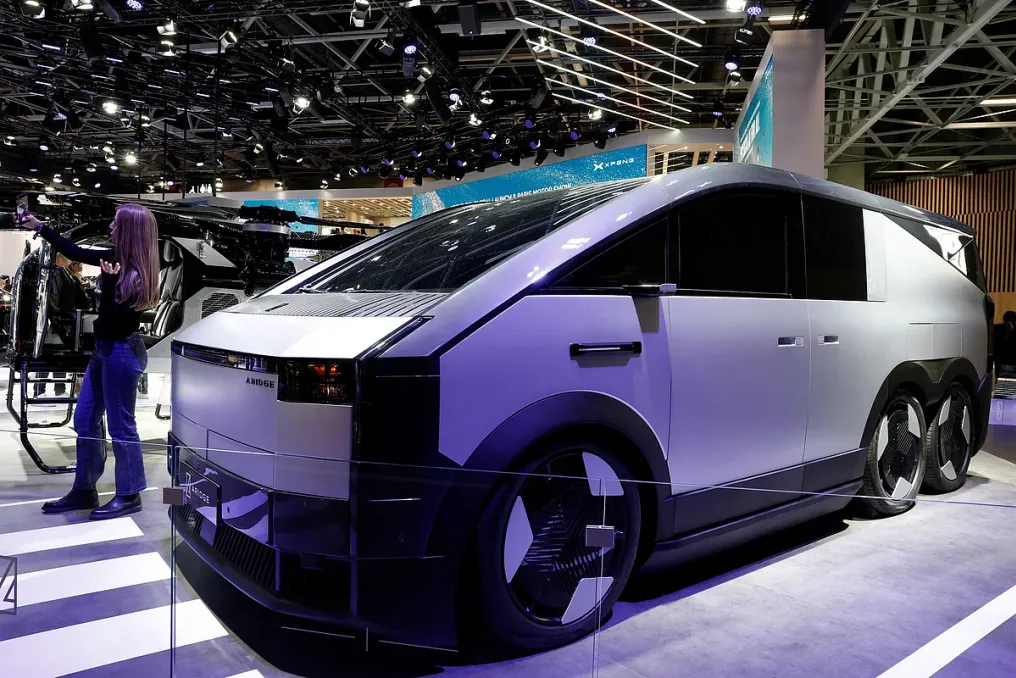
Aridge is targeting consumer deliveries of its flying car for the end of 2027 as the company progresses toward completing certification in China and prepares to begin trials in the United Arab Emirates (UAE).
Mikhail Du, Aridge's CFO, told Khaleej Times during the Dubai Business Forum in Shenzhen, China, that the aircraft has undergone test flights approved by Chinese authorities and awaits final type certification.
Last month, the company signed an agreement with Ras Al Khaimah to establish a regulatory sandbox, which will allow for thorough testing of the aircraft before it is presented to the general public.
The company expects to commence test operations in the UAE as early as early 2027, provided the details of the Ras Al Khaimah regulatory sandbox are finalized and the import of the aircraft into the country is organized.
Du emphasized that the key factor is not only the product itself but also the operational environment. He explained that authorities will require time to develop regulations for operating new aerial vehicles.
The program is planned to be implemented gradually over the next six to twelve months, giving local authorities the opportunity to develop working procedures and adapt existing norms to advanced air mobility.
According to Du, Ras Al Khaimah is chosen as a starting point because it has fewer densely populated areas than Dubai. Ultimately, the company aims to expand its presence across the UAE, including demonstration routes connecting emirates such as Abu Dhabi and Ras Al Khaimah.
Du noted that under an ideal scenario, consumer deliveries could begin at the end of 2027; however, timelines might shift to early 2028 depending on the pace of regulatory and operational environment development.
He added that 'the sandbox is essentially a reliable path leading to the final delivery of a commercial product.'
'Land Aircraft Carrier' from Aridge consists of two components: the aircraft itself and the vehicle in which it is housed. This system is designed so that users can drive to their destination, park, and then take off in the aircraft for shorter flights. The company positions this as a modular flying car system intended for personal and recreational use.
The aircraft module, known as X3-F, has reached the TIA stage in the Chinese certification process. The company has also completed government-approved test flights, although the final type certificate has not yet been obtained.
According to Du, Aridge received over 300 pre-orders by last year. He stated that the company believes annual deliveries could eventually reach several hundred units and potentially approach 1000, even though the product is not yet actively sold in the UAE.
Du suggested that the 'Land Aircraft Carrier' might enter the market sooner than the company's larger electric aircraft, which are designed for longer intercity travel.
A separate aircraft, the A868, is designed to carry up to six people, including the pilot, with a claimed range of 500 km and a maximum speed of 360 km/h. Du mentioned that it could serve routes like Dubai—Abu Dhabi, in a segment overlapping with other companies developing electric air taxis.
Unlike these larger craft, the 'Land Aircraft Carrier' is intended for short recreational flights and can help authorities gain experience in regulating and operating advanced air mobility services before the introduction of more complex aircraft.