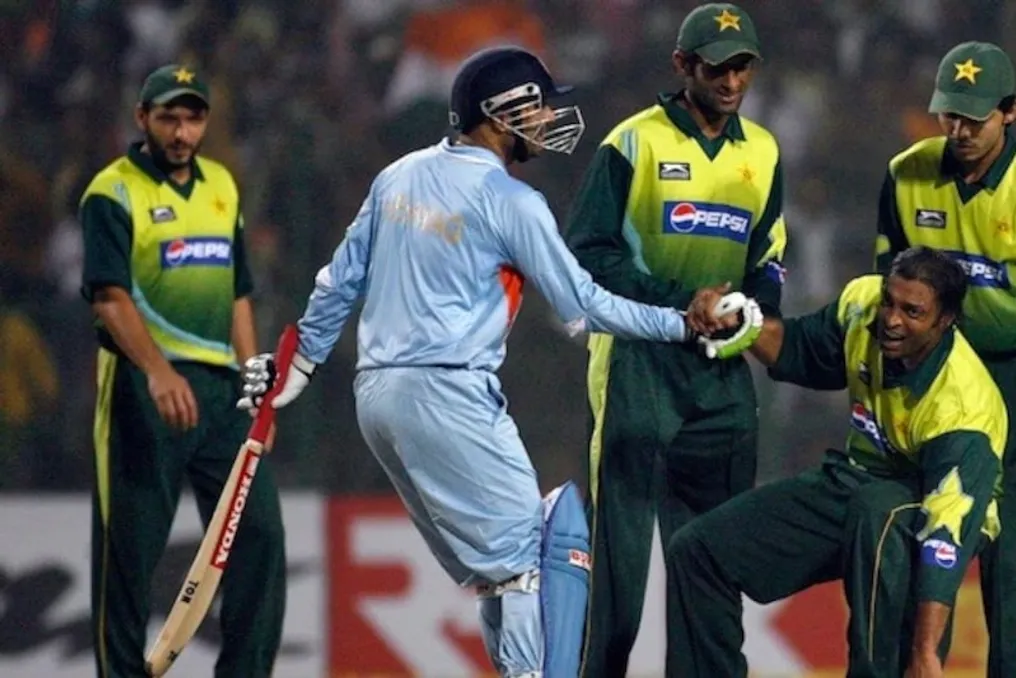
The history of confrontations between Indian and Pakistani teams has always been characterized by an atmosphere of high tension and spectacular clashes, including verbal battles between players.
October 20 marks the 48th birthday of Virendra Sehwag, a former opening batsman for the Indian national team. Throughout his 14-year career, Sehwag demonstrated mastery, dealing significant damage to many prominent world cricketers.
Sehwag usually played at his own pace on the field, but when any player tried to throw him off balance, he responded to provocations both verbally and with his bat.
One of the well-known and memorable episodes involves Pakistan's fast bowler Shoaib Akhtar. During one match, Akhtar attempted to disrupt the Indian batsmen with his speed, but Sehwag successfully directed his balls all over the field.
Annoyed by this, Akhtar began bowling constant bouncers at Sehwag, constantly teasing him with the phrase: 'If you can, show me a hook shot.' Sehwag, who was playing openly, singing and whistling, soon realized that Akhtar was provoking him.
Initially, Sehwag responded calmly, asking if he was bowling or begging. However, when Akhtar insisted and challenged him to play a hook shot, Sehwag gave him a harsh reply that is still discussed in cricket circles.
Responding decisively to Akhtar, Sehwag pointed towards the non-striker's end and stated that his father was standing there. He challenged: 'If you dare, ask him, he will play a hook shot.' At that moment, Sachin Tendulkar, the Master Blaster, was at the non-striker's end.
After this, when Sachin came to the crease, Akhtar bowled another bouncer at him, which Sachin brilliantly deflected and sent out of the stadium for a sixteen runs. After this powerful shot, Sehwag approached Shoaib Akhtar and mockingly said: 'Son, son remains a son, and father remains a father.'
Virendra Sehwag's international career was exceptionally successful. Analyzing his Test results, it is clear that he scored 8586 runs in 180 innings played in 104 matches, with an impressive average of 49.34. His best individual score was 319 runs. In Tests, he maintained an aggressive style of play, scoring 23 centuries and 32 half-centuries at a strike rate of 82.23, and hitting 1233 fours and 91 sixes.
In One-Day International (ODI) format, Sehwag also displayed magnificent play. In 245 innings played in 251 ODI matches, he earned 8273 runs with an average of 35.05 and an explosive strike rate of 104.33, including his double century (maximum 219 runs). In ODIs, he scored 15 centuries and 38 half-centuries, and hit 1132 fours and 136 sixes.
Furthermore, in 19 T20 International matches, he scored 394 runs at a strike rate of 145.38.