Dream Labs has raised $90 million in seed funding to create artificial intelligence intended for use in everyday robots. The San Francisco-based startup was founded in 2026 by former leaders of NVIDIA's GR00T research group.
The funding round was led by B Capital and Kindred Ventures. Other investors included A. Capital, Unusual Ventures, SV Angel, Wing VC, Scribble VC, and Adrian Aoun. The company believes that robots often face a problem similar to humans: they are trained for one specific task but cannot apply the acquired skills in other areas.
Dream Labs aims to create more flexible robots using a unified AI model. Such a system would allow it to perform new tasks or work with new equipment while requiring less expertise. CEO Joel Zhang noted that there is sufficient capable hardware in the industry, but there is a lack of intelligence that could function across different robots.
In addition to raising funds, Dream Labs introduced Dream API. This service converts video streams from a robot's camera and instructions given in simple English into motor commands. Developers can use this service to program supported robots without needing to build their own AI.
Furthermore, the company launched Fine-tuning as a Service. Developers and robotics manufacturers can upload demonstration data to receive a custom-tuned model for unequipped or new functions. The technology can also be tested via Robot Playground.
Any user with a browser can send commands to a physical robot at Dream Labs' office in San Francisco and observe the reaction in real time. These products aim to make robotic AI more accessible to developers and manufacturers, and also give potential users the opportunity to test the technology before large-scale implementation.
The company's flagship model, Dream-1, is trained on videos of people performing routine actions. It uses visual information to predict subsequent events and determine the robot's action. Dream-1 is designed to transfer capabilities between different hardware.
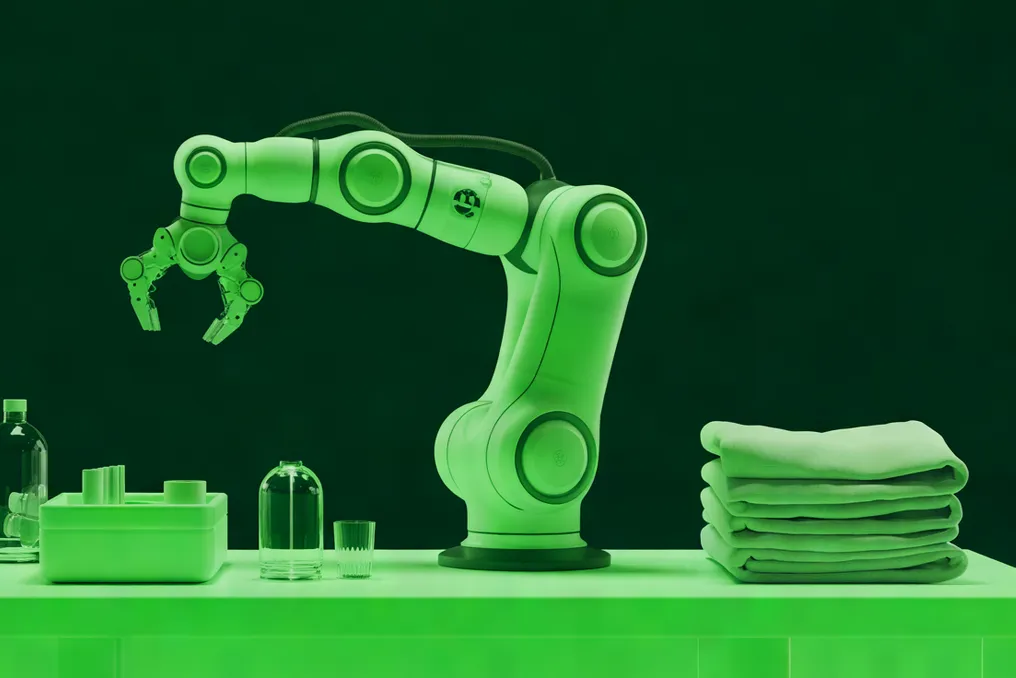
The company claims it can control compatible robots equipped with grippers without additional task-specific training. Dream Labs currently collaborates with over 20 hardware partners. The model is capable of performing desk tasks such as picking up items, placing objects, and folding laundry.
Support for wheeled mobile robots and more dexterous robotic arms is planned. General Partner Daisy Kai of B Capital stated that the reduction in equipment costs opens up opportunities for the development of robotic intelligence. She believes that accessible software will help developers create more useful applications on existing machines.
Dream Labs plans to direct most of the new capital toward developing computational infrastructure. These investments will support more users and expand the range of tasks and types of robots that Dream-1 can handle. Although the potential is significant, the researchers' approach still requires validation in real-world conditions.
Hundreds of millions of industrial robots operate worldwide, but most of them are limited to only a few tasks in specific environments. If the model works reliably with all machines, it could simplify production automation and other processes for companies. Furthermore, it could reduce the number of systems firms need to develop to accommodate various robots. However, Dream Labs' technologies must demonstrate their functionality in diverse conditions, as well as with different types of equipment and more complex applications.