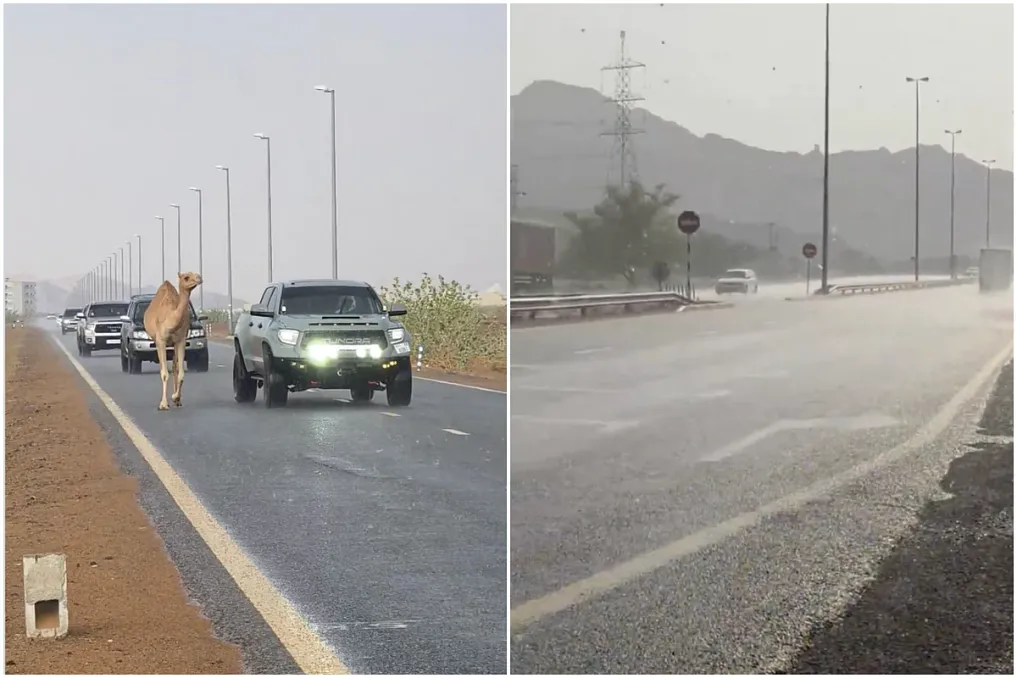
Parts of the United Arab Emirates (UAE) experienced heavy rainfall on Monday, October 19. Hail was observed in Fujairah, while in Sharjah, a camel was seen calmly walking down a wet road.
Video footage published by the Storm Centre demonstrates the fall of hail and rain in Murbad and Masafih, Fujairah, where the downpours brought a welcome change in weather.
In Sharjah, rains passed through the Al Madam and Margam areas. Drivers were not the only ones navigating the wet roads; in one location, a camel was spotted walking along the road in the rain, seemingly enjoying the stroll amidst the downpour.
These scenes occurred after the UAE had forecasted rain in parts of the country for Monday, and the downpours altered weather conditions in several areas.
The National Center of Meteorology (NCM) previously warned that the UAE might see above-average precipitation in the coming months due to the expected persistence of the El Niño climate phenomenon until early 2027.
Recent climate forecasts indicate a 96% probability that El Niño conditions will last until March 2027, with temperatures and rainfall potentially exceeding the average levels in the UAE. This phenomenon is predicted to peak in October and November 2026, when the Niño 3.4 index approaches +3°C, indicating a very strong event.
Nevertheless, El Niño itself does not guarantee extreme rainfall, storms, or flooding in the UAE; its impact depends on the region and season, as well as local weather systems.
NCM also refuted viral claims on social media linking El Niño directly to severe flooding and unusually heavy rainfall, strongly urging residents to rely on official weather forecasts and warnings.
Earlier this year, NCM meteorologist Ahmed Habib told Khaleej Times that the influence of El Niño on the UAE could become more noticeable in autumn, particularly in October and November. Habib noted: 'From autumn, especially in October and November, the influence of El Niño will be felt over our region. Currently, during the summer season, its influence is stronger in East Asia than in West Asia.'
He added that this phenomenon is capable of increasing humidity over the UAE and raising the probability of precipitation, depending on local weather conditions.