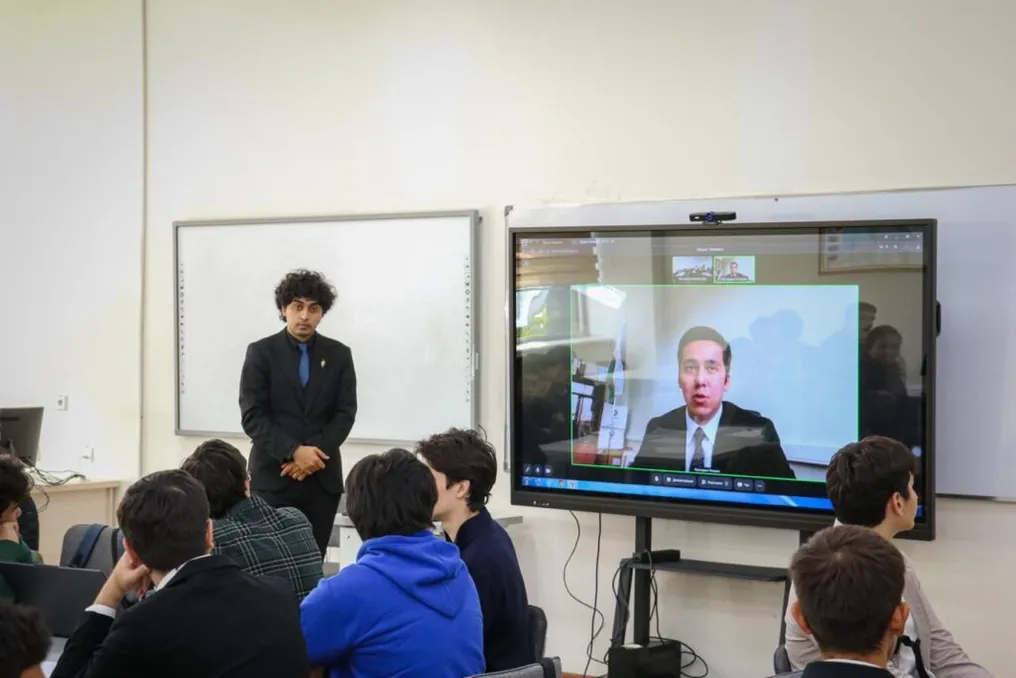
A youth nuclear dialogue was held in Tashkent, where participants discussed a wide range of topics, including microreactors, nuclear technologies for space, and methods for popularizing nuclear energy among the general public.
The event took place on October 9 as part of the international initiative Impact Team 2050 and gathered students, young scientists, representatives of relevant agencies, industry organizations, and youth associations.
Mukhidden Umidov, representing Uzbekistan in the International Youth Advisory Council of Impact Team 2050 under the General Director of Rosatom, shared details of the meeting.
The meeting began with informal discussions between young people and leaders in the nuclear sector. Azim Ahmedkhadzhayev, Director of Uzatom Agency, decided to forgo a long welcoming speech and focused on the needs and expectations of the students. He emphasized that the current generation of young specialists has a unique chance to participate in shaping the industry, becoming not just employees but creators of the atomic industry of new Uzbekistan.
A significant moment was the team assignment: participants first had to identify the difficulties they face when choosing nuclear professions and building a career, and then propose possible solutions to the experts. The discussed aspects included education, career paths, professional orientation, the state of regional infrastructure, and public perception of nuclear energy.
A distinctive feature of the dialogue was the heightened interest of students in advanced engineering fields beyond traditional work at NPPs. Mukhidden Umidov noted that he was pleased by the participation of students from various educational institutions, as they were concerned about automated process control systems, modeling, and microreactors. Questions about the application of nuclear technologies in the space field were also raised, which surprised him.
Students from the Tashkent Branch of NUPI MEPhI, Tashkent State Technical University named after I. Karimov, the 'New Uzbekistan' University, and other educational institutions, as well as future teachers, participated in the dialogue. Umidov considers such participation natural, as training personnel for nuclear energy must begin long before entering a specialized university. A strong school foundation in mathematics, physics, and foreign languages is critically important for successfully mastering engineering disciplines, nuclear physics, and NPP operation, which directly influences the formation of future industry workers.
Participants also touched upon topics such as gaining practical experience, internships, and interaction with industry organizations, which is particularly relevant against the backdrop of the development of nuclear power generation and personnel training for future facilities in Uzbekistan.
Another topic of discussion concerned public attitudes towards nuclear energy. Umidov stressed that technical knowledge alone is insufficient; a future specialist must be able to explain complex technologies to people without corresponding education. At the meeting in Tashkent, participants discussed how to raise awareness about professions in the nuclear sector and simplify technical explanations for young people.
According to Umidov, although the nuclear industry has its own professional information space, it can be difficult for outsiders to understand the technical nuances. Meanwhile, the Uzatom Agency and the MEPhI Tashkent Branch are already conducting informational work on social networks. Participants suggested strengthening the use of these platforms and making the content more accessible to young people, with some even mentioning humor and memes despite the seriousness of the subject, as it is difficult to interest a non-specialist with complex technical data.
Parallel to discussing new communication formats, Azim Ahmedkhadzhayev reminded everyone of the extremely high requirements for employees in the nuclear industry. He stated that the nuclear field does not tolerate carelessness, demanding not only deep knowledge but also exceptional discipline, inner maturity, and a high level of safety. He needs leaders capable of continuous learning and understanding the consequences of every decision made.
International cooperation was also on the agenda. Dmitry Konstantinov, Deputy General Director of Rosatom Central Asia, emphasized the importance of experience exchange, joint youth projects, and internships for training specialists. Mukhidden Umidov himself is gaining such experience: after graduating from the Tashkent Branch of NUPI MEPhI, he continues his studies in the Master's program at the Obninsk Institute of Atomic Energy (IAAE), where he studies NPP operation, while simultaneously representing Uzbekistan in the Impact Team 2050 international advisory council.
One of the council's initiatives is to hold a series of national youth nuclear dialogues in 16 countries this autumn. The results of these meetings will be compiled into a roadmap with recommendations for eliminating barriers to choosing nuclear professions. This document is planned to be presented to Rosatom General Director Alexey Likhachev at the sidelines of the UN Climate Conference COP31 in Antalya in November.
For Umidov, participation in the international council aims to expand the opportunities for young Uzbek specialists and their integration into the professional community. He expressed a desire for young Uzbek specialists to have the opportunity to voice their ideas on the world stage and communicate with colleagues from other countries. In this regard, the idea of creating a national youth team for Impact Team 2050 is being considered to unite young people interested in the development of the nuclear industry in Uzbekistan.
Although the Tashkent dialogue has concluded, work on participants' proposals continues, and it is now necessary to determine which of them can receive practical implementation to expand opportunities for youth in education, professional growth, and participation in industry projects.