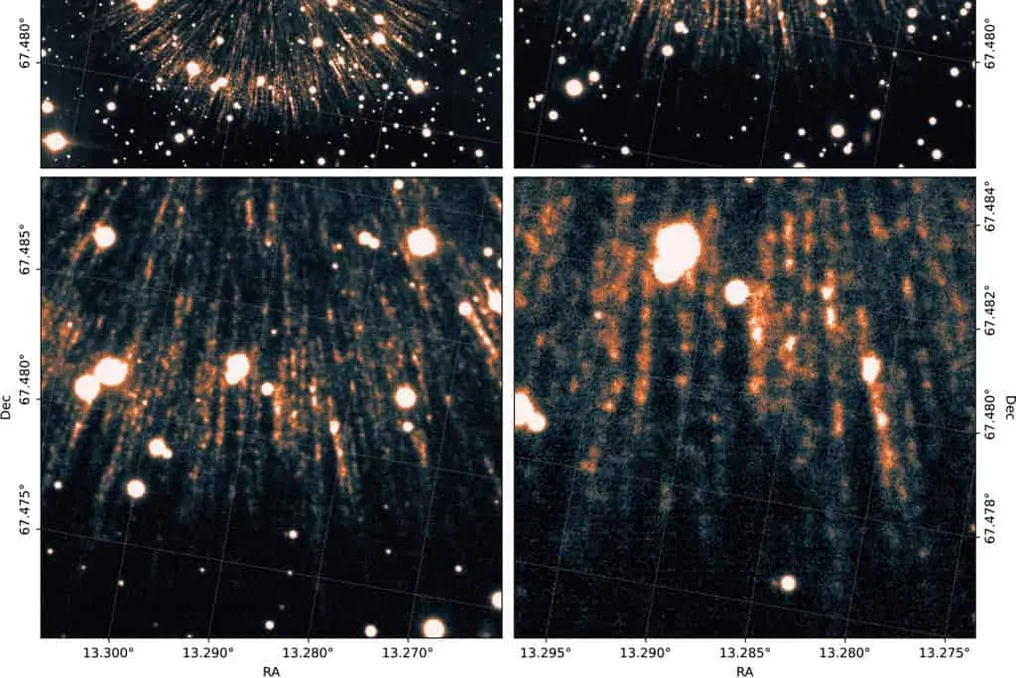
A living star that survived its own explosion almost 850 years ago continues to generate scientific interest. New images obtained with the Gemini North telescope in Hawaii have revealed unprecedented details of the supernova remnant Pa 30, which is linked to an astronomical event observed by Japanese, Chinese, and Arab astronomers in 1181.
The study, published in The Astrophysical Journal, demonstrates structures of ionized gas forming filaments and clusters with unusual uniformity. Another aspect attracting researchers' attention is the location of the surviving star, which remains almost at the center of the debris despite the immense power of the explosion.
Pa 30 is located about 7,500 light-years from Earth, making it relatively close on an astronomical scale. This proximity allows for the study of characteristics that would be difficult to detect in more distant remnants.
The new pictures were taken by the Gemini North telescope, which is part of the International Gemini Observatory, alongside its counterpart Gemini South located in Chile. The recordings show red filaments of ionized sulfur and blue-green filaments of ionized oxygen.
Observations of sulfur allowed for the identification of approximately ten times more filaments than previous images could distinguish. Researchers also noted that these structures are not merely continuous bands of gas; they consist of sequences of small clusters resembling strung pearls.
According to Ilaria Caiaccio, assistant professor at the Austrian Institute of Science and Technology and co-author of the study, each of these clusters is large enough to accommodate roughly ten times the size of the Solar System's planetary region, with ample space to spare.
The regularity of these structures is one of the topics the team plans to investigate. Scientists aim to develop models capable of explaining how the stellar explosion generated such similar clusters.
Pa 30 is associated with a Type Iax supernova—a rare category of stellar explosion that is less energetic than other supernovae. In this type of event, the explosion may be incomplete, leaving behind a surviving star informally called a 'zombie star.'
The hypothesis put forward by the researchers is that this phenomenon arose from the collision of two white dwarfs. These objects are extremely dense stellar remnants that have exhausted their fuel and lost their outer layers.
Pa 30 is the only known remnant of this type in the Milky Way. Although astronomers have discovered similar objects in other galaxies, this is the only case where a surviving star has been observed at the center of the structure.
In many supernovae, the explosion can be asymmetric and fling the surviving star away from the event site. However, in the case of Pa 30, the star remains almost at the center of the ejected material cloud.
This feature poses a problem for scientists. Since explosions retain momentum, a perfectly symmetric release of matter should not impart a significant push on the remaining star.
Caiaccio reported that the team managed to establish a precise upper limit on the star's transverse velocity, i.e., its apparent motion across the sky. The result shows that this displacement is surprisingly small.
Scientists still cannot fully explain the combination of the star's central position and the uniformity of the gas clusters. The team intends to use the features of Pa 30 to search for other Type Iax supernova remnants in the Milky Way and nearby galaxies.
Researchers also hope that new telescopes and astronomical surveys will allow them to discover similar objects that have not yet been recognized. Studying Pa 30 may help compare these candidates and distinguish the remnants of unusual stellar explosions.