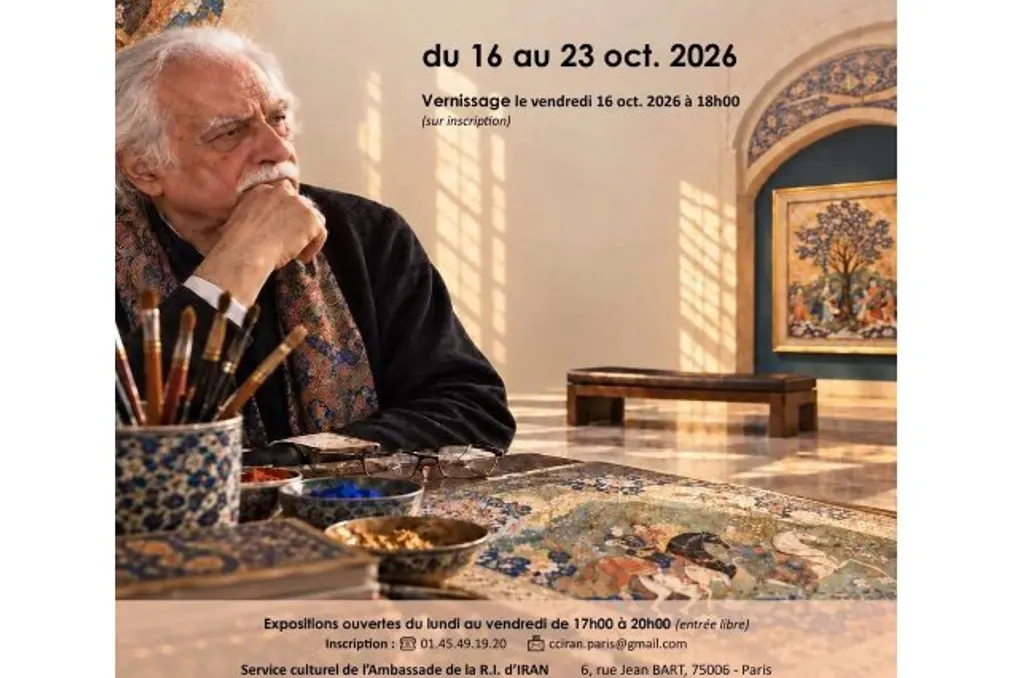
An exhibition of selected miniature paintings by the late master Mahmoud Farshchian has opened in Paris. The exhibition began on Friday at the Cultural Attaché in France at the Embassy of the Islamic Republic of Iran and will last for one week.
According to ILNA, this is the fourth and final cultural and artistic event planned by the Iranian embassy as part of its weekly cultural program for October. The opening ceremony gathered both Iranian and international connoisseurs of Iranian art and cultural heritage, as well as ambassadors of the Islamic Republic of Iran in France and UNESCO.
Overview of Farshchian's Style and Creativity
During the first day of the event, historical styles and periods of Iranian miniature art and its prominent masters were presented and explained. A video was also shown that told about Farshchian's works, his unique artistic features, his wide recognition among Iranians and foreigners worldwide, as well as his unprecedented success on the international stage.
Mahmoud Farshchian, born in 1930 in Isfahan, was recognized as one of the most significant figures in modern Iranian art. He was famous for his exquisite works inspired by Persian literature and religious texts.
His work is characterized by complex mastery, as it combines traditional techniques of Persian miniature with innovative elements that give new life to classical themes. His art vividly conveys the soul of Persian poetry, religious stories, and spiritual symbolism, creating compositions that are simultaneously striking in their beauty and carry deep meaning. Farshchian's mastery lies in the delicate balance between tradition and innovation—he creates bright, fluid lines, circular motifs, and dynamic colors that evoke emotion and transcend cultural boundaries.
Throughout his brilliant career, Farshchian's works traveled around the world, being exhibited in prestigious cities such as Paris, New York, Chicago, and Tokyo. Many of his canvases were gifted by Iranian officials as symbols of Iran's rich cultural heritage. His contribution earned him numerous awards, confirming his status as a national treasure.
Through detailed elaboration, dynamic compositions, and masterful use of color and symbolism, he transforms the canvas into a sacred space where sorrow and hope intertwine. These paintings not only preserve the historical memory of Karbala but also remind us of the eternal lessons of faith, justice, and resistance to oppression.
Farshchian's influence extended beyond his brush. He taught and served as director at the Faculty of Fine Arts at Tehran University, shaping generations of artists who continue to develop his artistic vision.
Despite international recognition, Farshchian remained true to his Iranian identity. His art drew inspiration from Persian poetry, the Quran, as well as the sacred texts of Christianity and Judaism, thereby creating a universal language of spiritual art. His ability to unite tradition and modernity won worldwide admiration; for instance, the Italian art critic Umberto Baldini called him a 'phenomenon and a turning point in Iranian art.'
He made a significant contribution to promoting Iranian art internationally, often giving lectures at universities and cultural institutions around the world. Many books and scientific articles have been published about his works, cementing his legacy as an artist-master. Furthermore, his name has been included in the list of 2000 outstanding intellectuals of the 21st century by the UK, and collectors consider it an honor to own his creations.
Previous exhibitions held at the Iranian embassy in Paris included exhibitions such as 'Ancient Iran: History and Civilization,' 'Iran Today: Art, Culture and Innovation,' and the art exhibition 'Windy Dreams,' dedicated to the memory of children of the Shajare Tayebeh school in Minab and other children killed as victims of recent US aggression against Iran.
This series of exhibitions aims to introduce the audience to various aspects of Iranian culture, art, history, and civilization, as well as to promote dialogue, mutual understanding, and appreciation between the two peoples and cultures.