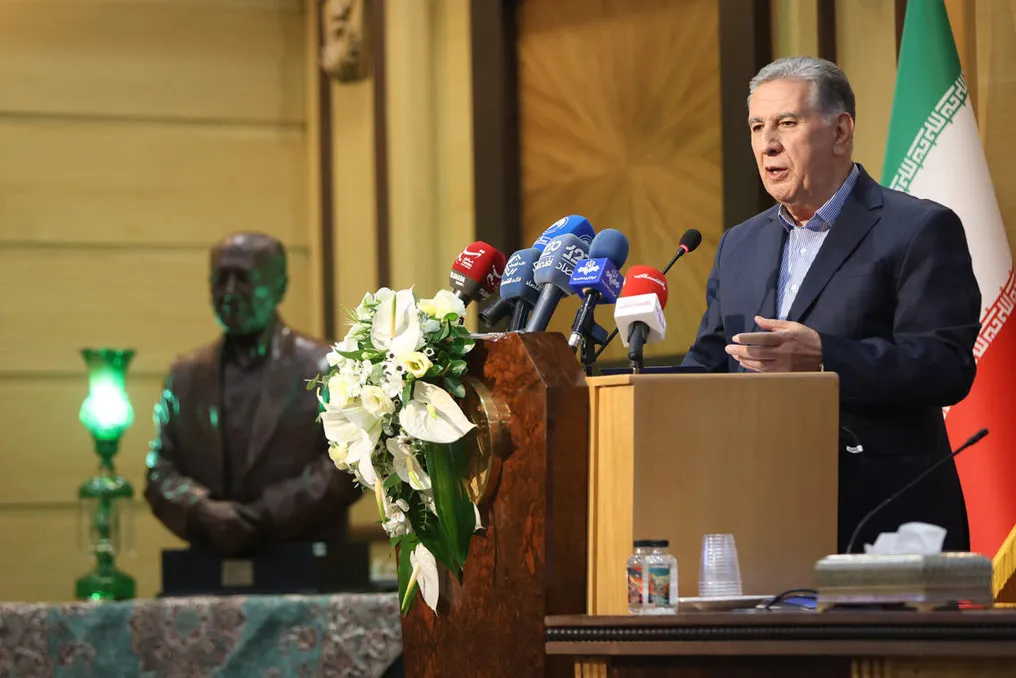
The President of the Iranian Chamber of Commerce, Industry, Mining, and Agriculture stated that the National Export Day this year should be an opportunity to rethink the sustainability of the country's foreign trade.
Samad Hassanzadeh, the Chamber's president, noted at a meeting of the Council of Representatives of the Iranian Chamber that amid maritime restrictions imposed by an hostile adversary, reducing export vulnerability is possible through diversifying transport routes, activating land and rail corridors, strengthening border trade, utilizing alternative ports, and developing regional distribution mechanisms.
He added that the National Export Day ceremony will discuss what steps economic enterprises must take in the country's difficult economic conditions to ensure continuous export of goods, despite most logistics routes being affected by restrictions imposed by the hostile adversary.
Hassanzadeh emphasized that today economic entities need to look at other markets and new conditions of the international economy. He noted that it is no longer enough to simply demand timely receipt of export revenue from officials; now economic players must interact with traders from different countries and develop new methods for promoting goods and forming international partnerships.
Expressing hope that all economic entities will play their role to the best of their ability alongside state policy and national programs to maintain production and preserve employment, the official stressed that the private sector must make every effort to ensure a continuous flow of exported goods via available routes.
The Chamber President also stated that despite the difficulties, he firmly believes that all officials are working around the clock to solve problems, especially in the economic and production spheres, and are making every effort so that the Iranian nation and the blessed Islamic Republic of Iran can stand with dignity and authority against the hostile adversary. Therefore, they hope that the problems will be resolved in the country's interest as soon as possible so that people and officials can carry out their duties in an atmosphere of peace, security, and tranquility.
Samad Hassanzadeh, referencing the participation of the Iranian Chamber delegation in the African Commerce and Industry Summit (ACIS 2026), reported that parallel to attending the summit, meetings and negotiations were held with the Minister of Trade and Investment of Kenya, the President of the Kenyan Chamber, and other chamber heads from various African countries present at the summit.
Noting that African countries are mainly consumers and do not possess sufficient production capacity, he stated that the economic activity and government officials of Kenya are very interested in expanding economic ties with Iran. To expand Iran's presence in African markets and determine avenues for presence, appropriate expert work and study are necessary.
The Chamber President announced preliminary negotiations on determining a venue for Iranian companies interested in being present in the African market. The determination of this location for showcasing and offering Iranian products is being considered by the Ambassador of the Islamic Republic of Iran in Kenya, and the results of the review will be announced to economic entities.
Hassanzadeh noted that given the restrictions created by sanctions on Iran's commercial activities in other countries, opening a trade route with Africa could be a very profitable horizon for the foreign trade of the Islamic Republic of Iran.
He described the volume of trade between Iran and African countries as very small, despite Iran's potential, and emphasized that with proper planning, Iran is capable of occupying a significant share of Africa's foreign trade.
The President of the Iranian Chamber also mentioned the Board of Directors' decision regarding the Chamber's role in social responsibility. During the trip of the Board of Directors and the group of chamber presidents in Yasuj, shortcomings in the educational sector were identified, and it was decided that the Iranian Chamber would prepare a charter for building business schools in the 10 least developed provinces in the education sector.
In conclusion, he reported that according to the report of the Abrar Charitable Center, 10 provinces need educational space, and they will prepare a corresponding charter in the Board of Directors and approve it in the Council of Representatives, inviting the presidents of provincial chambers to submit any proposals to the Iranian Chamber's Board of Directors for taking necessary measures to select these provinces.