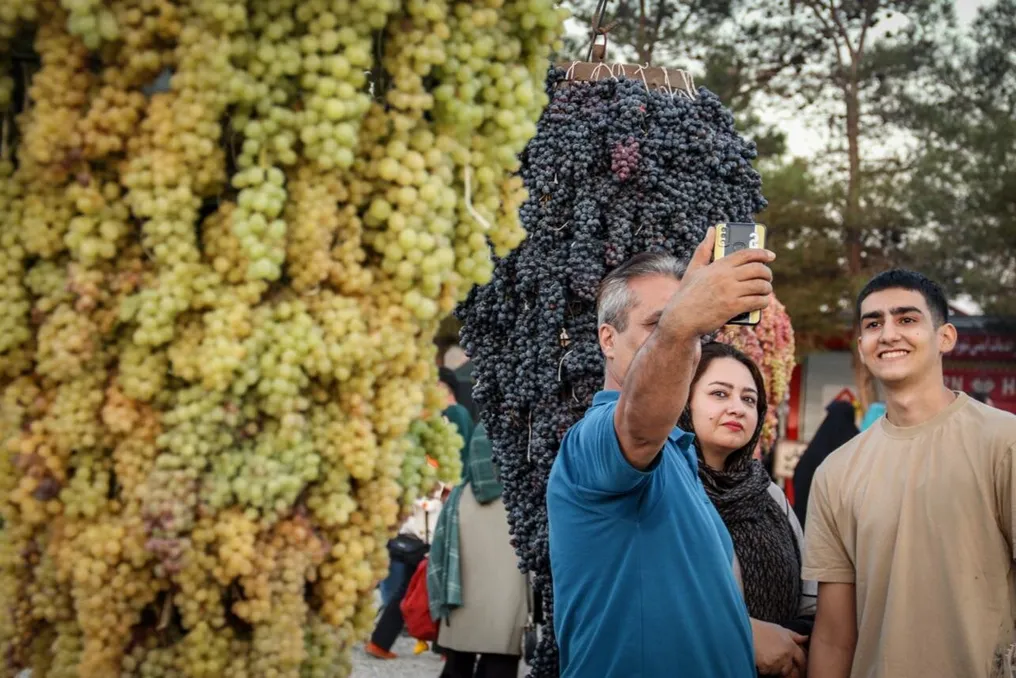
The Grape Festival, held in various grape-growing regions of Iran from August 21st to September 21st, is a traditional harvest celebration whose roots are believed to date back to ancient times—about 3000 years ago.
When the grapes reach full ripeness, this festival offers travelers an opportunity to experience Iran's agricultural traditions, folk culture, and living intangible heritage.
The festival is particularly closely associated with Urmia and the villages of West Azerbaijan, where the traditional grape festival and the preparation of doushab-pazan—a process of making grape juice and thick grape syrup called doushab—are registered as national intangible cultural heritage.
It is believed that this tradition originated in ancient times as an expression of gratitude for the grape harvest, and was later continued among Christian and Armenian communities in the region.
According to Visit Iran, the festival took place in villages such as Gerbabad, Digaleh, Resimanabad, Goshti, Jamalabad, and Gulan, while local communities maintain their own customs.
Historically, grapes were considered a blessing, and some communities refrained from consuming the first berries of the harvest until the ceremony. Caution was also observed during the harvest to prevent the berries from falling to the ground, reflecting the belief that wasting the fruit was an act of disrespect.
In the Urmia region, celebrations traditionally take place near vineyards and Lake Urmia. The Il Bashi, or tribal leader, plays a central role by opening the ceremony with words of thanks and a special prayer in Azerbaijani, followed by a translation into Persian. Traditionally, the leader is accompanied by four women symbolizing earth, water, air, and fire, as well as a young boy and girl symbolizing the continuation of life.
Children distribute grapes to participants as a blessing. Prayers are offered for the protection of vineyards and crops against hail, storms, and floods, after which the traditional pressing of grape juice using specialized tools and equipment takes place.
Subsequently, the festival transforms into a lively public celebration. Part of the festivities includes local wrestling competitions, Azerbaijani folk songs such as Kushmaj and Bayati, and traditional dances. The collective dance Yali, performed by participants standing in a line, symbolizes unity and cohesion.
Visitors can also see exhibitions and contests related to dried grapes and other products, including grape juice, vinegar, and raisins.
For travelers, the Grape Festival offers more than just a seasonal event. It is a chance to visit vineyards, meet local people, and witness traditions that connect agriculture with music, food, faith, and collective memory. Taking place during the transition from summer to autumn, this festival provides a unique way to discover the cultural landscape of northwestern Iran and the sustainable traditions of communities around Urmia.