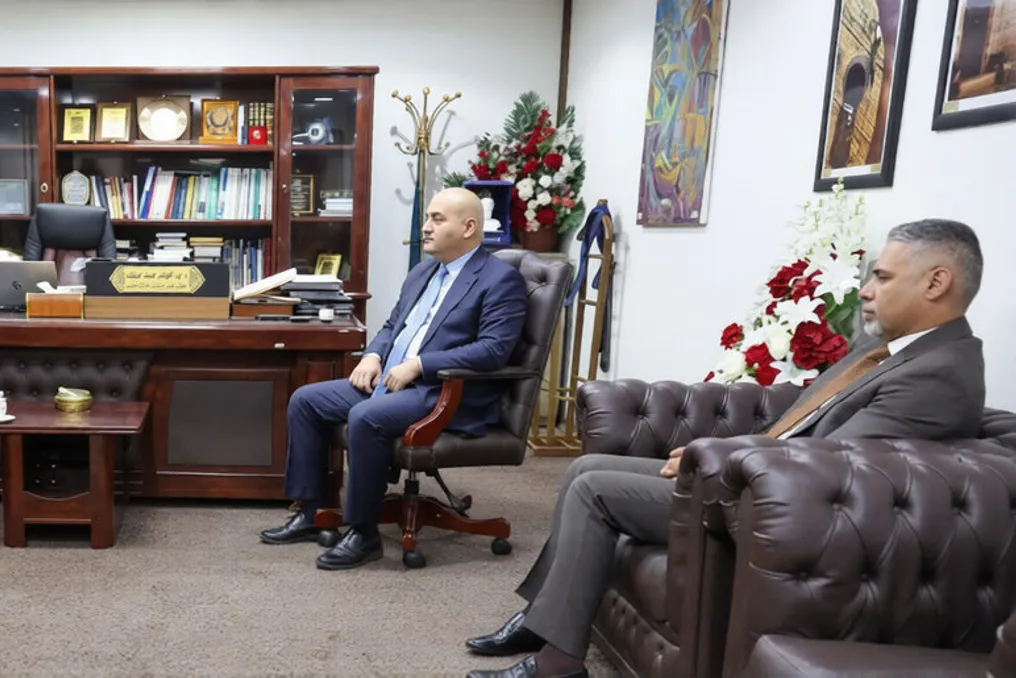
Mohammad Javad Najafi, Iran's scientific advisor in Iraq, and Haider Abd Dahed, Deputy Minister of Higher Education and Scientific Research of Iraq, discussed methods to enhance academic cooperation between the universities of the two countries. The main focus was on approaches to solving problems and meeting both domestic and regional needs.
During the meeting, reported by IRNA, key topics such as joint problem-oriented research, provision of scholarships, simplification of educational matters for students, and preparation for the 'Third Iran-Iraq Science Week' were addressed.
Officials also discussed implementing joint research projects, supervising joint postgraduate dissertations, and publishing joint scientific articles in authoritative international journals. Another issue raised by both sides was the educational difficulties and challenges faced by students in both countries.
In September, Alireza Afsharfar, Rector of Shiraz University, and Najafi explored opportunities to expand academic ties with Iraqi universities. On September 26, they met to discuss ways to develop joint educational courses, student and faculty exchange, attracting international students, and conducting joint research projects.
Other topics noted by the officials included establishing dual degree programs, holding summer schools and educational courses in English and Arabic, and participation in the Iran-Iraq Science Week. Furthermore, the necessity of exchanging the scientific and educational potential and opportunities of Shiraz University with Iraqi students was emphasized, as well as implementing research projects on common issues such as dust storms and the environment. They also discussed ways to establish connections with universities and scientific centers in Lebanon and Kurdistan.
Strengthening Technological Ties
On September 22, Ehsan Kabul, head of the Center for International Scientific Cooperation of the Ministry of Science, Research and Technology, and Safa Taki Abd Noor Al-Issawi, President of Mustansiriya University, highlighted the need to activate technological interaction and fulfill previously reached agreements. This meeting took place in Tehran, and the parties agreed to conduct joint research and supervise master's theses on common Iranian-Iraqi issues, including economic, social, cultural, agricultural, and industrial challenges.
Both sides agreed to actively participate in the Third Iran-Iraq Science Week. Kabul noted that the Iraqi university should play an effective role in this week by developing and implementing practical and synergistic programs in cooperation with leading Iranian universities. Emphasizing Iran's outstanding achievements in developing infrastructure for technology and innovation ecosystems, the official representative expressed the country's readiness to cooperate with Iraqi scientific research and academic centers to create joint technological products and services.
The proposed ideas were positively received by the Iraqi official, who stated his university's determination to expand ties with leading Iranian universities while insisting on the prompt implementation of these agreements.
On August 6, Iraqi officials, in a meeting with the Minister of Science, Research and Technology Hossein Simai-Sarraf, called for expanding academic, scientific, and technological cooperation with Iran. The Minister of Science met with Haider Abd-Dahed Al-Rubaiyeh, Deputy Minister of Higher Education and Scientific Research of Iraq, Abdul Hussein Al-Musawi, Minister of Health of Iraq, and Abdul Hussein Al-Musawi, Acting Minister of Higher Education and Scientific Research, in Baghdad.
During the negotiations, both sides stressed the importance of accelerating the implementation of previously signed Memoranda of Understanding (MOU). Key areas of discussion included transferring Iran's experience in higher education development to achieve quantitative and qualitative goals, meeting the needs of Iraq's large youth population, and attracting talented Iraqi students and improving research cooperation.
Simai-Sarraf also met with Sayed Ammar Al-Hakim, leader of the Iraqi National Wisdom Movement. Highlighting the extensive scientific and academic potential of Iran and Iraq, both sides exchanged views on strategies for promoting scientific cooperation, expanding joint research, and developing academic interaction between the higher education institutions of the two countries.
In April, Simai-Sarraf and Al-Aboudi emphasized the need to increase scientific and technological cooperation between the two countries. The officials also discussed ways to develop joint work in artificial intelligence (AI), utilizing the potential of both nations.
During the meeting in Tehran on April 18, Al-Aboudi announced that the issue of opening a branch of the Tehran University of Medical Sciences in Iraq had been included in the agenda. For his part, Simai-Sarraf expressed Iran's readiness to share its scientific, research, and educational achievements with Iraq to strengthen bilateral relations. He reported that Iranian and Iraqi students had conducted a total of 350 joint research projects, which requires improvement given the available opportunities.
Referring to the upcoming Iran-Iraq Science Week, scheduled in Isfahan and Fars provinces, Simai-Sarraf mentioned that the event had been postponed due to the war imposed by the US and Israel, but would be held at the earliest opportunity. As agreed by the two officials, AI and smart education will be topics of discussion during the Iran-Iraq Science Week. This event is expected to serve as a basis for holding a joint AI conference in the near future.