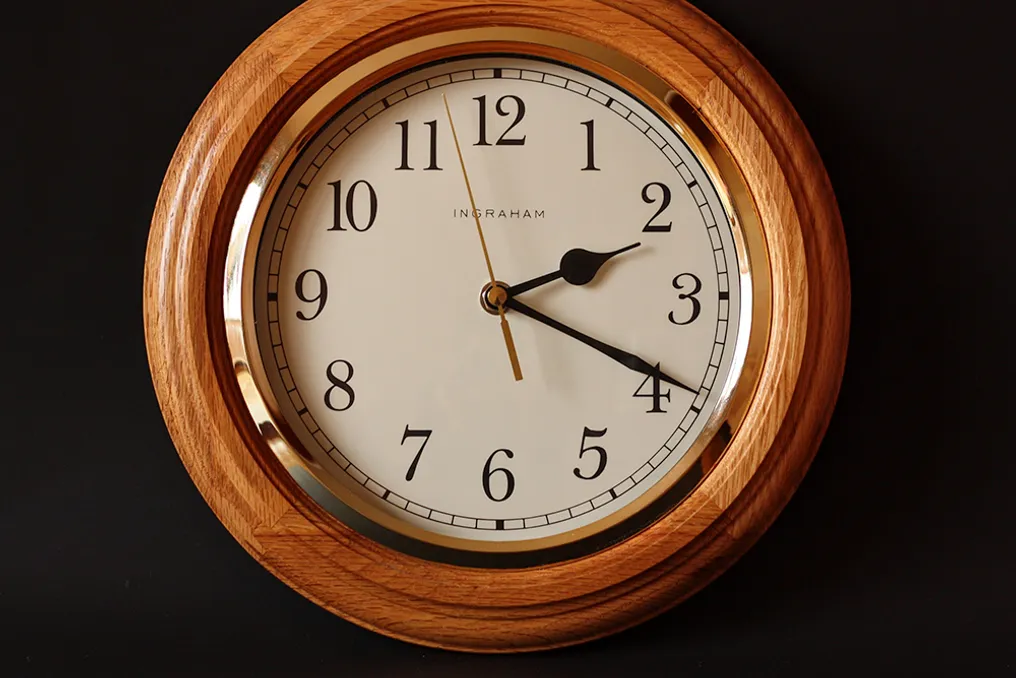
The operation of world clocks is about to undergo significant changes following the approval to eliminate leap seconds. Since the 1970s, scientists have periodically added a leap second to global clocks. This procedure aimed to keep high-precision atomic clocks synchronized with the Earth's rotation cycle.
However, modifying clocks on a global scale can generate serious problems in the world's digital infrastructure, resulting in website failures, flight delays, and network instabilities, reminiscent of the millennium bug fear that occurred during the transition from 1999 to 2000.
The International Bureau of Weights and Measures (BIPM), the institution responsible for establishing international standards for time, weight, and distance, has decided to cease the use of leap seconds after years of deliberation among specialists and scientists.
The extinction of leap seconds does not eliminate the divergence between clocks and Earth's rotation, as both will continue to drift apart. However, the scientists' new proposal is to correct clocks only when the difference reaches an interval of one hour, a correction that, according to projections, will only be necessary in more than a thousand years.
This determination was sanctioned by representatives of 69 nations during a conference held in France this Thursday (15), obtaining the majority of votes. The measure will come into effect on May 20, 2027, designated as World Metrology Day, although it is likely that most of the civilian population will not notice the change.
The way we measure time is fundamentally a human creation, known as UTC, or Coordinated Universal Time, which functions as the global standard for temporal counting. This standard allows for the synchronization of clocks anywhere on the globe and the definition of planetary time zones.
Until the mid-20th century, the concept of time or timekeeping was determined by terrestrial observations, such as the alternation between day and night. A day naturally corresponded to the time the planet took to complete one rotation on its axis, a process called rotation. A second was a fraction of this period.
This methodology was superseded with the introduction of atomic clocks. In 1955, British physicists Louis Essen and Jack Parry developed the first high-precision cesium atomic clock. This advance revolutionized time measurement, leading to the abandonment of the definition of a second based on Earth's rotation in 1967. Since then, a second has been formally defined as equivalent to 9,192,631,770 oscillations of the cesium atom.
The challenge lies in the fact that the Earth does not follow this absolute precision. Its rotation time fluctuates unpredictably, influenced by elements such as tides, winds, ocean currents, and the movement of the planet's liquid core.
Although these variations are insignificant for daily activities, they accumulate in applications requiring high accuracy, potentially reaching fractions of a second. UTC was established precisely to harmonize astronomical time with the time provided by clocks. When the discrepancy increases, an additional second, the so-called leap second, is added.
Despite being a relatively recent innovation, leap seconds are vital, serving as a reference for recording time on computers, phones, aircraft, vessels, satellites, and other equipment, in addition to supporting navigation systems like GPS. 27 leap seconds have been incorporated since 1972.
In the mid-2010s, it was noted that the Earth's rotation was beginning to accelerate. Scientists anticipated the need for a 'negative leap second,' meaning the removal of a second from the day. However, engineers expressed concern that forcing all clocks to abruptly go back could trigger chaos in the digital infrastructure.
One example of this occurred in 2012, when a leap second was added, causing problems in certain computer systems because their operating systems were not prepared to handle the existence of 61 seconds in a minute. Servers, including Reddit and LinkedIn, froze and stopped responding, and there were reports of flight delays.
Since 2022, scientists, government authorities, telecommunications professionals, and other experts have been working to find a solution to the leap second dilemma. With the decision to implement leap hours, UTC will no longer require frequent adjustments, operating continuously for at least several centuries.