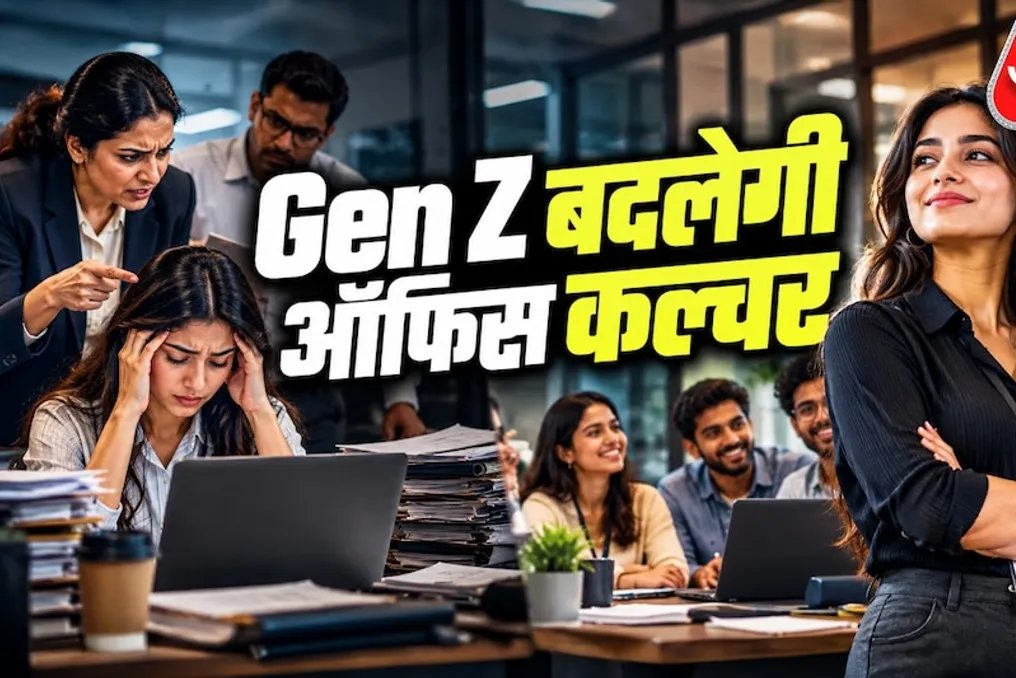
Gen Z Women Discuss Office Culture Problems and How They Will Become Better Leaders in the Future
Read more
Aaj Tak
www.aajtak.in

Gen Z Women Discuss Office Culture Problems and How They Will Become Better Leaders in the Future

Issues of work culture are regularly discussed on social media. While older generations struggle with the working style of Gen Z representatives, members of this generation often face toxicity in the workplace, problems with personal boundaries, and dissatisfaction with management.

In one Instagram video, user Mitali Sharma stated that future generations can create a more favorable atmosphere by becoming better leaders after observing the current situation.

Mitali Sharma shared several stories from her experience interacting with managers, which she described as 'toxicity manifesting in small details.' These experiences helped her realize what kind of manager or employee she never wants to become in the future.

Firstly, she noted how some senior colleagues interfered with an employee's personal preferences during professional disagreements. Giving an example, she recounted how one of her managers told her: 'Get out of your social media world. Social media is not the whole world. I don't know what you think you are.'

Furthermore, Sharma described a situation where, after recovering from chickenpox, she requested sick leave. However, her management started asking questions precisely when she was ill. The manager asked her to stay away during a conversation, fearing she had not fully recovered. Moreover, this same manager questioned her medical certificate, stating: 'Your medical certificate looks a bit fake. I don't know if you really had chickenpox.'

Mitali emphasized that employees are not meant to perform personal errands in the office. She criticized managers who expect their subordinates to complete personal tasks. In her opinion, there is a difference between a friendly attitude and coercion into working just because someone is a senior colleague.

Mitali also highlighted the issue of expecting work after official working hours. An employee should not be labeled lazy or inattentive just because they are only in the office during their shift. Sharma also criticized the practice where new employees are expected to handle new tasks in full without proper guidance, and then punished for questions or mistakes.

In conclusion, she said: 'When I was an employee, many such things happened to me in real life. But when I become an employer myself, I will never treat my employee like that.'

Similar stories

Gen Z Founder Introduces Unique Corporate Culture: Encouraging Criticism and Double Pay for Weekend Work
Read more
www.aajtak.in

Gen Z Founder Introduces Unique Corporate Culture: Encouraging Criticism and Double Pay for Weekend Work

Some may not believe it, but there is a Generation Z founder who implements such an approach in his company. He allows employees to mock him when necessary, offers double pay for working on weekends, and does not tolerate problematic clients who create difficulties for the team.

25-year-old Pratham Jindal from Chandigarh shared on Instagram how he manages his company. His posts contain many aspects that differ significantly from standard office practices. For Pratham, managing a company means not only earning a high income; he pays equal attention to employee experience and creating a positive atmosphere.

Pratham wrote in his post: 'I let my team roast me.' This means he gives his team complete freedom to tease him. He mentioned that there are moments in his team where employees can openly joke about him. Usually, workers communicate very cautiously with their superiors, but Pratham wants his team to feel comfortable around him and able to express their opinions without fear.

Pratham's thoughts are not limited to jokes and communication. His approach also differs regarding weekend work. He stated: 'If someone gives up their day off to work, I believe they should be paid 2X for it.' According to Pratham, an employee's personal time is extremely important, and if it is used for work, it should be fairly compensated.

Pratham also openly discusses the financial status of the company with his team. He wrote: 'I talk openly about our numbers.' He is convinced that employees should know the company's standing. This helps them feel like part of the company, not just executors of orders.

Another aspect highlighted in Pratham's post is the attitude towards clients. He wrote: 'I always choose to let go of a client than an employee.' That is, if any client creates problems for his team, he will prefer to lose that client rather than cause suffering to his employee. He clearly stated that he does not allow his team to tolerate bad behavior from unscrupulous clients.

Furthermore, Pratham mentioned that he spends money on things that do not bring direct profit. These include time spent with the team, the office atmosphere, and end-of-month parties. He noted: 'I spend more money on things that don't directly make money.' For him, a good team and a positive environment are part of the company's success.

In conclusion, Pratham emphasized that these are not established rules for any company. They are principles he has believed in while building his company over the past few years. His approach makes it clear that for him, the office is not just a place to complete tasks, but an environment where employees can freely express their thoughts, receive fair compensation for their time, and feel respected.

Gen Z employee explains to boss why he doesn't watch the clock using a calculator
Read more
www.aajtak.in

Gen Z employee explains to boss why he doesn't watch the clock using a calculator

Changes constantly occur in the office environment: new employees arrive, some leave the company, work pressure increases, or discussions about the work atmosphere and methods begin. For a new employee, mastering a new workplace, getting acquainted with colleagues, and understanding processes is a unique experience.

Since Generation Z became part of the working culture, various reviews about working with this generation regularly appear on social media. Their approach to work, as well as their views on the office and employment, attract public attention. One such incident is currently being actively discussed on social media: a young Gen Z employee used an unusual method to leave work, which attracted widespread attention.

One user on X shared their experience, telling about their Gen Z intern. The user on X reported that one day a new intern arrived at the office at 9:07 AM. The boss was in the office and, looking at the clock, asked, 'Are you late today?' The intern, without hesitation, looked at the boss and replied, 'My working time starts at 9 AM, but my best productivity starts at 9:15 AM.' Silence fell in the room after these words, as no one expected such an answer.

The boss first smiled slightly, and then decided to test his employee. He tried to evaluate him by saying, 'A dedicated employee does not watch the clock.' And then something happened that perhaps only a Gen Z representative would have the courage to do. The employee opened a calculator and stated, 'If I work more than fixed hours, my hourly wage will decrease. This is not a profitable deal for me.'

This response was likely unexpected by everyone in the room. The boss stood there for about ten seconds. He blinked, then silently turned and returned to his office. This intern didn't just come to work; with his answers, he became the most discussed employee in the entire office.

Although this story could have been published humorously on social media, it reflects the changing work culture of Generation Z. For the current young generation, the measure of diligence is not just about staying in the office longer. They also place great importance on the balance between working time, salary, responsibilities, and personal time.

Popular