When Shraddha Gupta stood on the summit of Mount Everest at an altitude of 8,849 meters above sea level on May 21, 2026, the world below seemed to have vanished. Around her stretched a landscape of snow, ice, and distant ridges, and the peak itself could barely accommodate a person. At 41 years old, this banker from Delhi, who for years balanced work in boardrooms and client calls with early morning workouts and long weekends in the mountains, finally reached the highest point on Earth.
Gupta told The Better India: 'I didn't know I would go to Kilimanjaro when I started hiking. When I began climbing Kilimanjaro, I had no idea I would end up on Everest.'
Her journey is notable because Everest was not a childhood dream planned over decades. Just three years before the ascent, she rediscovered her love for mountains, which she felt as a child. Today, she has conquered five major peaks on three continents, including four of the Seven Summits—Kilimanjaro in Africa, Elbrus in Europe, and Aconcagua in South America, as well as Manaslu and Everest in the Himalayas. However, Shraddha's story began long before the photos on the summit.
It began with a glass desk, a long recovery, and the realization that life was passing by.
The Trauma That Made Her Look Back
Shraddha spent two decades in the banking sector. Born in Delhi, she left India at 17 to study engineering in Singapore, then joined DBS Bank, starting her career on the trading floor. She worked in Singapore for 11 years before moving with the same bank to Dubai in 2017, where she currently manages corporate business for the Middle East.
For a long time, work took up most of her life. Then, in 2020, a domestic accident changed her perspective. A glass fall caused a serious forehead injury requiring reconstructive surgery. A bone was broken, muscles were torn, and doctors had to put everything back layer by layer. Recovery took about 18 months.
'The first one or two months were very difficult. I couldn't even walk properly because it affected my balance, and it constantly hurt,' she recalls. This experience made her think about how close she was to losing her familiar life, as well as everything she had been putting off.
'I think, in the end, it was just a transformative experience for me,' she adds. 'I started thinking about how life had taken over me, how work had taken precedence, and you just keep going year after year, forgetting what is important to you and what brings you joy.' One of those things had always been the mountains.
Growing up in Delhi, Shraddha remembers her parents driving the family to the mountains during school holidays. Nainital, Mussoorie, Pitorgarh, Sangla Valley, and other regions of Himachal Pradesh were part of her childhood. As a teenager, she even climbed Fuji with her parents, and later went hiking in Malaysia while studying in Singapore. But for a long time, she did not return to the mountains. This changed in February 2022.
From Weekend Hikes to a Grander Dream
A friend invited Shraddha on a hike in Dubai with a group of women. Previously, she associated Dubai with skyscrapers, not mountains. 'I didn't even know I could hike in Dubai,' she says. 'I didn't suspect there were mountains just two hours away.'
After the first hike, she kept returning, heading to the mountains around Ras Al Khaimah and Fujairah almost every weekend. Hiking became a place where she could disconnect, move, and feel like herself again. Then came a long-held wish from her bucket list: Kilimanjaro.
As her 40th birthday approached, Shraddha decided she didn't want to wait any longer. 'I don't know how long my body and mind can support me. So, if I need to do it, let's just do it. There's no point in waiting anymore.'
One practical problem arose. Kilimanjaro could take seven to nine days, and in her corporate career, Shraddha had never been unavailable for so long. She manages business dealing with large corporate clients, so being offline was unfamiliar territory for her. Eventually, she found an expedition during the Eid holidays, which gave her a week off work. In June 2023, she set off.
It was also her first expedition with strangers: five women, including three Indians, an Algerian, and an Egyptian, along with a man and their British expedition leader. The mountain gave them something in common. 'You support each other there, talk about your life stories, and share food together.'
More importantly, Kilimanjaro showed Shraddha that she was truly capable of doing it. 'I learned that I could climb when I almost thought it was impossible,' she shares.
One Peak Led to Another
After Kilimanjaro, Shraddha traveled to the Everest Base Camp in October 2023. It was there, watching the sunrise from Kala Patthar, that the thought first occurred. Looking at Everest as the sun appeared behind it, she thought: 'One day I want to stand on top of this mountain.'
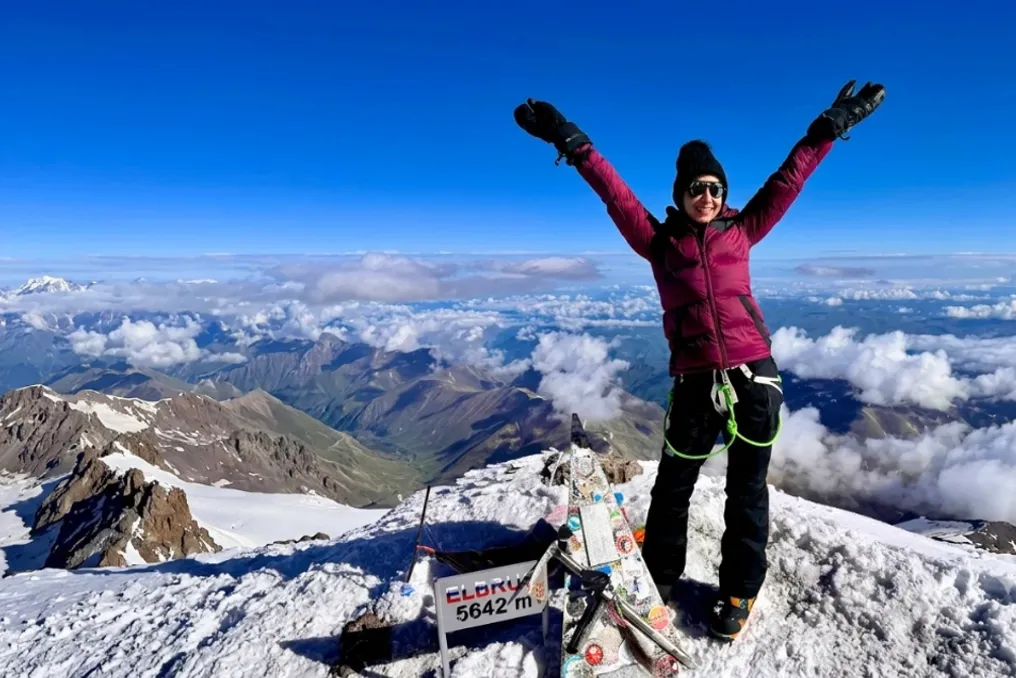
It wasn't a plan yet, but the idea never faded. Her next challenge was Mount Elbrus, the highest mountain in Europe, in June 2024. If Kilimanjaro tested her on altitude, and the Everest Base Camp tested her endurance on a longer trek, Elbrus introduced her to technical climbing on ice and snow.
This was followed by Aconcagua in January 2025, the highest mountain in South America and the highest peak outside Asia. According to her, each expedition served as a way to introduce a new variable: greater altitude, longer duration, more complex terrain.
By then, Everest was no longer just a thought. However, before attempting it, Shraddha wanted to test herself at 8,000 meters. In September 2025, she climbed Manaslu, the eighth-highest mountain in the world, at an altitude of 8,163 meters, with Elite Exped. This was her first 8,000-meter peak and a completely different world compared to the mountains she had conquered before.
There were fixed ropes, ladder traverses, glacial crevasses, avalanches, and extreme conditions that climbers call the 'death zone.' 'Once you reach the 8,000-meter zone, it's a completely different world,' she says. 'It is harsh, and almost every day it feels like you are fighting for your life because you don't know what might go wrong.'
Manaslu confirmed that she was ready for the Everest attempt. But it also showed her how much preparation would be required.
Preparing for the Mountain While Maintaining a Career
Training for Everest became another full-time commitment layered on top of her main job. In Dubai, Shraddha hikes whenever she can. In the summer, when the temperature makes outdoor training difficult, she uses the indoor slope at Ski Dubai. Her routine also includes strength training, incline treadmill sessions, StairMaster workouts, swimming, and running.
At the peak of her training, she spent nearly two and a half to three hours exercising every day, split between morning sessions before work and evening ones afterward. Her Everest coach, Mike McCall, based in Las Vegas, USA, started working with her in January 2026. He notes: 'She started in good shape. She completed the expedition preparation.'
McCall's program focused not only on cardiovascular fitness but also on the demands of the expedition: ascending with weight, strength endurance, muscular strength, recovery, and the ability to keep working after fatigue sets in. For him, Shraddha's age was not a determining factor. 'I train the athlete in front of me, not the number written next to their age,' he says. Instead, his focus was on her consistency. 'She balanced a demanding professional career, travel, stress, and normal life with Everest preparation,' says McCall. 'Consistency doesn't mean following a perfect program for months. It means getting back to the process when life disrupts the schedule.'
Everest Demanded Everything From Her
The 2026 Everest expedition did not go according to plan. Due to the conflict in the Middle East, which created uncertainty in air travel, Shraddha left Dubai and traveled to Delhi at the end of March to complete her preparation without risking delays closer to the expedition. On the mountain, she slipped on an icy wall in the Khumbu Glacier and injured her left shoulder, making it barely possible for her to lift a one-liter bottle. Since the route through Khumbu was also delayed, she returned to Kathmandu for four days to recover before returning to the mountain.
Then came the terrible Khumbu cough. The incessant dry cough deprived her of sleep and gradually weakened her. By the time she started the summit push, she was battling bruised ribs, illness, and exhaustion. 'Nothing tested me like Everest,' she says. 'I have never been so sick, so injured, and so ill on a trek as on Everest.'
Nevertheless, she kept moving, relying on the lesson she learned on Kilimanjaro: break the biggest goal into smaller steps. 'My only duty today is to deal with today. We will deal with tomorrow when it comes.'
Her coach, Mike McCall, saw the same resilience. 'Mountains punish rigidity. The weather changes. Bodies change. Plans change,' he says. 'Shraddha faced setbacks both during training and during the expedition... But she kept adjusting course.'
When she finally reached the summit, there was joy and gratitude, but the ascent was not over. She still had to descend with an exhausted body and little energy left. She had to keep walking.
There Is Still a Mountain Somewhere
For Shraddha's family, watching her journey from weekend hikes to 8,000-meter peaks became a personal experience. While the early expeditions caused them less worry, Manaslu and Everest were different. She kept them updated via satellite communicator, remaining aware of the risks. Before tackling the 8,000-meter peaks, she signed body disposal forms, knowing that preparation could not eliminate all dangers.
'When you enter the world of 8,000-meter peaks, you are ready to die,' she says. 'I know the risks I face. Of course, I will fight until my last breath to survive, but sometimes it can be beyond my control.'
Today, she is between Dubai and Delhi, returning to the corporate life she led parallel to the mountains. But three years after the first hike, Everest is behind her, and the journey still feels far from over. For someone who once viewed mountains as a place for family recreation, perhaps there is no better way to look forward than with the lesson that brought her to this point.
She adds: 'Whatever your dream may be, it doesn't have to be mountains. It can be anything in life. Take that first step.' She concludes: 'Maybe you are not in your best shape. Maybe you are not in the best condition. But if you want it desperately, if you give it everything you have, the world will come together to help you achieve it.' And so, after Everest, there is still another first step ahead somewhere.