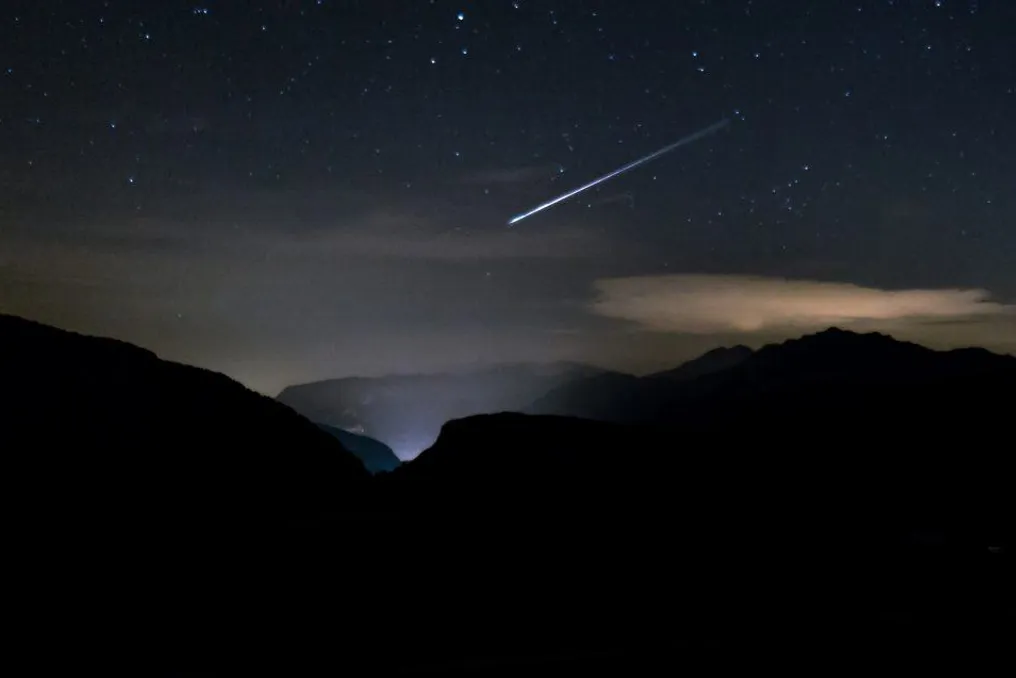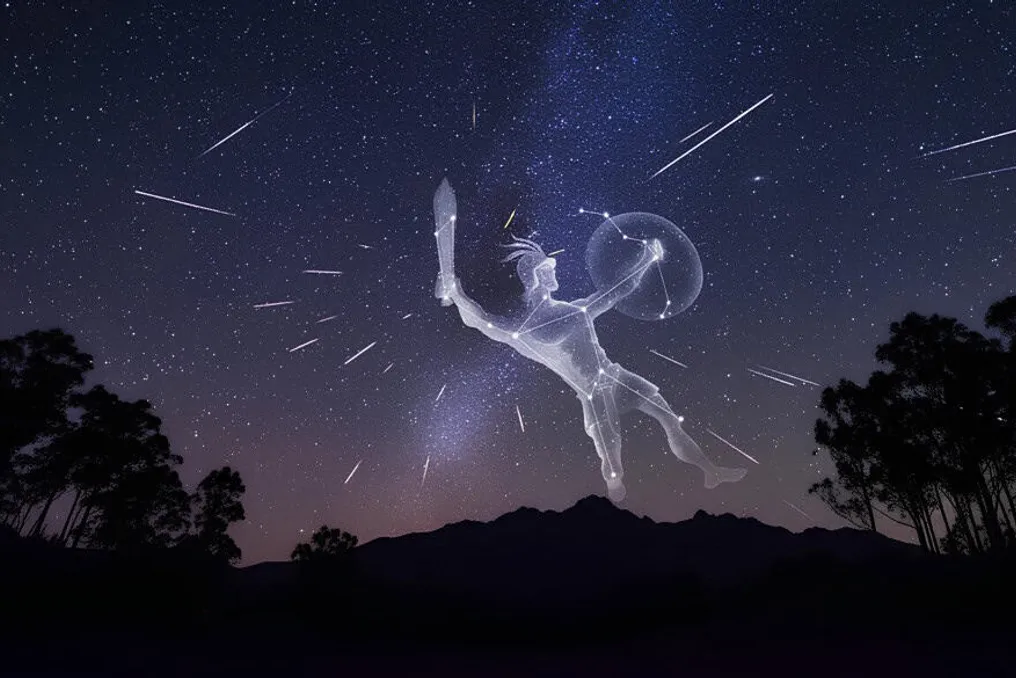
Astronomy enthusiasts have an excellent reason to observe the sky this week, as the Orionid meteor shower is at its peak period. This event occurs annually between October 2nd and November 7th, with the day of maximum activity falling between October 21st and 23rd each year. Near the apex, it is possible to record the passage of 10 to 20 meteors per hour.
The phenomenon occurs when the Earth crosses the debris trail left by Comet Halley, which travels through the inner Solar System every 76 years. Upon entering the Earth's atmosphere, these particles combust, generating luminous trails known as meteors. The name Orionids derives from the constellation Orion, the celestial point from which these trails appear to emanate, near the star Betelgeuse.
Although the radiant is located in the northern celestial hemisphere, the shower is easily observable in Brazil. The fragments reach the atmosphere at remarkable speeds of 67 kilometers per second, equivalent to 241 thousand km/h. Even at such high speed, they leave bright trails that can last for a few seconds, providing a visually impressive spectacle.
On certain occasions, the meteors intensify, transforming into fireballs visible to the naked eye, surpassing any star in brightness. Besides the Orionids, Comet Halley is also responsible for the Eta Aquariids shower, which occurs annually in May.
Marcelo Zurita, president of the Paraíba Astronomy Association (APA), member of the Brazilian Astronomical Society (SAB), technical director of the Brazilian Meteor Observation Network (BRAMON), and columnist for Olhar Digital, states that the official date of the peak of the Orionid meteor shower is October 21st. He emphasizes that, although it is a fixed date, in practice, it can show small variations from one year to another due to various factors.
Zurita explains that some meteor showers occur when the Earth passes through a very narrow debris trail, allowing for a more precise determination of the peak. Older and established showers, like the Orionids, have more dispersed and less uniform trails, which prevents the peak date from always falling on the same day.
According to the astronomer, there are fundamentally two elements influencing this pattern. The first is that the peak can only be measured by calculating the number of meteors seen per hour, usually through radio detection, a method that ignores regional climatic conditions. Since the trail is not homogeneous, the highest rate of meteors may occur on different days. The second factor is the occurrence of leap years; when there is an extra day in February, subsequent showers tend to occur one day earlier. In the case of the Orionids, this can cause the peak date to vary between the 20th and 23rd, depending on the study.
Another agent can cause changes in the peak dates over the years: gravitational interactions with other planets, especially the gas giants, can modify the geometry of the debris trail. However, Zurita points out that this is not the case for this year's Orionids, suggesting that the divergence between sources is probably due to different studies.
Additionally, because the Earth year has 365 days and a quarter, there is a compensation of approximately six hours between one year and the next. Therefore, in astronomy, dates are not used as references for meteor shower calculations; the solar longitude parameter is used, which defines the Earth's position in its orbit, regardless of the date.
The best approach recommended by the specialist is to monitor the meteor shower over several days, without focusing on a single date. Zurita clarifies that between Tuesday (20th) and Friday (23rd), there may not be a large difference in the hourly rate of meteors, making it valuable to observe the Orionids on any of these days, regardless of which is the peak day.
The Orionids shower is visible in both the Northern and Southern Hemispheres. According to the astronomical observation guide InTheSky.org, for an observer in São Paulo, the peak of activity begins around 10:50 PM on Wednesday (21st), remaining visible until 5 AM on Thursday (22nd), shortly before dawn.
The ideal time for observation is during the early morning hours, when the radiant is highest in the sky. In the São Paulo area, it reaches about 50° above the eastern horizon. At this time, the forecast indicates the possibility of seeing up to 11 meteors per hour at the peak. In locations with low light pollution and clear skies, the number can vary between 15 and 20 per hour. In large urban centers, light pollution reduces this count to about 5 to 10 meteors per hour, although the phenomenon remains perceptible.
To locate the meteors, one should look towards the east, in the direction of sunrise and the constellation Orion. Around 3 AM, the radiant will be at an altitude of 30°, rising to 50° near 5 AM. The longest and brightest meteors appear between 45° and 90° away from this point. Sophisticated equipment is not necessary; one just needs to find a dark place, far from city lights, and allow the eyes to adapt to the darkness for about 20 minutes. Apps like Stellarium, Star Walk, or SkyView help in locating Orion.