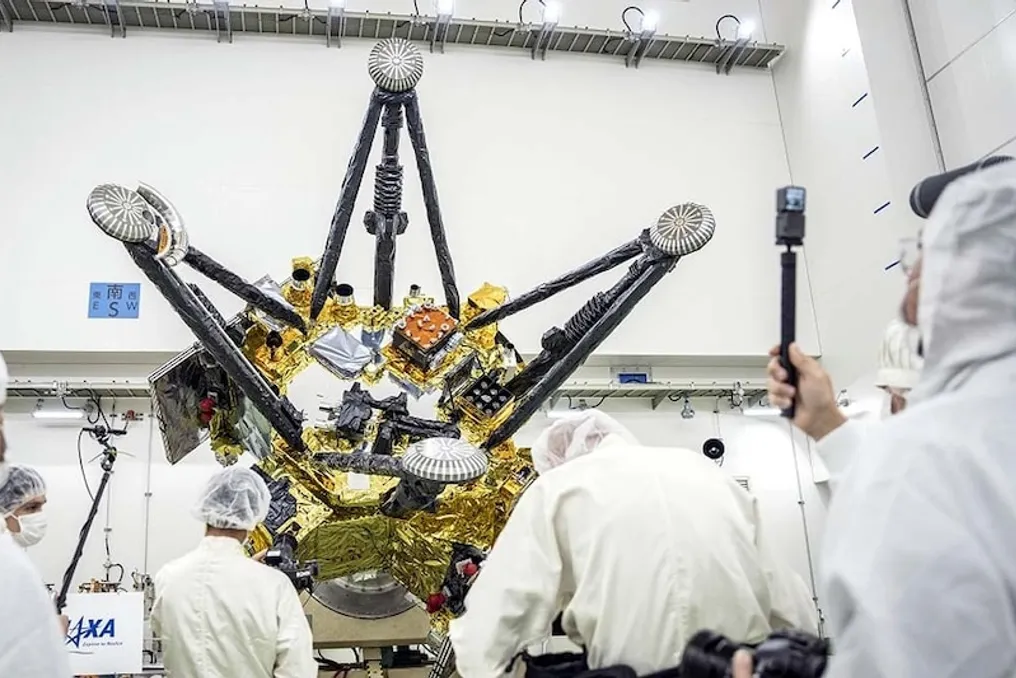
The Japanese space agency JAXA is preparing its first mission in the world to collect samples from Mars' moon Phobos. The robotic spacecraft, named Mars Multi-Mission X (MMX), is scheduled to launch on October 20, 2026, at 4:41 AM Japan time from the Tanegashima Space Center using the H3 rocket.
A preliminary briefing conference was held on October 18 before the launch. This mission is intended to collect at least 10 grams of material from Phobos and study both of Mars' moons. The collected samples will be delivered to Earth in 2031. Phobos and Deimos are two small satellites of Mars, and scientists have long discussed their origin.
One theory suggests that these asteroids were captured by Mars' gravity. Another hypothesis proposes that the moons formed from debris ejected by Mars following a major collision. The MMX mission aims to find answers to these questions. Phobos' soil may contain traces of water and organic matter, which could help understand the genesis of life in the Solar System.
The mission will not be limited to sample collection. It will also map the surface of Phobos, study its structure, and fly past Deimos. This will provide a more complete picture of the evolution of the Martian system. According to JAXA, these samples could also be useful for future crewed missions to Mars, as Phobos is considered a potential base.
The spacecraft will reach the vicinity of Mars in about a year. After entering Mars' orbit in August 2027, it will be in a quasi-satellite orbit around Phobos. After a detailed surface study, it will perform one or two landings. Special systems have been installed for sample collection. It will be accompanied by the IDEFIX rover from the French-German team, which will move across the surface and assist in selecting safe landing sites.
After collecting samples, the spacecraft will head back to Earth to deliver them in 2031. This mission is based on the success of JAXA's Hayabusa2 mission, which successfully delivered samples from an asteroid. However, MMX is significantly more complex as it will have to operate in Mars' gravitational field.
NASA, the European Space Agency (ESA), the French agency CNES, and Germany's DLR are participating in this project. Many instruments and rovers are developments from these countries, which is an example of global partnership. Nevertheless, there are serious difficulties. Phobos' gravity is very weak, which complicates landing and takeoff. Power management and communication during the long journey also present a complex challenge.
For Japan, this mission is ambitious. The reliance on the H3 rocket and the use of a precise launch window are critically important. If successful, Japan will take a leading position in the study of the Martian system and achieve new heights in space exploration. The results of MMX will not only expand scientific knowledge but also pave the way for future human missions. Analysis of Phobos' soil will show the presence of resources and open a new chapter in understanding the origin of the Solar System and the probability of life.