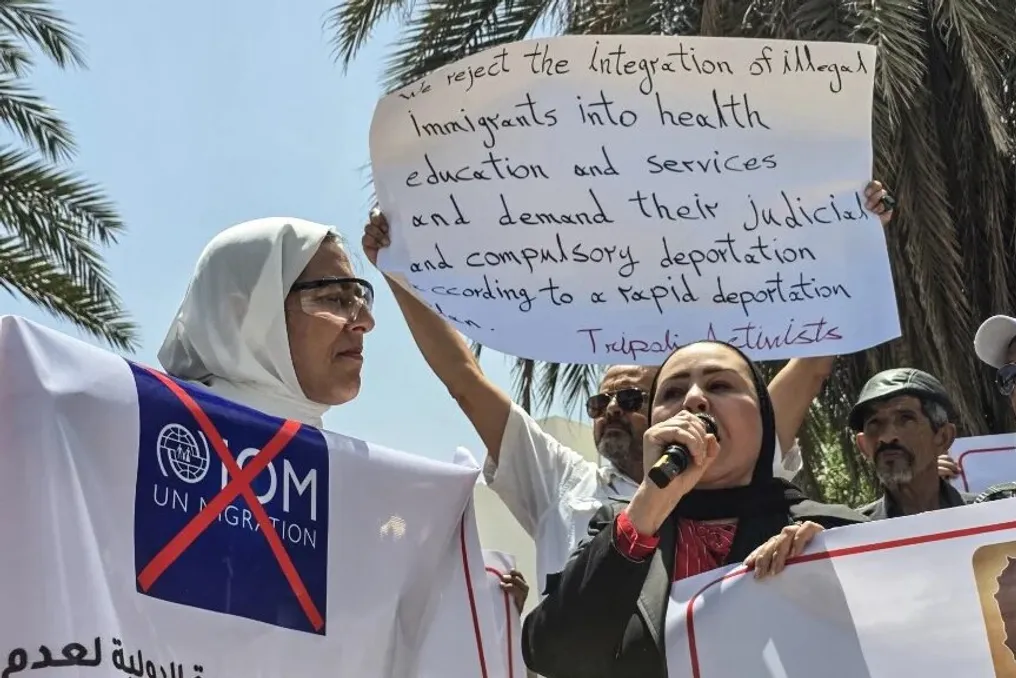
October 1 was scheduled as a 'deadline' for foreign migrants in Tripoli. Ahead of this date, dozens of groups and pages on social media called on Libyans to take to the streets with openly xenophobic protests.
These widely circulated posts on Facebook contained racist insults and images of migrants from sub-Saharan Africa, Arabs, and Asians, creating an atmosphere of intimidation. The group Refugees in Libya reported receiving a handwritten threat directed at 'black people,' which was delivered with a bullet just days before the planned protest.
Ultimately, the demonstrations barely took place, overshadowed by a major teachers' strike over unpaid salaries, aimed at Abdul Hamid Dbeib, head of the Government of National Unity (GNU), which governs the western part of the divided country.
Nevertheless, on October 2 and 9, dozens of protesters took to the streets of Tripoli, gathering at Martyrs' Square and chanting slogans such as 'Libya for Libyans' and 'No Resettlement.' Similar actions have been held several times a month in central Tripoli since April, constantly increasing hostility towards migrants.
Nearly 700,000 sub-Saharan Africans reside in the Tripoli area, including about 335,000 Sudanese refugees fleeing war. The Libyan capital has become a major hub for migrants seeking entry into Europe. From January to August, Libya served as a departure point for approximately 80 percent of the 19,000 migrants who reached Italy via the Mediterranean Sea. Over 90 percent of departures originated from western Libya, particularly from the coast between Tripoli and Zuwara, long known as a major boat departure point.
Attacks on migrant aid agencies
Migrants, who already face smuggling networks, arbitrary detention, kidnapping, torture, and slavery—what the UN calls 'systematic human rights violations and abuses'—as well as violent interception at sea, are now facing growing threats in their homes and workplaces.
Albert G, a 37-year-old resident of eastern Tripoli of Yerreon origin, told Middle East Eye: 'I feel that Libyans are increasingly allowing themselves to do whatever they want to us without being obliged to obey the law.'
He added: 'Not only will torture and imprisonment continue to be a reality for migrants, which is already a known problem, but it also creates additional difficulties when we have no opportunity to visit public places or look for work to survive.'
Albert noted that hostility began to rise with the first protests in the spring and became truly frightening in early summer. In June, large groups of Libyans protested against the so-called 'resettlement plan,' which was claimed to be organized by the United Nations to prevent migrants from leaving the country.
Despite firm denials from the International Organization for Migration (IOM) and the UN High Commissioner for Refugees (UNHCR), hundreds of protesters blocked the UNHCR headquarters in Tripoli on June 4, accusing international agencies of trying to change the demographics of Libya.
These protests were accompanied by anti-migrant violence and waves of arrests of sub-Saharan Africans by police and armed factions linked to the Ministry of Interior in several western Libyan cities, forcing many sub-Saharan Africans to stay home for several days.
Although the unrest subsided in the summer, small gatherings and sporadic incidents continued. On September 7, tensions escalated when a group of Libyans stormed the IOM Migrant Response Centre in western Tripoli. Although no casualties were reported, the attack deeply alarmed the sub-Saharan African community.
Albert stated: 'If the authorities can allow an attack on the IOM camp, many lives will be affected because there will be no safe place for migrants.'
Authorities accused of 'inaction'
Following this incident, the GNU stated that 'the right to peaceful protest can never justify attacks, vandalism, or threats to life,' warning that those responsible could face legal liability.
When MEE asked about measures taken after the attack, the Ministry of Interior did not respond. Meanwhile, popular Facebook and X pages created in the spring remain active, spreading hate speech and calling for mobilization. Groups such as 'Libyan News – No to the Resettlement In Libya' (76,000 members) and 'The Tripoli Activists Movement' (39,000 members) daily share hateful content targeting migrants.
The degree of coordination of the movement and its origins remain unclear. A BBC investigation in August showed that the June protests were fueled by online rumors.
Locally, public figures such as lawyer Touria Al-Tuwaibi and journalist Salma Al-Shaab have repeatedly led the protests—which they call 'peaceful'—reinforcing their momentum.
Ahmed Hamza, a Libyan human rights defender, told MEE: 'These campaigns are still ongoing, even though they are based on false and misleading information.'
He added: 'The actions of those who support or coordinate this criminal movement constitute criminal offenses punishable under the Libyan Penal Code.'
Hamza pointed to a 'state of complacency, complicity, and suspicious silence on the part of the Ministry of Interior and other authorities.'
Migrants share this view, stating that while the GNU allows them to live and work in Libya—and sometimes even hires them—it has never guaranteed their safety in Tripoli.
Kingsley (pseudonym), a Cameroonian refugee who has lived in Tripoli for four years, told MEE that he 'never felt safe in Libya.'
This young man, arrested twice by security forces in 2024 and 2025, said he was only released after paying money to those he described as his 'kidnappers.' In addition to criminal gangs, armed groups affiliated with state institutions have been repeatedly accused of ransoming civilians.
Kingsley added: 'Now I consider the vast majority of Libyans a threat.'
While sub-Saharan Africans remain the primary targets of online hate campaigns, some posts are also directed against Palestinian, Syrian, and Bangladeshi communities—who are particularly numerous in eastern Libya but are becoming increasingly visible in Tripoli.
Migrants also report more frequent violations of their rights and disrespect from local residents amid the hostile environment, even when incidents are not directly related to the anti-resettlement movement.
Albert reported: 'Last week I worked on a construction site for two days and did not receive payment. I had to go home with an empty stomach.'
New protest dates have not been announced, but tension surrounding the anti-resettlement movement continues to build, raising fears that the situation could worsen.
Hamza warned: 'The authorities must fulfill their duties. The situation could escalate and get out of control.'
Currently, the hostile environment has not prompted a large number of migrants to leave Tripoli, but some are considering this option. IOM conducts voluntary return programs that have helped about 16,000 migrants in 2025, while Libyan authorities deported over 37,000 last year.
Albert said: 'Even if the situation there is terrible, I would prefer to be in Tunisia or Algeria. I don't know what awaits us here in the coming months.'