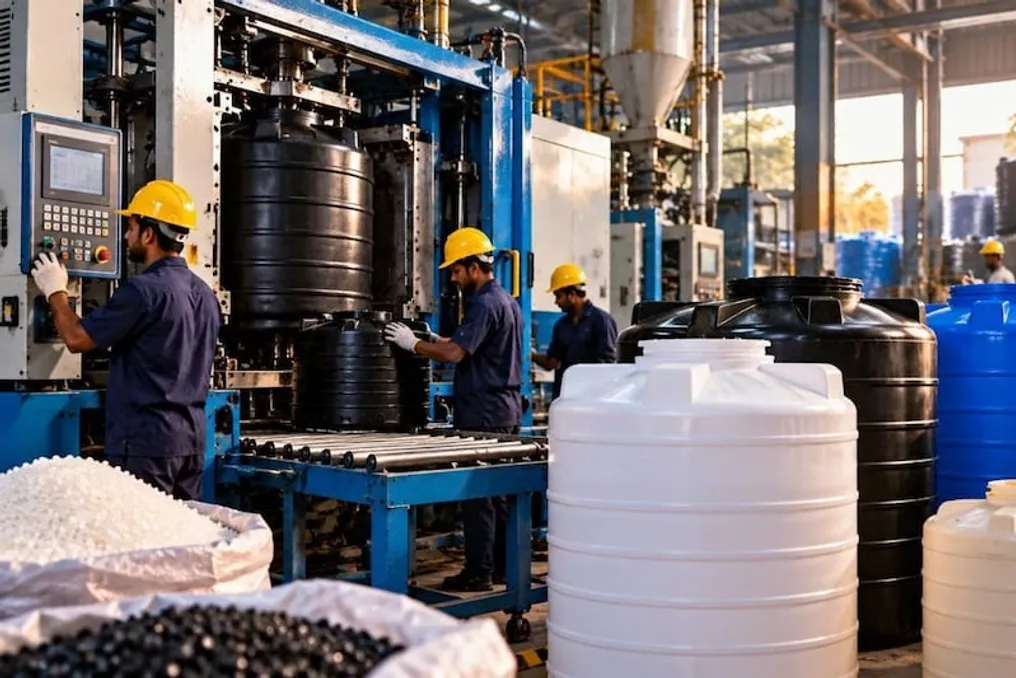
Regardless of the season, plastic water tanks are needed everywhere. If you plan to start a business manufacturing such tanks, questions may arise regarding necessary costs, equipment, and regulatory requirements. The following discusses the essential elements for launching a water tank manufacturing business and cost calculations.
Various components are required for water tank production. Launching a production unit for plastic tanks involves expenses for equipment, molds, raw materials, premises, electricity, and personnel. According to an old report by the MSME Development Institute in Trishur, total capital investments to set up a plastic reservoir production unit could have been around 53.04 lakh rupees. This amount included fixed investments of approximately 24.16 lakh rupees and working capital for three months of about 28.87 lakh rupees. However, it should be noted that this report is outdated, and when creating a new project budget, current prices for equipment, raw materials, rent, electricity, and salaries must be considered.
Rotational molding, or rotomolding, is used in the manufacturing of plastic tanks. Additionally, depending on the tank size, molds, raw material preparation equipment, and quality control systems may be required. According to various media sources, the cost of one machine for rotomolding water tanks can be around 7 lakh rupees or more, while a two-arm biaxial machine can cost up to 18 lakh rupees, with more powerful machines costing more.
Plastic resins, such as polyethylene, are typically used to manufacture plastic tanks. The demand for raw materials varies depending on the volume, weight, and design of the tank. A masterbatch for coloring and other production-related materials are also necessary. The production unit requires a sufficiently spacious premises to accommodate equipment, store raw materials, and safely warehouse finished products. When choosing a rented premises, the monthly rent payment and electricity costs must be factored into the budget.
If you do not have enough capital to open a large factory, you can consider the option of dealership or resale of water tanks. In this model, tanks are purchased from an existing company and then sold to customers, equipment stores, plumbers, builders, or other participants in the construction industry. This approach eliminates the need to install production equipment but requires funds for initial inventory, rent for a shop or warehouse, transportation, and adherence to distributor terms. The investment size will depend on the company, region, inventory volume, and business scale, so an exact figure cannot be established without knowing supplier prices and dealership terms.
The cost of tanks varies depending on their volume: for a 500-liter tank, the price ranges from 6,000 to 12,000 rupees and above; for 1000 liters—approximately from 7,000 to 17,000 rupees and above; and for 2000 liters—from 14,000 to 25,000 rupees and above.