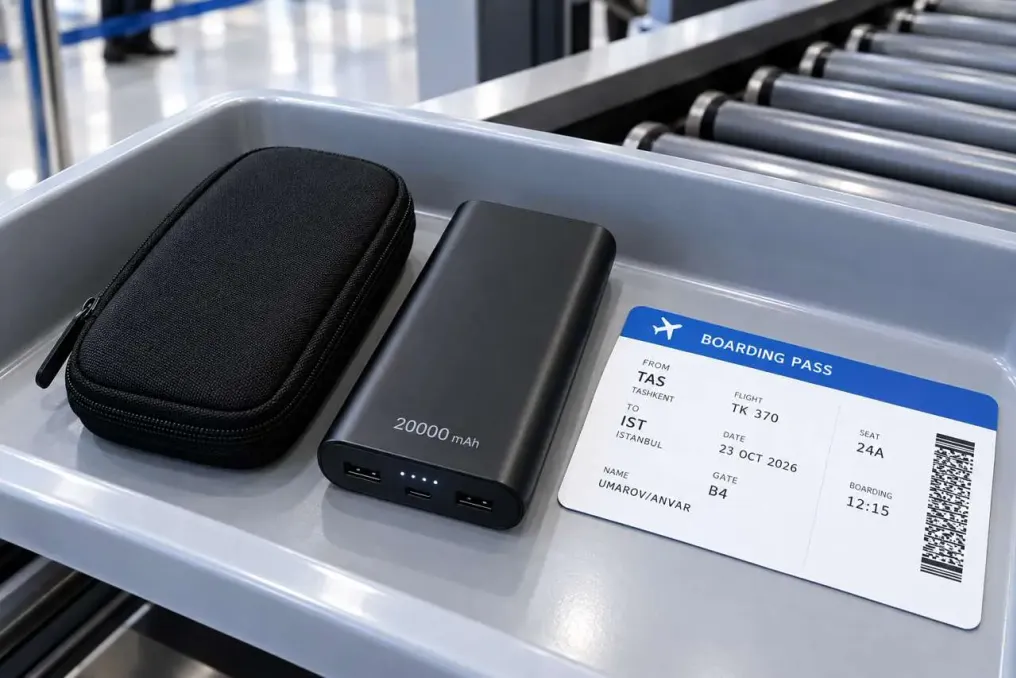
A power bank is one of the most common items in carry-on luggage, but the requirements for it vary across airports in different countries. Some only check the capacity, others check the number of devices, and China additionally requires a safety certification mark. Passengers who familiarize themselves with these rules in advance pass through security checks without delays and keep their batteries.
On March 27, 2026, Supplement No. 1 to the ICAO Technical Instructions for the Safe Transport of Dangerous Goods by Air (Document 9284) came into force. The International Civil Aviation Organization (ICAO), a UN agency, sets aviation safety standards. This document classifies power banks into a separate category and establishes unified rules for their carriage by passengers. Furthermore, since June 2025, China has mandated the presence of the national CCC mark on power banks transported on domestic flights.
Below is a detailed explanation of how to pack and transport a power bank according to current regulations, how to determine its capacity, how to use it on board, and what additional requirements apply in China, Hong Kong, South Korea, and Taiwan.
Power Bank Carriage Rules on Airplanes in 2026
According to ICAO standards effective from March 27, 2026, passengers may carry no more than two power banks in carry-on luggage. Each device must be packed separately to prevent short circuits and comply with the UN 38.3 standard. The basic rules are based on ICAO and the International Air Transport Association (IATA), which unites global airlines. Nevertheless, airlines and national civil aviation authorities may establish their own requirements, so passengers should check the rules on their carrier's website before flying.
Individual packaging helps keep battery contacts away from metal objects. An original box, insulating tape on open contacts, or a separate pouch is suitable for this purpose. The UN 38.3 standard is part of the UN Manual of Tests and Criteria; compliance confirms that the battery withstands changes in pressure, temperature, vibration, and impact.
Permitted Power Bank Capacity and Conversion of mAh to Wh
Power banks with a capacity of up to 100 Wh (approximately up to 27,000 mAh) can be carried in carry-on baggage without special airline permission. Devices with a capacity between 100 and 160 Wh can be carried with airline approval until the end of 2026. However, as of January 1, 2027, according to IATA, the 100 Wh threshold becomes the only permissible limit for passengers. Manufacturers usually indicate capacity in milliampere-hours (mAh), whereas aviation rules use watt-hours (Wh), which account for voltage and better reflect stored energy. For a typical lithium-ion cell with a voltage of 3.7 V, the conversion formula is: Wh = mAh × 3.7 / 1000.
According to IATA, the provision allowing the carriage of 100–160 Wh power banks with airline permission will not be included in the 68th edition of the Dangerous Goods Regulations, effective January 1, 2027. Batteries exceeding 160 Wh must be transported exclusively as dangerous goods in the cargo hold, not as personal items.
How to Use a Power Bank On Board an Airplane
According to ICAO rules, a power bank cannot be connected to the aircraft socket or the USB port in the seat. ICAO and IATA also recommend not charging phones or other devices from it during the flight. The decision on how power banks can be used on a specific flight is made by the airline. This restriction is due to the fact that the battery heats up during charging, increasing the probability of thermal runaway—an uncontrolled reaction of a lithium-ion battery where the cell overheats and may emit smoke.
Airlines apply this rule differently. Thai Airways and AirAsia prohibit the use or charging of power banks at any time during the flight, while Singapore Airlines does not allow them to be charged via seat USB ports. Many carriers also ask passengers to keep power banks with them, rather than in the overhead compartment, so that the device is visible in case of overheating.
Basis of the New Power Bank Rules
The ICAO rules were developed by the ICAO Special Group on Dangerous Goods, which studied the risks associated with lithium-ion batteries in the cabin. Among these risks was the fire aboard Air Busan on January 28, 2025, the preliminary cause of which was identified as a power bank. This fire on Air Busan Flight 391 resulted in injuries to 27 people and the destruction of the aircraft. The ICAO Special Group on Dangerous Goods analyzed this and other cases in working document DGP/30-WP/34 in October 2025. Based on this analysis, requirements were established regarding the place, quantity, capacity, and method of using power banks.
IATA separately advises paying attention to the origin of the device. The association notes that inexpensive, counterfeit, and wireless power banks most often lack confirmation of testing according to the UN 38.3 standard. The ICAO regional working document for the Asia-Pacific region (APRAST/24) suggests that states adopt a general approach: carriage only in the cabin, capacity and quantity restrictions, prohibition of charging during flight, and prohibition of using damaged or swollen devices.
What is the CCC (3C) Mark and How to Carry a Power Bank on a Domestic Chinese Flight
CCC (China Compulsory Certification, or 3C) is mandatory product safety certification in China. Since June 28, 2025, only power banks with a valid 3C mark are permitted on domestic flights in China. In practice, this requirement is also checked on international flights departing from mainland China. CCC certification was mandatory for power banks sold in China starting in August 2024. Notification from the Civil Aviation Administration of China (CAAC) officially extends this requirement to domestic flights in mainland China; international passengers comply with it when transferring to a domestic flight.
The mark must be clear, and the model must not belong to a recalled batch. International certificates, such as UL, are not accepted in place of the 3C mark. In practice, security services at mainland Chinese airports also apply this requirement to passengers flying on international routes: travelers have reported confiscation of unmarked power banks at international control in Beijing and Shanghai. Aviation service providers advise against bringing power banks without the 3C mark to China, as they may not be allowed on board upon departure. The requirement does not apply to flights arriving in China. The same model may be sold in China with the CCC mark and abroad with the European CE or American FCC mark.
What Standard is China Introducing for Power Banks from April 1, 2027
On March 31, 2026, China published GB 47372-2026—a mandatory national safety standard for power banks, which comes into effect on April 1, 2027. Power banks purchased earlier with a valid CCC mark can continue to be used. The new standard establishes requirements for protection against high temperatures, overcharging, and crushing, introduces a test for lithium plating after cycle aging, and requires devices to store data on abnormal operation. Each device receives a unique identification code that can be used to search for information, such as the battery manufacturer.
On May 31, 2026, the China National Certification and Accreditation Administration (CNCA) included GB 47372-2026 in the CCC system and approved the CNCA-C09-02:2026 certification rules. Until March 31, 2027, manufacturers can certify products either under the old or the new standard. Starting from April 1, 2027, only power banks certified under the new rules can be manufactured, sold, or imported. When purchasing, it should be noted that some items marked 'new national standard' are designed according to it but have not yet been certified under it.
Rules for Hong Kong, South Korea, and Taiwan
Only mainland China requires a national safety mark for air transport. Hong Kong, South Korea, and Taiwan apply ICAO rules regarding quantity and on-board use, paying particular attention to the clear indication of capacity on the device. The Hong Kong Civil Aviation Department allows departing passengers up to two power banks in carry-on luggage, which cannot be used to charge devices during the flight; devices exceeding the limit remain at security. The airline may refuse to carry an older power bank with illegible markings.
Several Asian airlines require that the device specify capacity in watt-hours, ampere-hours, and voltage. In South Korea, a passenger whose power bank lacked such marking was denied boarding. In South Korea and Taiwan, power banks are not used or charged during the flight. The CCC mark is not required in these jurisdictions.
How to Prepare a Power Bank for Flight According to Current Rules
Before flying, you must check the capacity indicated on the body: take no more than two power banks, each rated no higher than 100 Wh. Each should be packed separately and placed in carry-on luggage. When flying out of mainland China, you must also check for the CCC mark, and for any flight, check the specific airline's rules. Only use functional power banks: they must not be swollen, have damaged casings or signs of overheating, nor belong to recalled batches. The capacity must be clearly visible on the casing. If the label is worn off, it is easier to replace the device in advance than to explain its characteristics at security. If your route includes a domestic flight in China or departure from a Chinese airport, it is more convenient to take a power bank with the CCC mark. Final rules for a specific flight are set by the operating airline, so they should be checked on the official website before traveling to the airport. If only mAh is indicated, you need to convert it using the formula: mAh × 3.7 / 1000.