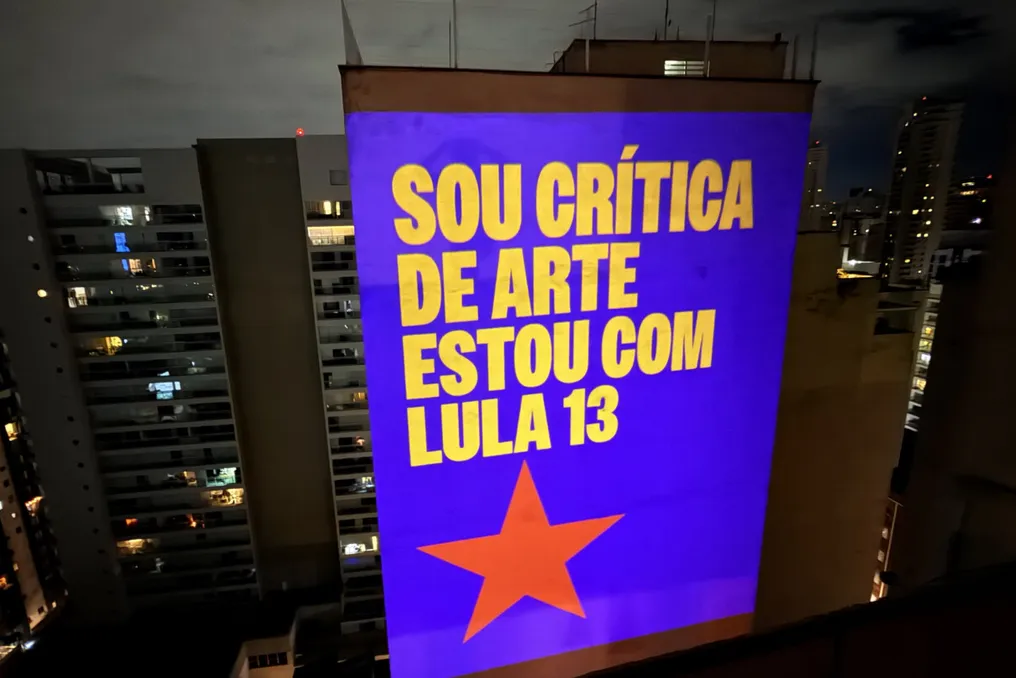
It is questioned whether gallerists and collectors need to endorse the political positions of their artists, raising the hypothesis that the most advantageous partnerships for the market are those that promote greater financial return. The author observes an increase in demands from artists for galleries, collectors, and art consultants to speak out during Elections, noting both the silence and the adherence of this sector with some perplexity.
What is strange is not just the omission of these agents, but the late perception that a market can negotiate works aligned with social transformation without assuming an equivalent commitment. For many years, this distance between the market and social engagement was accepted as inherent to the functioning of the business.
The author's trajectory in the artistic field did not begin with museum commissions; he maintained an independent magazine, but it was the interaction with artists that led him to collaborate with galleries, thus obtaining financial support to continue his artistic work. He reports not having received any text commission directly from a gallery, only occasional invitations for curatorial roles without artistic mediation.
Most often, those who seek the author are artists interested in interlocutors sensitive to their production, seeking poetic returns and the maintenance of a critical debate established in other contexts. Thus, the artists themselves end up financing the critical production that should be an integral part of the art system. This writing gives value to the works and accompanies trajectories, but its cost usually falls on those who already bear the production expenses. Furthermore, criticism faces the dilemma of writing about precariousness while its own remuneration remains uncertain.
The question arises as to why the subsistence of artists still depends on the willingness of agents whose main focus is the commercialization of their works. The text differentiates those who work physically—such as installers, transporters, technicians, and art handlers, responsible for moving and maintaining the exhibited work—from those who operate in the sphere of influence, such as researchers, producers, and, mainly, gallerists, collectors, and art consultants, who mediate the valuation, circulation, and purchase of the pieces.
This disparity is accentuated when the commercialized object is itself a critique of structures of exclusion and violence. A large part of current production that mobilizes collectors and institutions originates from Black, Indigenous, and peripheral demands, expressing not only pain but also the creation of resistant languages, memories, and ways of life. Although some of these movements achieve great recognition, the valuation of the works does not always reflect the dimension of the territories and relationships that made their existence possible.
The core issue is not individual recognition, but rather the ease with which the market converts a collective claim into private value. Dissent becomes an asset, and confrontation with inequalities, a characteristic that legitimizes the value of the work. Ferreira Gullar had already pointed out this mechanism, describing the process of capitalist society as something that transforms everything into commercial value, including gestures of refusal, which can become commodities.
In response to this, the author is interested in the initiatives of the artists themselves. The Maxwell Alexandre Pavilion offers a space to present works in development without being totally dependent on the circuit's schedules, while Sertão Negro, founded by Dalton Paula and Ceiça Ferreira, uses resources generated by the artistic production itself to create a living structure, including training and collective sharing. Both initiatives reject the idea that the value of a work ends with its sale.
Galleries and spaces managed by artists are not limited to representation; they can foster public programs, meetings, and training, feeding other trajectories. Although embedded in the market, artist management does not guarantee equitable relationships. There is a crucial difference between arrangements where artists participate in decisions and resource distribution, and those where this power is concentrated in owners, investors, or collectors.
Even though many people have given up producing art because they cannot guarantee a minimum dignified life, the author shares the necessity of combining writing, curating, production, and teaching to remain active. He criticizes the notion that accumulating these functions constitutes freedom, referencing the idea of the 'artist-etc' by Ricardo Basbaum, which, although initially poetic and political, has transformed into an economic requirement, being a symptom of the precarization of the field.
Citing Byung-Chul Han, the author points out that in neoliberal self-exploitation, aggression turns against the individual itself, resulting in depression instead of revolution. However, he believes that this does not eliminate the possibility of collective organization, but makes it more urgent and challenging, as organizing requires time and breath, a scarcity for those who need to work incessantly.
The criticism of the market's dominance over art is not new, but its capacity to absorb and incorporate opposing discourses is notable. Indignation itself can circulate as a marker of distinction without altering contracts or remunerations. The strength of elections will only be real if it is capable of paving the way for fairer agreements, cooperative relationships, and solid commitments to working conditions, and not just to the themes addressed in the works.