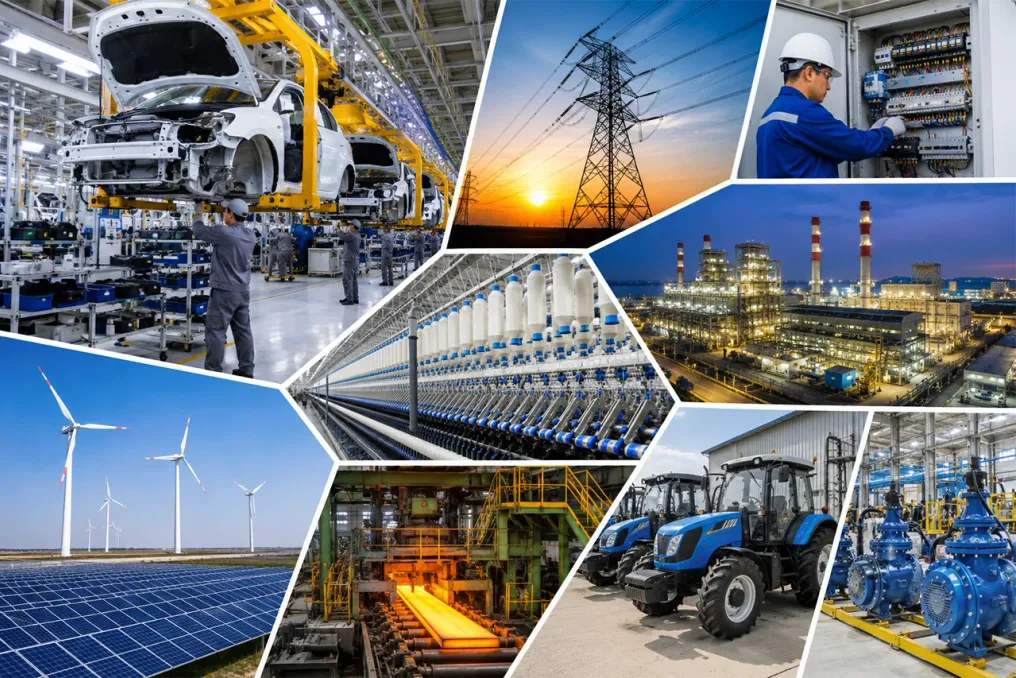
Uzbekistan demonstrates a more balanced model of industrial participation in global value chains compared to other Central Asian countries. To support automotive production, engineering, and advanced processing, the country is increasing the import of technologies and components. These findings are presented in a working paper by economists from the Eurasian Fund for Stabilization and Development (EFSD), which analyzes the participation of Kazakhstan, Kyrgyzstan, Tajikistan, and Uzbekistan in global value chains.
According to the authors' calculations, Uzbekistan's intermediate exports—goods that are subsequently processed in other countries—accounted for 13.1% of GDP in 2024. Final exports reached 4.5% of GDP, resulting in an approximate ratio of three to one. Between 2022 and 2024, the domestic value added embodied in intermediate exports grew from 11.5% to 13.1% of GDP. Uzbekistan's overall participation index in global value chains reached 55.8% in 2024, up from 55.6% in 2022, while the reverse participation index, reflecting the use of imported components, stood at 24%.
EFSD economists suggest that between 2022 and 2024, Uzbekistan showed the most significant growth in value chains in the region. Although the average length of production chains remained unchanged, the distance between Uzbek exports and final consumers increased from 2.76 to 2.97. The authors believe that products such as textiles and goods produced by industrial clusters are becoming increasingly complex intermediate components for global production. According to the report, 86% of the domestic value added in Uzbekistan's exports comes from industries with relatively long production chains.
Automotive manufacturing has the longest production chain among Uzbekistan's industries (2.89), while the share of foreign components is 1.20. The report views this as evidence of the deep integration of the automotive sector into global production networks. In metallurgy, the production chain length is 2.07, and the share of foreign technology is 0.73, which the authors attribute to the use of imported equipment for smelting and rolling.
The authors define Uzbekistan's textile and automotive clusters as a positive exception in the region, noting that policies encouraging processing have helped lengthen domestic production chains. Previously, domestic value added in the textile industry was focused on cotton cleaning, but now it also includes spinning, weaving, design, and branding. Buyers of Uzbek textile products include Inditex, H&M, LC Waikiki, The North Face, and Kiabi. The authors also point out that Uzbekistan's relatively large domestic market creates a natural foundation for the development of complex industrial clusters.
Switzerland remains the largest destination for Uzbekistan's added value, receiving $1.71 billion, or 17.9%. The authors explain this due to Switzerland's role as a gold processing center. According to EFSD, Uzbekistan continues to be a major supplier of natural gas and gold. China ranks second with a share of 7.5%, and Turkey accounts for 4.7%.
Imported added value primarily comes from Russia, amounting to $2.25 billion, or 29.9%, and China, which provides $1.64 billion, or 21.7%.
Economic ties with neighboring countries remain weak. Of Uzbekistan's $9.7 billion in added value included in other countries' exports, only $132.8 million comes from Kazakhstan's exports. Meanwhile, Uzbekistan is the largest regional recipient of Kazakh added value, receiving $579.7 million out of $766 million supplied to neighboring Central Asian countries. The combined contribution of five key Kazakh industries to Uzbekistan's metallurgical sector exceeds $325 million.
In comparison, Kazakhstan remains a major supplier of oil, ores, and metals, according to the authors. Kyrgyzstan heavily relies on imported components and functions as a transit and logistics hub, while Tajikistan is closer to the beginning of production chains as a raw material supplier. Overall, the region continues to export predominantly raw materials, and most of the revenue related to technology goes to the countries that process them.
The authors recommend deepening economic cooperation in Central Asia, gradually shifting from raw material exports to higher-processed products, attracting foreign direct investment linked to local processing and technology transfer, and reducing transaction costs in regional trade. The calculations are based on the intercountry 'input-output' tables of the Asian Development Bank.