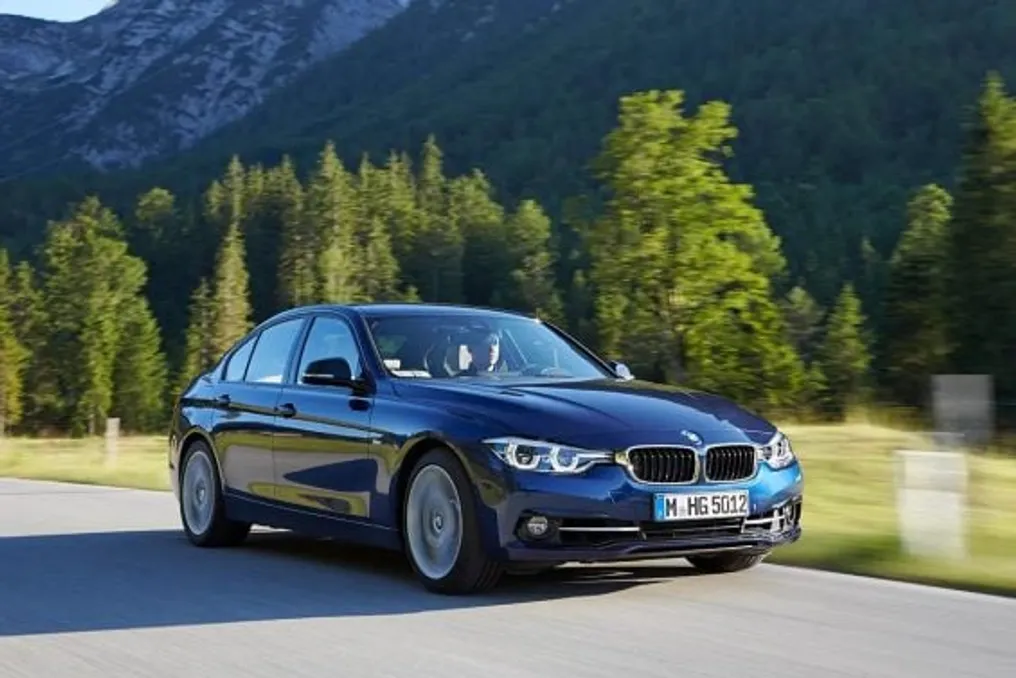
The BMW 320i is recognized as the most successful model from the German manufacturer in the Brazilian market. This success is largely due to it being one of the most accessible options offered by the manufacturer and having been produced in the country since 2014. Furthermore, the sedan incorporates the sportiness, dynamics, and refinement expected of a premium brand, making it a coveted choice in the used car segment.
This article details ten aspects of the 2016 BMW 320i, belonging to the sixth generation, manufactured in Brazil, and equipped with a flex engine.
History of the BMW 320i in Brazil
The trajectory of the BMW 320i in Brazil began shortly after the liberalization of imports. The third generation of the sedan (E36) started being officially imported in 1991, using the M50B20 engine, a 2.0 inline six-cylinder engine that generated 150 hp and 19.4 kgfm.
In 1998, the fourth generation of the 3 Series was introduced in Brazil. This version featured more rounded lines and a renewed architecture, promising 70% greater structural rigidity. At that time, the BMW 320i used a 2.2 setup, with 170 hp and 21.4 kgfm, coupled with a five-speed automatic transmission.
The fifth generation of the Bavarian brand's sedan, designated E90, arrived in Brazil in May 2005. With a bolder and sportier look, this model introduced the iDrive system, which concentrated the control of various vehicle functions into a single command. The engine remained an enhanced 2.0, maintaining 150 hp and a six-speed automatic gearbox.
Around 2012, the Brazilian market received the sixth generation of the BMW 3 Series and, consequently, the 320i. In this iteration, the sedan came equipped with a 2.0 turbocharged four-cylinder engine, delivering 184 hp and paired with an eight-speed transmission.
In subsequent years, the engine became flex, and the BMW 320i began to be assembled locally. There was another platform change in 2019, with the departure of the F30 model and the arrival of the seventh generation, under the G20 code. More recently, a new 3 Series was displayed in Europe, featuring a controversial design and fitting into BMW's Neue Klasse concept, with an expected arrival in Brazil in the second half of 2027.
Local Production and Technical Features
In 2014, BMW inaugurated its automotive factory in Araquari (SC), following the Inovar-Auto program, with an initial projected capacity of 32,000 units annually. The first 3 Series produced on the Santa Catarina assembly line was a 328i. Subsequently, the plant began manufacturing the 320i with the 184 hp ActiveFlex engine, a version of the 3 Series line that achieved great popularity in Brazil. In 2019, the seventh generation of this three-volume also began to be produced locally.
Besides the sedan, the Araquari unit also produced the 1 Series. Currently, the factory manufactures SUVs such as the X1, X3, X4, and X5, the latter in plug-in hybrid versions. Recently, the plant's production surpassed the mark of 110,000 vehicles.
An interesting aspect of the 3 Series is that it became flex before starting production in Brazil. The 2.0 engine, equipped with turbo and direct injection, was developed in collaboration between BMW engineers from Germany and Brazil, along with Bosch, to accept ethanol and gasoline. Thus, the BMW 320i was launched as flex in its fourth generation in 2013, but only started being assembled in Santa Catarina the following year. It is notable that the 3 Series was the world's first flex turbo vehicle.
The 320i with the ActiveFlex engine fulfills the BMW emblem, maintaining 184 hp compared to the gasoline-only version, while preserving the agility and performance characteristic of a sports car. The sedan demonstrates good performance in initial accelerations, and the eight-speed automatic gearbox contributes to agile driving, marked by quick and well-executed shifts. According to BMW itself, the 0 to 100 km/h time for the 2016 320i is 7.7 seconds.
The pull-ups are efficient; even at low RPMs, the engine responds voluntarily and vigorously. From 1,250 rpm onwards, the maximum torque of 27.5 kgfm is available to provide pleasure to the driver. When pressing the accelerator pedal more instinctively and at high RPMs, the deep sound of the engine encourages acceleration. Reaching the allowed 110 km/h on highways presents no difficulty, and at these cruising speeds, the BMW 320i maintains a 'serene' behavior, with the tachometer indicating 2,000 rpm.
However, it is important to note that having a powerful BMW with a flex engine and low fuel consumption is not a reality. The average consumption figures for the 2016 BMW 320i, according to PBEV/Inmetro, must be consulted separately.
Comfort, Safety, and Dimensions
The rear-wheel drive inherent to the BMW 320i provides a distinct driving experience. It is a premium brand sedan, endowed with German engineering and fine tuning that pleases the driver. Its architecture reveals a robust vehicle, with a very rigid body that encourages acceleration and firm cornering. The steering is precise and directs well, while the pedals and suspension transmit solidity, characterizing an authentic BMW.
With a length of 4.62 meters and a wheelbase of 2.81 meters, the 2016 BMW 320i can be considered suitable for family use. Both the driver and passengers enjoy good leg and knee space, and the rear seat comfortably accommodates up to three adults of medium height. The suspension, configured with MacPherson in the front and independent multi-link at the rear, has a firmer calibration, but this does not result in excessive vibrations in the steering wheel or discomfort for rear occupants.
The interior finish of the 320i possesses the level of sophistication expected of a BMW, and the acoustic insulation is surprising, especially during long trips. The trunk offers capacity for medium and large luggage, totaling 480 liters.
Considering the 2016 BMW 320i M Sport version, safety features include six airbags, stability and traction control systems, hill start assist, rear sensor, tire pressure monitoring, electrochromic rearview mirror, disc brakes on all four wheels, LED headlights, and daytime running lights. Additionally, there is a reverse camera.
In terms of comfort, the vehicle features dual-zone automatic air conditioning, electric adjustments for the front seats, steering wheel shift levers, leather upholstery, light and rain sensors, cruise control, electric sunroof, gas spring-supported hood, among other items.
The multimedia center integrates a prominent screen on the dashboard, offering native GPS, DVD/CD player, USB port, and Bluetooth connectivity. The car is also equipped with a sunroof and 18-inch alloy wheels.