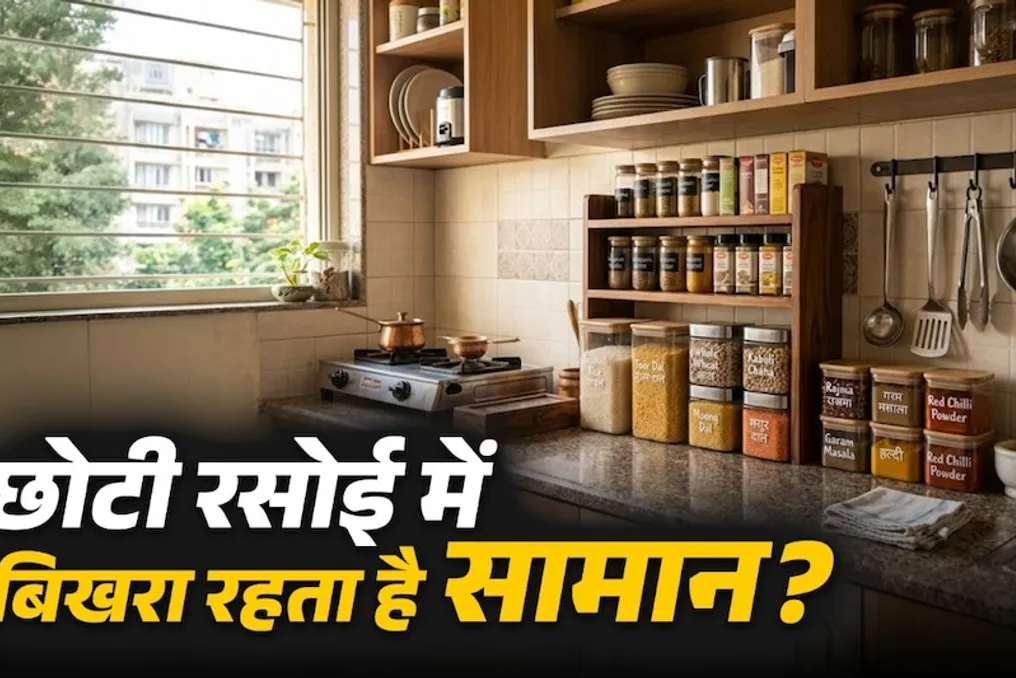
During holidays such as Dasara and Diwali, house cleaning begins, and maintaining order in the kitchen becomes one of the biggest tasks. This is especially true in Indian homes where space quickly fills up with beans, rice, flour, spices, oil, and various containers. Sometimes there isn't even enough room to keep necessary items visible. However, with a little understanding, you can effectively utilize every centimeter of a small kitchen.
This does not require expensive storage systems; it is enough to arrange containers correctly and use the available space. If you store items in a small kitchen in an organized manner, every item is easily found and accessible when needed. We present several simple methods that will help keep your kitchen in perfect order.
How to organize a small kitchen:
Use square containers for beans and rice
Although round containers look aesthetically pleasing in kitchen cabinets, most people buy them, leaving empty space between them. Instead, you should use square or rectangular containers. They fit together easily, minimizing wasted space on shelves. Storing uniform-sized containers with beans, rice, rajma, lentils, and other grains makes the entire cabinet more orderly.
Create two levels on one shelf
If there is a lot of empty space above in your kitchen cabinets, you can use shelf risers. This allows you to create two levels on one shelf. Small containers can be placed on the upper level, and larger ones on the lower level. Thus, storage space increases without the need to install new cabinets.
Utilize cabinet doors
Often, the inside of a cabinet door remains unused. Small shelves or hooks can be installed here to hold small spice jars, foil, parchment paper, or light kitchen utensils. This frees up more space on the main shelf, allowing you to place other necessary items there.
Place hooks on the wall
It is not necessary to store everything in drawers or cabinets in a small kitchen. Hooks can be hung on the wall for cups, ladles, spoons, and small baskets. This looks nice, and using the free wall space frees up a lot of counter and drawer space.
Label every container
After storing beans, rice, and spices in uniform containers, it can sometimes be difficult to know exactly what is inside. In such cases, small labels are very useful: simply write the contents' name on each container. This eliminates the need to open containers while cooking and helps keep the kitchen clean and tidy.
Store frequently used items separately
Items used daily should be placed in easily accessible locations instead of constantly keeping them inside a cabinet. For example, sugar, salt, tea, or daily beans. Easily opening containers or dispensers can be used for this purpose. This reduces the hassle associated with constantly opening and closing large containers.
Do not store too many grains at once
People often tend to accumulate the entire stock of grains in the kitchen, but if your kitchen is small, you should avoid excessive food stock. Instead of placing a large 10 kg package of rice or beans on the floor, divide it into small airtight containers. Grains must always be stored in a dry and cool place, away from the stove, oven, and direct sunlight.
Use old stock first
After purchasing a new supply, you should not place the new product on top of the old one in the same container. You must first completely use up the old stock, then clean the container and fill it with the new product. This ensures that the old products are used in time and that the new stock does not spoil due to mixing with the old.
Check containers during rainy weather
During rainy weather, moisture can lead to insects or clumps in beans and grains. Therefore, it is recommended to open the containers once a week and check the contents. If signs of moisture, odor, clumps, or insects are found in any container, it should be isolated from the other products.
The most important rule for a small kitchen
The simplest way to maintain order in a small kitchen is to apply the principle: when you bring one new thing home, get rid of one old or unnecessary thing. Also, try to use containers of the same type and assign a permanent place for every item. Thus, even a kitchen with limited space can become clean, organized, and easy to use.