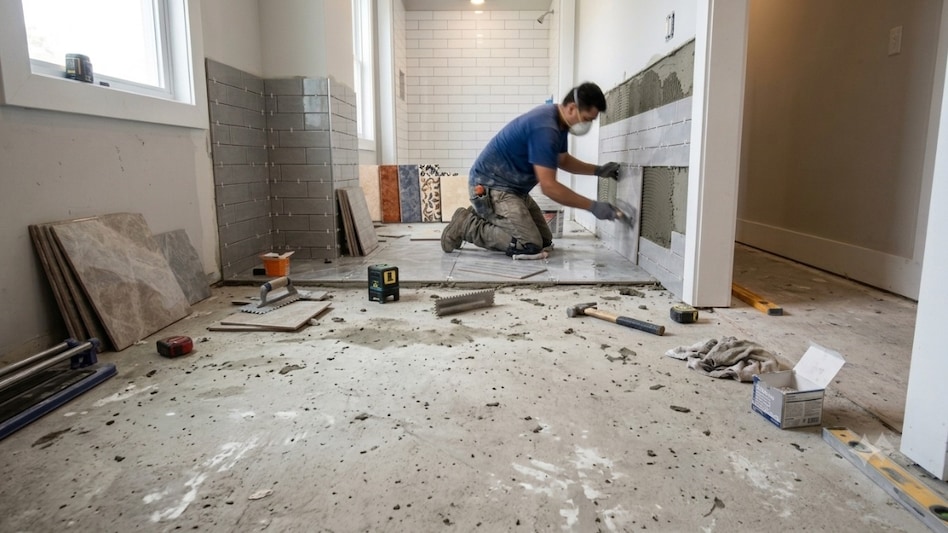
When building a house, it is crucial to choose the appropriate tile for floors and walls. Two types of tiles are widely used in the market—ceramic and vitrified. Although they may look identical at first glance, there are differences between them in structure, strength, water absorption capacity, and price. The question arises as to which tile will be better for the house and which option will be more budget-friendly.
Ceramic tile is made by mixing clay, water, and other minerals. This mixture is shaped to the desired form and fired in an oven. Often, a glaze is applied to its surface—a glossy or colored layer that improves the tile's appearance and simplifies cleaning.
Generally, ceramic tile absorbs more water compared to vitrified tile. However, the ability to absorb moisture depends on the quality of the tile itself and its surface coating. Due to its relatively low cost, it can be a good choice for those building or renovating a home with a limited budget.
It is used for walls in bathrooms and kitchens, as well as for walls in bedrooms and low-traffic areas. Ceramic tile can also be laid on the floor, but before doing so, its strength and slip resistance must be checked.
To produce vitrified tile, materials such as clay, silica, feldspar, and quartz are used. These components are mixed and subjected to firing at very high temperatures. This process is called vitrification. As a result of this process, a dense, glass-like structure forms inside the tile, and pores become minimal.
This is why high-quality vitrified tile absorbs very little water; typically, the water absorption level is less than 0.5 percent. It resists stains and scratches from daily use. However, its performance characteristics depend on the type of tile, surface quality, and overall quality level.
Vitrified tile is used in living rooms, kitchens, offices, stores, and high-traffic areas. Polished vitrified tiles provide a glossy finish, while matte and anti-slip options are suitable for areas where there is a risk of falling.
The main difference between these two types of tile lies in their structure and water absorption capacity. Ceramic tile is generally more porous, whereas vitrified tile is denser. Because of this, vitrified tile is often considered a more durable option for flooring.
Ceramic tile is suitable for walls and general areas on a small budget. At the same time, vitrified tile may be the better choice for high-traffic floors. Both types of tiles are available in various design, color, and finish options.
Regarding service life, quality ceramic tile can last about 10–15 years with normal use. The service life of vitrified tile can reach 15–25 years. However, this is not a fixed term; the lifespan can decrease or increase depending on proper installation, maintenance, and operating conditions.
If considering the initial price, ceramic tile is usually cheaper than vitrified tile. This is especially true for wall cladding, where it is a budget-friendly option. Nevertheless, the price of both types of tiles varies depending on size, design, thickness, brand, and quality.
Although the initial cost of vitrified tile may be higher, it can prove to be a more economical solution due to long-term use on the floor and low water absorption. If an area has high traffic, one cannot choose tile based solely on a low price.
When purchasing tile, you should consider not only the price per square foot. You must also add the costs for installation labor, adhesive material, cutting, edge finishing, and potential losses due to defective tiles. This will give you an accurate idea of the total budget.
Ceramic tile can be an economical choice for walls in the bathroom, kitchen, and bedroom. Here, attention should be paid to light weight and ease of cleaning.
If the budget is limited for flooring in the bedroom, you can choose quality ceramic floor tile. In this case, you must check the tile's strength and slip resistance.
For the living room and office, i.e., high-traffic areas, vitrified tile will be useful. Here, you should choose tile capable of withstanding daily use.
When choosing tile for the bathroom and balcony, you should not only look at the price or shine. Protection against slipping, drainage, and proper waterproofing are also important. Anti-slip tile is preferable for wet floors.