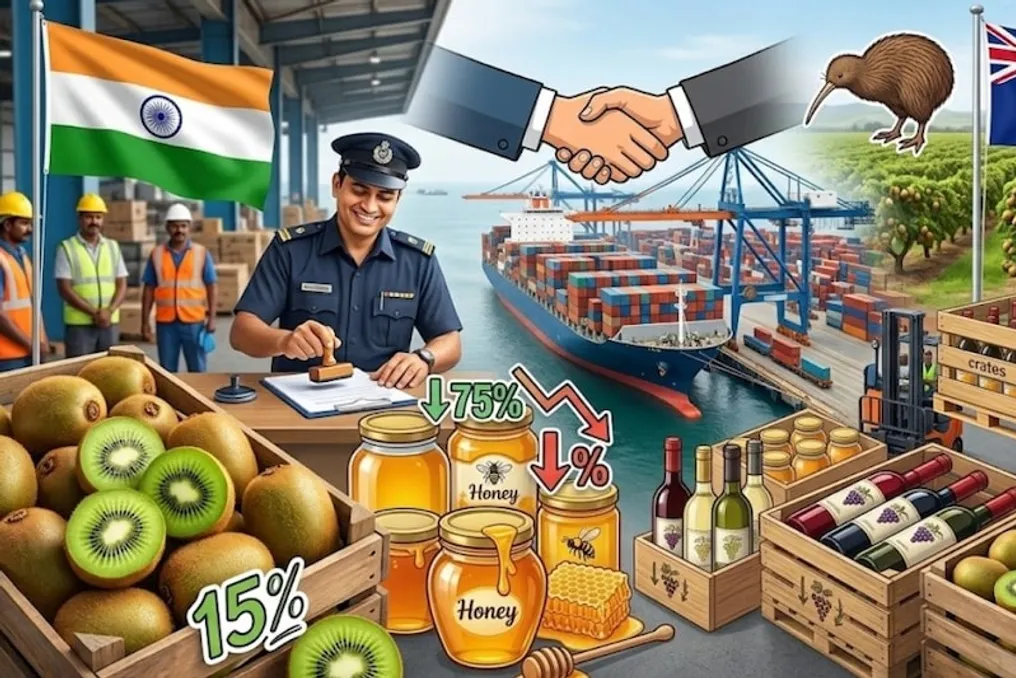
Preferential tariffs on alcohol, kiwis, and other goods from New Zealand to India take effect on October 20
Read more
Aaj Tak
www.aajtak.in

Preferential tariffs on alcohol, kiwis, and other goods from New Zealand to India take effect on October 20

Although the free trade agreement between India and New Zealand was announced earlier, details regarding the size of customs benefits for various goods from the Indian side had not been officially published. However, India has now announced the first abolition of duties on imported goods under this Free Trade Agreement (FTA) with New Zealand.

With this announcement, preferential rates come into effect on October 20 for products such as alcohol, manuka honey, kiwis, and beef. The Ministry of Finance established revised basic customs duties and tax rates for certain goods in a notification dated October 16. These benefits apply provided that the listed goods comply with the rates and conditions set out in the notification.

According to the notification, fresh, chilled, and frozen sheep meat will be subject to a zero duty rate, but the Agricultural Infrastructure and Development Cess (AIDC) and health tax will apply. A 15% tax will be levied on the import of kiwi fruits valued at $2.50 per kilogram or more. This benefit is dependent on the conditions established for the classification and import of the respective products. A tax of 25.71% will apply to many types of fish, while AIDC and health tax will be zero.

Nevertheless, since the applicable rates vary depending on different duty categories, the available discount will depend on the classification of the imported goods. Instead of completely eliminating import duties, this notification provides relief on certain specific tariffs and levies. Importers must check the relevant tariffs to determine the applicable rate for each consignment.

This notification includes a quota system of tariffs, which allows the import of certain goods into India at reduced rates. Importers will have to meet the specific requirements for these products and provide a New Zealand certificate to claim the benefits. These measures provide limited access to imports from New Zealand while maintaining benefits for sensitive sectors. Dairy products and staple agricultural goods will remain outside the scope of the benefits.

The rates and conditions applicable to the first set of customs benefits under the Free Trade Agreement between India and New Zealand were determined by the Ministry of Revenue in accordance with Section 25(1) of the Customs Act of 1962.
Similar stories

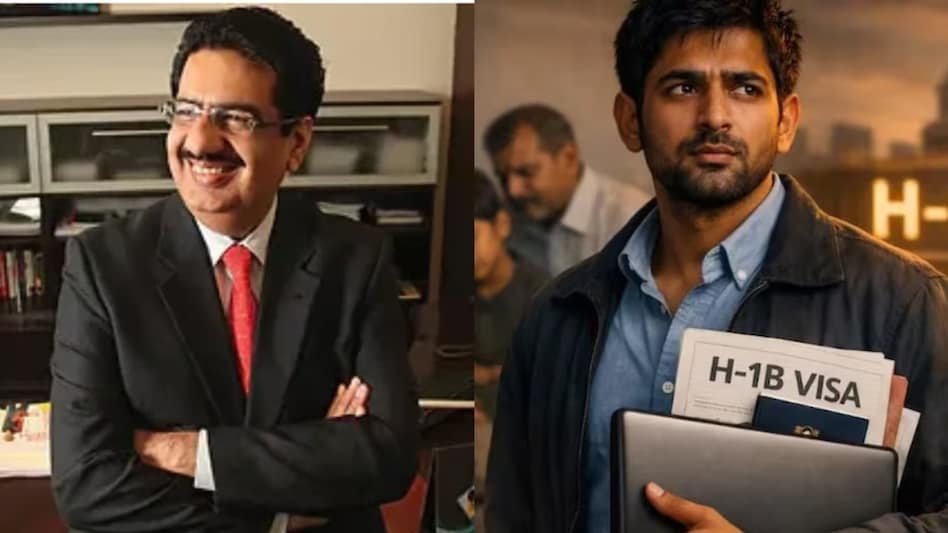
Former HCL CEO Vinit Nair Comments on Impact of US Green Card Program Restrictions on Work Transfer to India
Read more
www.aajtak.in

Former HCL CEO Vinit Nair Comments on Impact of US Green Card Program Restrictions on Work Transfer to India

Vinit Nair, former CEO of HCL Technologies, issued a statement regarding the halt of the American Green Card program on Friday. In his social media post, he noted that US President Donald Trump desires fewer Indian technical specialists to come to America. This, in turn, could unintentionally lead to more American technology tasks being transferred to India.

This statement came after US Labor Secretary Kit Sunderling announced on Thursday the suspension of processing applications under the PERM Green Card program for several large IT outsourcing firms.

Nair wrote that Trump aims to reduce the number of Indian technical workers in the US, which could potentially cause a larger volume of American IT work to shift to India. He stated that upon reading reports about US measures restricting the use of PERM by major tech companies, he felt no concern.

He also shared statistics, pointing out that the share of Indian IT companies among the 117,849 PERM certificates issued last year was less than 2%, or fewer than 1,400. Consequently, the direct impact might be smaller than it seems, but according to him, there are other interesting processes hidden behind this.

Nair explained that in the initial IT model, when a client in the US had an important task, India would send its engineers there. Later, it was discovered that much of this work could be done directly from India. This led to the 'on-site-offshore' model. He stated that he personally witnessed this transformation and believes that humanity may be on the threshold of another such change.

Furthermore, Nair pointed out a paradoxical situation: while America makes it difficult to attract Indian talent to its territory, technology simplifies the ability for small teams in India to take responsibility for faster tasks. Thus, America's desire to reduce the staff of Indian employees may accelerate the migration of American work tasks to India.

Nevertheless, he clarified that this is not about a new wave of coding and maintenance work. According to Vinit Nair, the real opportunities lie in architecture, product engineering, cybersecurity, AI, as well as product and intellectual property (IP) ownership.

He advised Indian entrepreneurs collaborating with American clients and companies. Nair suggested that Indian teams should not limit themselves to receiving instructions from New York; they should help define what needs to be created. They should not just support the technical platform of a global bank but participate in its redesign. Instead of simply providing engineers to solve others' problems, they should take ownership of those problems.

He further mentioned that for about three decades, the Indian IT sector grew parallel to the increase in employment in the Indian IT industry. This happened because companies usually hired more engineers as turnover increased. However, now, thanks to improved AI productivity, the advent of artificial intelligence will enable the execution of more complex tasks. Companies will be able to earn more money without increasing headcount proportionally. Warning the industry, Nair emphasized that while the Indian IT sector competed based on the cost of Indian talent for the last 30 years, the next 30 years will depend on the potential of these talents.

Popular