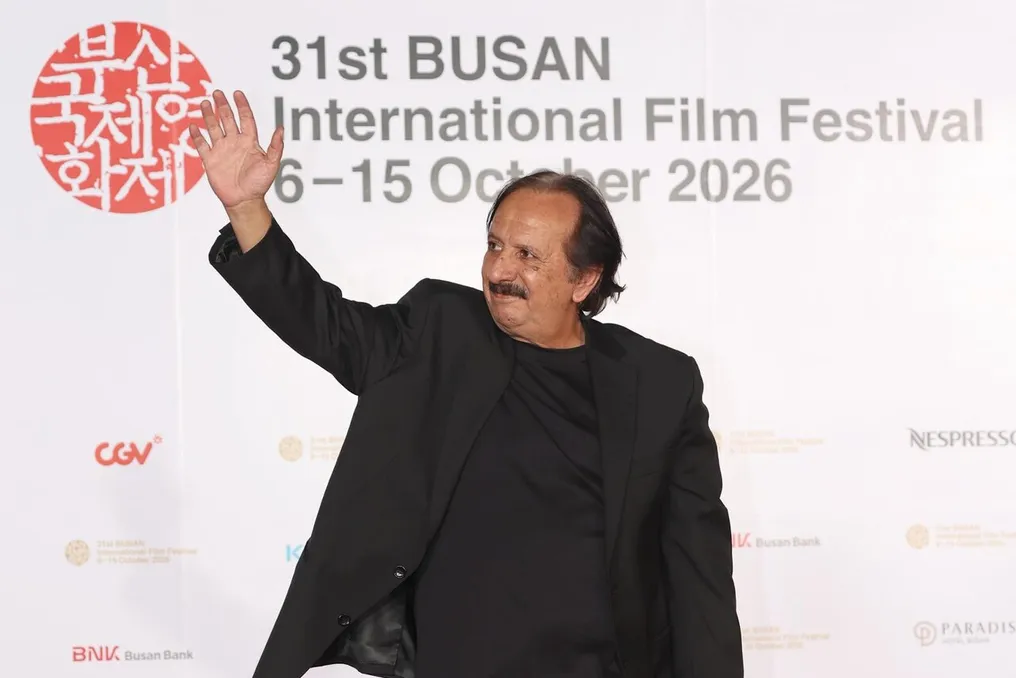
Majidi won the 'Best Film' award at the 31st Busan International Film Festival (BIFF) on Thursday for his new film 'Midday Meal'. By receiving this award, the renowned director has secured a direct path for his film to be considered for upcoming Academy Awards, as the film's world premiere took place at the festival.
Starting this year, the winner of the main prize in the Busan Award section automatically qualifies to submit an application in the 'Best International Feature Film' category at the Academy Awards ceremony. Furthermore, the 'Best Film' award comes with a monetary prize of 50 million won ($37,180).
Iran has already selected Babak Hajepashi's film 'Land of Angels', a drama about children surviving the war in Gaza, as its official nomination for the 99th Academy Awards. However, thanks to 'Midday Meal', an alternative route to participating in the race for the award has now opened up.
At the closing of the festival, jury president Zhang Yimou, a legend of Chinese cinema, highly praised 'Midday Meal', calling it a perfect film, and noted that all seven jury members unanimously reached this decision. Excitement surrounding Majidi's film grew throughout the week in Busan, and many correctly predicted that it would receive the top prize.
Upon receiving the award, Majidi expressed gratitude to the festival, noting that it was a great honor to receive such a significant prize during his first visit to Busan. He added that his energy comes from the memory of his late mother.
He dedicated the award to the 'brave people of Iran' who 'continue to resist oppression' and 'never give up'. Commenting on the economic sanctions imposed against Iran, the Iranian filmmaker stated: 'For 48 years, our people have been subjected to the harshest economic sanctions, to the extent that even access to medical care for treating children with cancer has been forbidden. Despite this, they have not capitulated.'
Majidi also mentioned the military attacks on Iran, stating: 'You all saw how, when they realized the Iranian people would not surrender, they repeatedly subjected our country and cities to the most intense and brutal bombings.'
He continued, describing the death of children on the first day of the attacks: 'On the first day of the attack, 168 innocent children were torn apart, and the bodies of some of them were never found.'
Referring to the attacks on homes, universities, and residential areas, as well as the death of thousands of people, Majidi questioned why the Iranian people should pay such a high price. He emphasized: 'What crime is our people committing? They simply want to be independent, and we will stand until the very end.' He concluded his words with a wish for a future free from war, filled with peace, love, and friendship.
Earlier at the festival, Majidi detailed in a press conference how he almost declined the invitation to South Korea because he felt depressed and exhausted due to the difficult situation at home. Ultimately, he decided that the trip would allow him and his film to convey 'some small message from my people to people of other nations and places.'
'Midday Meal' captivated critics in Busan with its powerful, parable-like narrative and confident visual style. The story is about Davoud Soulan (Mohammad Rahimi), a contract teacher in a remote village in southeastern Iran, whose hopes of securing permanent government employment are threatened after the death of a wealthy benefactor and the disappearance of free meals that helped his poor students attend school. Determined to save both his school and his future, Soulan resorts to increasingly desperate measures, including dangerous cross-border fuel smuggling, as his innate kindness conflicts with his modest ambitions.
This film continues Majidi's long-standing thematic focus—the moral pressure faced by people on the periphery of society, which was evident in his early works that received awards at festivals such as 'The Color of Paradise' (1999) and 'Baran' (2001).
For 'Midday Meal', he assembled a completely non-professional cast by searching for actors on the streets in the region, staging their performances against the backdrop of the harsh, otherworldly landscape of Iran's so-called Martian mountains. Majidi and cinematographer Human Behmanesh capture much of the drama using a tracking camera, often placing the protagonist against the severe, otherworldly landscape of the region. The film gradually acquires the quality of a mysterious existential parable.
This is the first time Majidi has been invited to Busan; previously, he appeared at Cannes, Berlin, and Venice over the past 35 years. He is the most represented Iranian filmmaker in the international category of the Academy Awards, having received a nomination in 1999 for 'Children of Heaven' and being shortlisted in 2021 with 'Sun Children'. Thanks to his humanistic approach to social realism and special emphasis on children's well-being, 'Midday Meal' aligns with Majidi's creative legacy, which includes films like 'The Color of Paradise' and the 2020 Venice submission 'Sun Children'; however, he remains most internationally known for his 1998 film 'Children of Heaven', the first Iranian work ever nominated in the category now called Best International Feature Film.
_