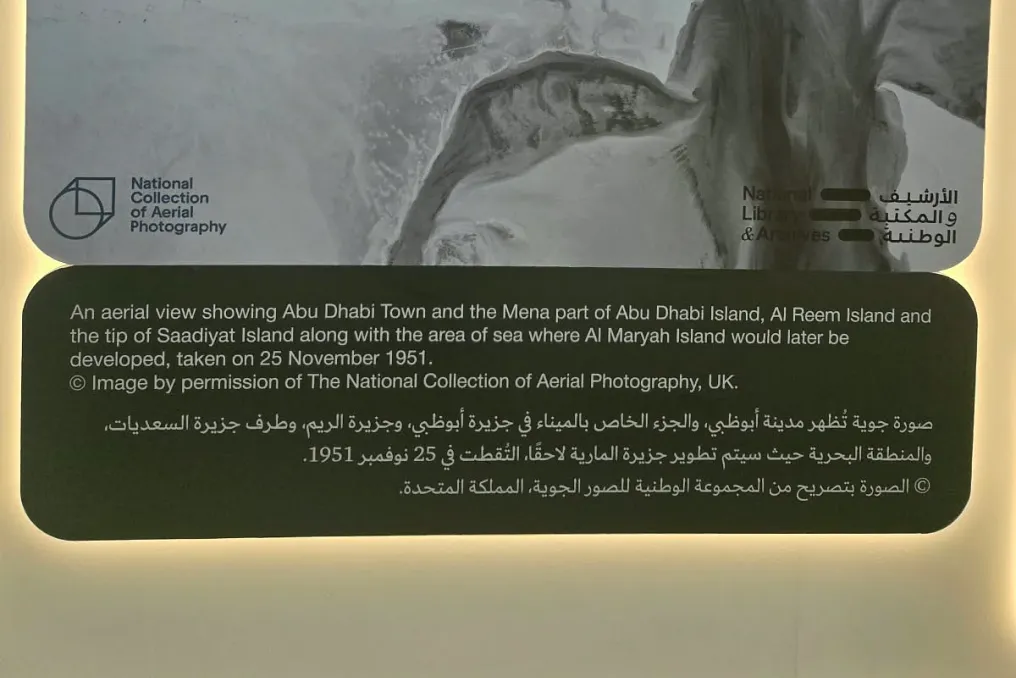
Before Al Maryah Island transformed into a financial hub composed of skyscrapers, luxury hotels, and global company headquarters, it was merely a stretch of coastline. Today, the transformation of this area can be recreated using an aerial photograph consisting of 44 images, which is held in the UAE National Library and Archives. This remarkable collage captures Abu Dhabi at a time when much of the city that defines its current silhouette did not yet exist.
Upon close inspection, the landscape may appear almost unrecognizable. The photos show Kasr Al Hosn, the old city of Abu Dhabi, coastal sections, open land, and water, but Al Maryah is absent in the form it exists today as a business and residential center. Mina Port has not yet taken its final shape, and Saadiyat remains largely undeveloped. Many islands, roads, towers, and landmarks familiar to modern residents have yet to appear.
According to Justin Kodrai, Senior Expert at the National Library and Archives, this is why aerial photography is so significant. The aerial image does not just demonstrate what Abu Dhabi looked like; it can show how the city was forming.
These 44 photographs were stitched together to create an extensive panorama of Abu Dhabi from 1968, providing a rare bird's-eye view of a city that was at the beginning of transformations that changed its geography. The National Library and Archives itself is located on reclaimed land, serving as another reminder of the complexity of imagining the physical boundaries of the old city from a modern perspective.
At that time, even some infrastructure elements that would later connect Abu Dhabi to the wider emirate were just beginning to emerge. The first full bridge in Maktah had not yet become a familiar entrance, and the first Abu Dhabi International Airport had not yet opened.
There are also ground-level photographs. Afraa Butti Al Kubaisi, Content Accessibility Specialist at the National Library and Archives, conducts tours through images that allow one to perceive the transformations not so much as a urban planning exercise, but as human history.
One series is dedicated to the late founder of the UAE, Sheikh Zayed bin Sultan Al Nahyan, and his travels in the 1950s to Rome, Paris, and New York, long before Abu Dhabi became an international business center. In one photo, Sheikh Zayed is pictured by the Eiffel Tower, and in another, in Central Park in New York with his brother who required medical attention. A Palestinian man named Mohammed Badran overheard a conversation in Arabic, approached the group, and offered assistance.
This encounter subsequently became part of the archive: the National Library and Archives acquired Mohammed Badran's collection, which brought with it a group of photographs documenting a completely different Abu Dhabi and a completely different era of international travel. For Al Kubaisi, these pictures help place the transformation of Abu Dhabi in a human context.
The archive contains images of daily life alongside major infrastructural projects that changed the emirate: early oil and LNG facilities, Yas Island, the Umm Al Nar refinery, the first Abu Dhabi hospital, and experimental agricultural projects. One photo shows an experimental farm on Saadiyat, developed in collaboration with the University of Arizona to test the possibility of growing vegetables in Abu Dhabi's sandy conditions. Another captured a mobile bank operating from a Land Rover, providing banking services to oil industry workers.
There are also photographs of hospitality venues, including Bait Al Shamal and a guesthouse in Al Ain, as well as a 1904 picture showing Zayed bin Khalifa, Sheikh Zayed's grandfather, sitting in a majlis. These details are sometimes unexpectedly mundane, and that is what makes them valuable.
The city can be remembered by its towers and roads, but it can also be remembered by the places where people met, the ways they earned a living, the places they shopped, and the appearance of the coastline before it was filled and built up.
An exhibition held at the Four Seasons Hotel Abu Dhabi presents part of these materials in a setting that is itself part of history. The hotel, opened in 2016, celebrates its 10th anniversary with the Perspective, Crafted program, which includes an exhibition from the National Library and Archives tracing the transformation of Al Maryah through archival and contemporary images. Visitors enter through a large floral installation of thousands of purple and lilac flowers before seeing the historical photographs.
This juxtaposition is intentional: the modern hotel lobby is situated above a landscape that itself has undergone changes in living memory. However, the archive also demonstrates that the transformation of Abu Dhabi was never limited only to Al Maryah.
As Al Kubaisi moves through the exhibition, the images build a chronology of the city transitioning from low-rise houses and reed structures to roads, ports, industrial sites, and ultimately, to a much more complex urban landscape. For example, a photo of an early souk demonstrates the transition from informal street vending to a commercially purpose-built space.
Aerial photographs provide the corresponding overhead view. A later shot shows the Saadiyat experimental farm, the developing Corniche, and the emerging Mina Port, with Al Maryah already visible in the landscape. The next generation of photos demonstrates further progress: the port, changing coastline, and landmarks that have themselves become historical references.
Kodrai notes that the archive does not have a definitive answer as to which building appeared first on Al Maryah. But there is something perhaps more telling: evidence of the gradual emergence of the island within a much broader process of urban expansion. This distinction matters because today's Al Maryah might seem inevitable when viewed from the ground. It is not.
Currently, the island is associated with financial services, offices, luxury retail, hotels, and restaurants, as well as a dense waterfront silhouette. But the archival photographs show the land before these functions existed, and more broadly—the city before many of its defining elements were built.
Kodrai links the acceleration of Abu Dhabi's development to the period after Sheikh Zayed became the ruler of the emirate in 1966, describing a sharp change in the pace and ambition of development. He suggests that this story is one of successive generations building upon the achievements of previous ones. However, preserving this history comes with its own challenges.
The National Library and Archives are working on digitizing aerial materials stored in British collections, including photos obtained from the RAF, US Navy, and private surveying companies such as Hunting Surveys. About 50,000 aerial photographs have been digitized, and another 100,000 are in the process of being processed. The broader archive contains millions of photographs and documents, as well as extensive film footage and government records. For Kodrai, this work is urgent because the landscape itself is constantly disappearing under the next version of the city. An aerial photograph can preserve not only the shape of a road or coastline but also details invisible from ground level. When a high-quality image is magnified, the city suddenly comes alive again: people, vehicles, buildings, and small details appear. These images can then be compared with ground-level photographs, allowing researchers to move between the physical landscape and the life lived within it.