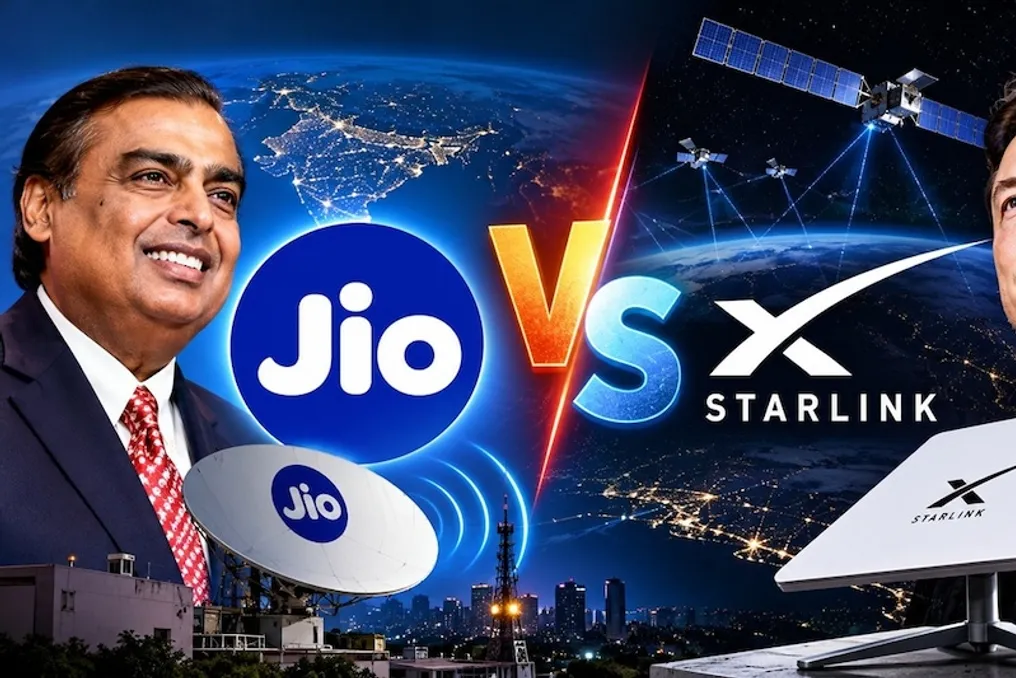
Jio and Starlink prepare to launch satellite internet services in India; competitive advantages and cost are being discussed.
Read more
Aaj Tak
www.aajtak.in

Jio and Starlink prepare to launch satellite internet services in India; competitive advantages and cost are being discussed.

Satellite internet services are soon to be launched in India. In this race, Starlink from Elon Musk and Jio from Reliance Industries are actively participating, attracting significant public attention. The Indian government has already issued licenses to three companies to provide satellite internet services, and they now need to obtain security approvals and allocate frequency spectrum before they can start operations.

The question arises as to what satellite internet service entails and at what price it will be available. Before answering this question, it is worth noting that there has recently been tension between Elon Musk and the Reliance company on social media.

Musk expressed doubts regarding delays in the launch of Starlink in India. In response, the Ministry of Government of India issued a statement clarifying that licenses have been granted to three companies, and the further process must be completed. Among the companies that received licenses are mentioned Starlink, Jio, and OneWeb.

Satellite internet service allows users to receive high-speed internet directly at home without the need to lay fiber optic cables or use ground mobile towers. This is achieved by placing satellites in low Earth orbits that provide high-speed internet transmission directly into homes.

Typically, during severe storms, earthquakes, tsunamis, or other natural disasters, ground poles and towers are destroyed, leading to internet connection outages. Satellite internet service remains protected and continues to function under such conditions.

The signal is sent from the satellite and then received by a home antenna dish, which is also called a terminal. This terminal receives the signal from the satellite and transmits it to a Wi-Fi router, providing users with high-speed internet.

The greatest benefit from satellite communication (SATCOM) will be enjoyed by areas where fiber optic lines have not yet been laid.

India is a very large market, and many companies are striving to launch their services here. This is precisely why Starlink is entering the market. The question arises as to which company, Jio or Starlink, will prevail. Competition in India is limited not only to technology; price is also an important factor, alongside speed, coverage, and installation cost.

Jio is already known for its affordable tariff plans and strategy. However, there is no official information yet on what price Jio and Starlink will begin offering their plans in India. Nevertheless, there are Starlink plans available in the USA. For example, in Chicago, USA, the initial monthly cost for residential and business customers is 55 US dollars (5,222 rupees). This plan provides a speed of 100 Mbps and is intended for small and medium-sized homes. Although the installation of the terminal and setup of the equipment that receives the signal from the satellite and transmits it to the router is provided, there is no official information yet on whether the terminal and installation in India will be free or paid.
Similar stories

SpaceX CEO Elon Musk states that Starlink services should be available in India, and competition benefits consumers
Read more
business-standard.com

SpaceX CEO Elon Musk states that Starlink services should be available in India, and competition benefits consumers

Elon Musk, founder of SpaceX, stated that Starlink services should be accessible to more people in India, and that the emergence of competition will benefit customers. He noted that even if Reliance Jio earns less money, the company will not go bankrupt.

These statements came shortly before the expected Initial Public Offering (IPO) of Jio, which could be the largest in India and value the company at over $100 billion. Musk once again spoke out against the Reliance group, calling it a 'de facto monopolist in India.'

In his post on his social media platform X, in response to user messages that he claimed supported Reliance Industries Ltd (RIL), Musk criticized the arguments put forth by the 'army of internet propagandists of Ambani.' He called them 'absurd hypocrisy and hyperbole,' pointing out the contradiction: first they claim Starlink cannot compete with the monopolist's low prices, and then they state that Starlink will be too strong a competitor.

Musk emphasized that competition always benefits the average citizen of India by providing them with more options. He added that if Starlink turns out to be too expensive in India, no one will use it, so SpaceX must make the prices affordable.

His comments followed a series of messages questioning delays in the approval of Starlink services in India and suggesting that some large business conglomerates, particularly the Reliance group, are hindering Starlink's entry into the Indian market.

Earlier, on Saturday, Musk addressed Prime Minister Ambani, apologizing for not realizing that he was the 'real boss of India.' He asked whether Ambani was willing to allow Starlink to compete despite the preference for maintaining 'monopolistic exploitation of the great people of India.'

He also pointed out that Starlink could be useful to users, including small businesses and children's education, in areas of India lacking internet access, and could save lives during natural disasters when other communication systems fail.

However, Musk's accusations drew sharp criticism. Nishikant Dubey, Chairman of the Parliamentary Committee on Communications and Information Technology, responded that the government is aware of the problems faced by the country's security services through Starlink since 2013–2014, and that the Ministry of Defence, the Ministry of Home Affairs, and investigative agencies suffer from these threats' dangerous games. He called for providing internet access to the poor in their own country, America, at affordable rates first, before making accusations, noting that India is a healthy democratic sovereign nation that does not change its security policy under pressure or on social media.

Rajiv Kumar, former Vice Chairman of NITI Aayog, stated that India should challenge Musk's monopoly in space communications by using the $145 billion USO fund. He proposed using these funds to assist Indian telecom operators such as Airtel and Reliance Jio so they can urgently deploy their satellite networks to compete with Elon Musk's Starlink. He believes this would be a better use of funds than endlessly waiting for BSNL to develop the necessary capacity for universal coverage.

Eutelsat OneWeb (now Eutelsat Group), supported by the Bharti group, and Jio Satellite Communications, a subsidiary of Reliance Jio, have received licenses, but they are still awaiting security clearances. Starlink received its latest approval in 2025, while Eutelsat and Jio received theirs earlier.

Jio is independently building its constellation of Low Earth Orbit (LEO) satellites, which will compete with global players like Starlink and Amazon Leo.

The government refuted Musk's claims last week, stating that all satellite broadband providers must comply with safety regulations to operate in India. The Ministry of Communications stated that the country's authorization system for telecommunication and satellite services is 'fair and non-discriminatory,' and any suggestion of its selective application is 'unfounded and erroneous.'

Telecom Minister Jyotiraditya Singh 'clarified the situation' on Friday, stating that India does not permit monopolies in any sector, including satellite communications, and that licenses were issued to all three companies—Reliance Jio, OneWeb, and Starlink—that applied. He also mentioned that the fourth interested party, Amazon Leo, must undergo the same process. Security clearance is conducted by the Ministry of Home Affairs, which will also issue final approvals. Singh added that the government is in discussions with the Telecom Regulatory Authority of India regarding satellite spectrum pricing, and only after all entities meet or comply with the security conditions can they begin operations.

Questions about Elon Musk's silence regarding the Starlink ban in China after licensing issues in India
Read more
www.aajtak.in

Questions about Elon Musk's silence regarding the Starlink ban in China after licensing issues in India

The issue of Starlink licensing continues in India. Elon Musk, head of the satellite company Starlink, expressed his dissatisfaction with the lack of approval in India and made several serious accusations.

This raised the question of why Musk is not expressing similar dissatisfaction in China, where Starlink is also banned. This question was posed on the platform X by Rajiv Malhotra, a researcher and author of Indian origin.

Musk, one of the world's wealthiest individuals, has invested significant funds in Tesla's business in China, yet the Starlink service has not yet received permission there.

In his post on X, Rajiv Malhotra asked: 'Elon, why hasn't Starlink received permission in China? Could some Chinese industrialist (oligarch) be behind this? You have invested heavily in Tesla in China, but the Starlink service is blocked there.'

Earlier, on Wednesday, a post circulated on social media claiming that Musk accused 'oligarchs' (influential industrialists) of obstructing the launch of the Starlink service in India, although he did not name names.

Following this, Musk criticized Mukesh Ambani, Chairman of Reliance Industries, questioning his status as India's 'chief boss'. After Musk's post was published, Congress politician Rahul Gandhi also posted a comment on the X platform.

Malhotra explained that the Starlink problem goes beyond technology and service quality; it is also related to national sovereignty. He noted that there are many reasons for this delay.

The Indian government also responded to Musk's statements. It stated that rules in India are the same for everyone and do not allow discrimination. It was clarified that licenses for satellite communication have been issued to three companies, and all must undergo a security vetting process while awaiting final approval.

The government mentioned the three companies granted licenses: Elon Musk's Starlink, Reliance Jio satellite communication, and Eutelsat OneWeb, supported by the Bharti group.

Popular