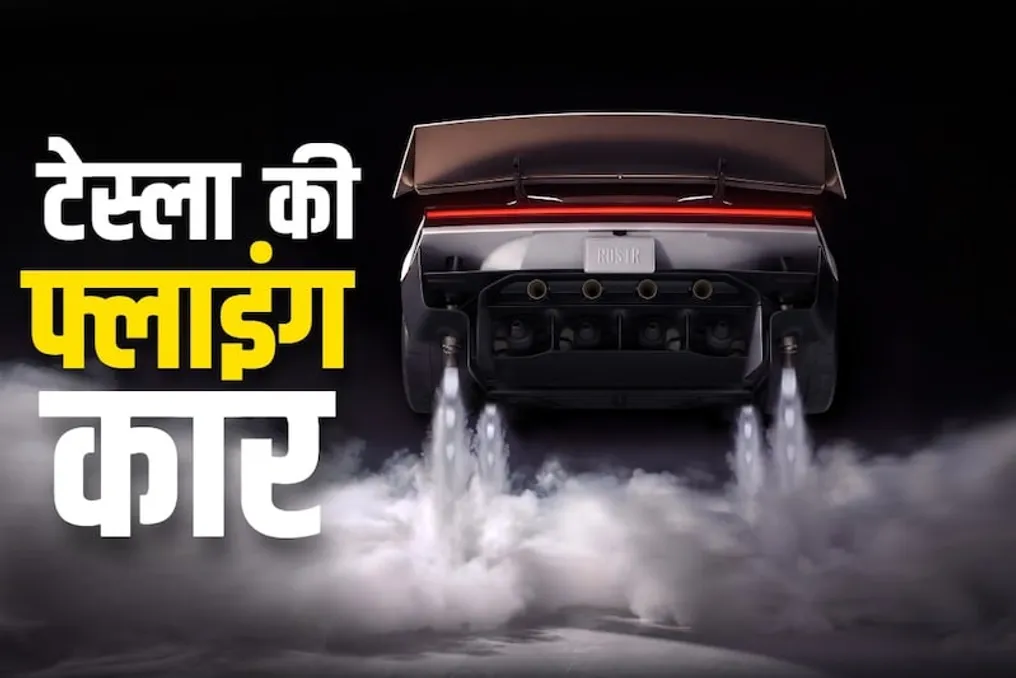
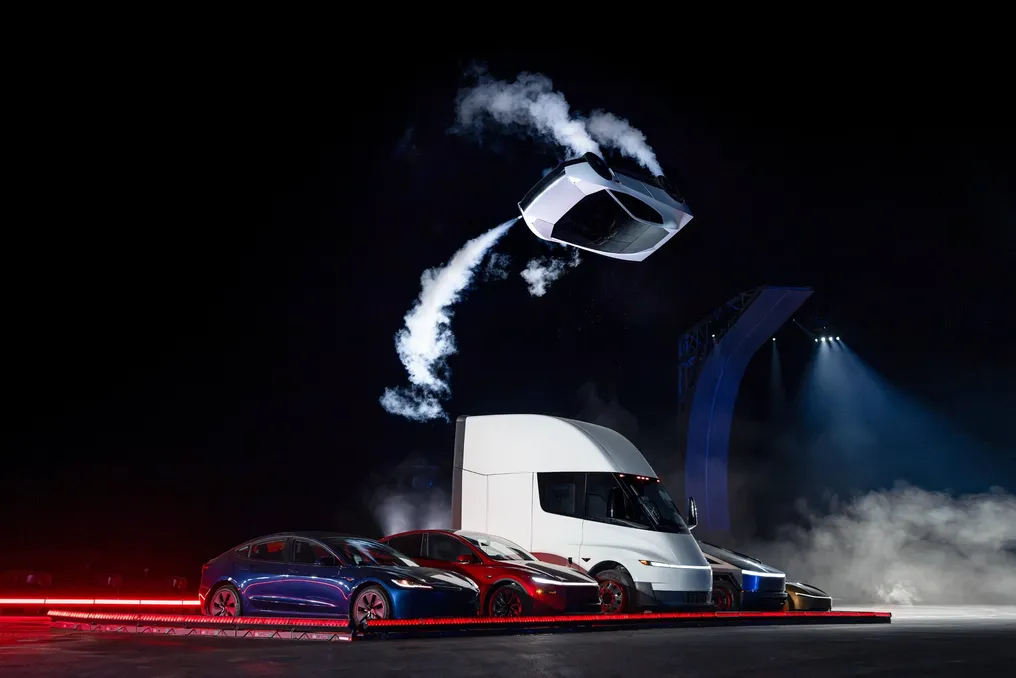
The possibility of flying cars, a recurring theme in science fiction, has gained a new dimension with the presentation by Tesla. The new Tesla Roadster demonstrated impressive maneuvers, including abandoning an inverted ramp, 180-degree spins on its wheels, and jumps over other vehicles.
During the exhibition, the prototype performed spectacular movements, generating great interest, especially among technology and economy vehicles, indicating Elon Musk's target audience with this new model.
To understand the viability of these actions, it is necessary to analyze the physics involved. Before the demonstration, MotorTrend magazine gained exclusive access to the prototype at the SpaceX test track in McGregor, Texas, speaking with Tesla's head of design, Franz von Holzhausen, and Vice President of Engineering, Lars Moravy.
What exactly is the new Tesla Roadster?
Tesla revealed that the new Roadster line, scheduled for production in 2028, will be offered in three distinct versions, all based on an unprecedented platform.
The Performance version serves as the entry point, utilizing four powerful electric fans (about 20 kW each) under the chassis. These fans, combined with deployable skirts, create a low-pressure zone that adheres the car to the asphalt, allowing the prototype to climb steep ramps and remain stuck upside down. With 1,500 hp and two electric motors, it promises to reach 96 km/h in 1.6 seconds.
The Thrust version complements the aerodynamic package with a 200-liter carbon fiber tank (COPV) containing nitrogen pressurized to 10,000 psi (690 bar). This gas powers four cold gas thrusters (CGTs), aiming for acceleration under 1 second and a top speed near 615 km/h.
The Rocket model, which executed the aerial pirouettes, requires removing the passenger seat to accommodate a double 600-liter compressed gas tank. It also incorporates six additional thrusters: four pointing downwards for vertical lift and jumps, and two at the tip for yaw and rotation control. This is a single-seater model, sold exclusively by invitation from Tesla.
The 'vacuum cleaner' effect
To understand how the Roadster manages to adhere to vertical surfaces, it is crucial to know about the fan technology in the floor. Although the idea of creating instantaneous downforce by sucking air under the vehicle is not original, it dates back to the 1970 Chaparral 2J, a known 'vacuum cleaner car' from Can-Am.
More recently, this technique was taken to the extreme by the McMurtry Spéirling Pure, an electric supercar that set a record at Goodwood, generating over two tons of downforce even when stationary.
In the Tesla Roadster, the principle is identical: the 20 kW fans pull air while movable skirts seal the floor. This generates a partial vacuum area whose suction force easily exceeds the weight of the vehicle. This suction allows the car to climb a vertical ramp and remain fixed to the ceiling, provided there is power to the fans and the seal is maintained, supporting the prototype's 1,700 kg against gravity without relying on speed for aerodynamic pressure.
And the pirouettes?
The Roadster's aerial maneuvers are physically and theoretically possible, without requiring completely new technological inventions. The first step in evaluating the jump and flight is considering the car's target mass, defined by Tesla as 1,700 kg.
Under Earth's gravity, the weight force exerted on this mass is approximately 16.7 kN (equivalent to about 1.7 ton-force). Therefore, just to float, the vertical jets must generate exactly 16.7 kN of upward thrust. To brake a fall at 0.5 g, the thrust must reach 25.0 kN, and to stop a fall at 1 g, 33.4 kN is required.
The fundamental rule establishes that the jet force must exceed the mass multiplied by gravity plus the desired deceleration. The 690 bar pressure refers to the storage pressure in the COPV tanks, which compress about 250 kg of nitrogen into 600 liters. The jet itself operates by action and reaction, expelling mass of gas at high speed (approximately 600 m/s) and receiving a counter force.
It is estimated that, to generate 16.7 kN of thrust, the car expels about 28 kg of gas per second. To strongly brake the descent (25 kN), this flow increases to 42 kg/s. With 250 kg of gas, the Roadster has enough propellant for about 10 to 13 seconds of total thrust, which is more than enough for a brief maneuver.
The notable feat was the 180-degree spin in the air, achieved using the RCS (Reaction Control System), an aerospace engineering technique used by NASA to orient spacecraft and satellites. The principle consists of applying forces outside the center of mass, generating rotational torque. To spin half a turn in 1.5 seconds, the required torque is approximately 3,900 Nm, requiring a thrust difference of only about 500 kgf between the left and right sides.
The main challenge lies in the electronic management to control and apply this force in the correct location and moment. For this, Musk utilized the support of SpaceX, the majority shareholder, whose laboratory in McGregor, Texas, is nearby. SpaceX technologies, such as reinforced COPV tanks and RCS systems used in rockets, were miniaturized and adapted for the supercar.
What the video doesn't show
Even knowing that the technology exists, a critical analysis of the video reveals three important points. First, the physics of free fall: the ramp was about 20 meters high, and an object in free fall would take approximately 2 seconds to hit the ground; in the video, the descent lasted about 4 seconds, confirming that the jets partially supported the weight.
Second, the direction of the jets during landing: when the car is inverted, the floor jets point upwards, which would imply pushing the car against the ground if activated at that moment. The order of activation is vital: the side jets must rotate the body so that the floor jets point downwards and can brake the descent.
Third, the actual weight of the prototype: the 1,700 kg is a goal, but a car equipped with reinforced tanks, high-pressure piping, robotic actuators, and 250 kg of gas could be substantially heavier, demanding greater system thrust.
It is concluded that the distance between this highly controlled demonstration and a practical application in the real world is immense. A margin of error of zero means that a small delay in the algorithm or a real weight exceeding the goal can result in a catastrophic landing. Although the maneuver is technically plausible with the presented data, the realization of a floating car for the public depends on factors beyond mere demonstration.